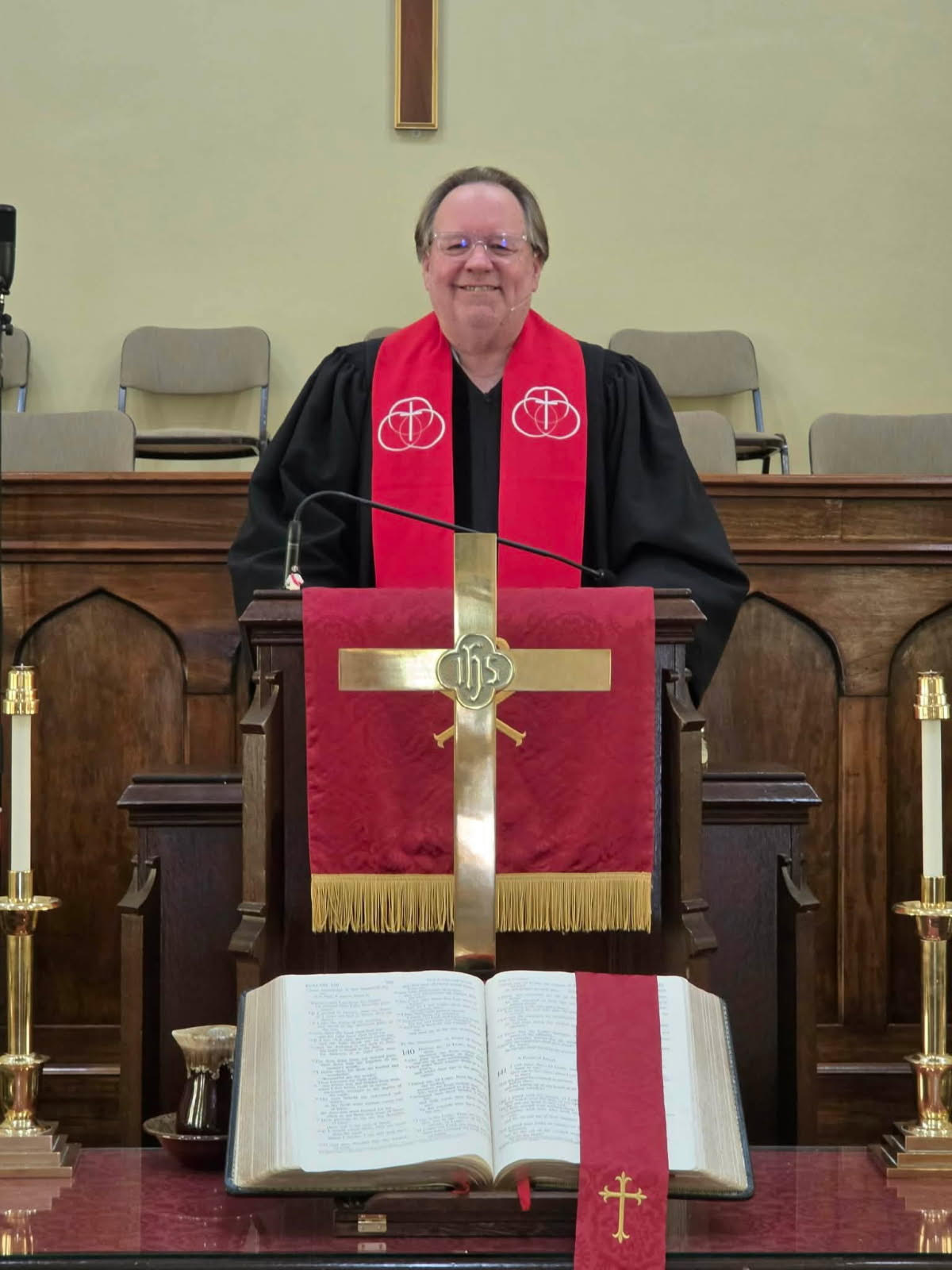
Sermon Series – “A Model for Believers—Thessalonica”
1 Thessalonians 4:13-18
“Encourage One Another”
I have an App downloaded on my phone and iPad that’s called Lectio 365. It’s a recorded prayer rhythm and they offer three recordings each day: morning—lunch time—and evening. I listen to the morning prayer almost every day where we pray [P.R.A.Y.] very simply each day – [P] Pausing to be still. [R] Rejoicing with a Psalm and Reflecting on a Scripture. [A] Asking God to help us and others and [Y] Yielding to His will in our lives. Come what may.
Every morning, as they read the Scripture for the second time you are instructed to look for a word or a phrase from the text that you want to concentrate on. This is how I read the texts that I preach from every week. I read it over several times and search for a word, phrase, or theme for that week. Some weeks there are several words that stick out to me. This week, reading Paul’s letter to the Thessalonians, I came away with two words: Hope and Encouragement!
Those words; hope and encouragement pretty well some up the Apostle Paul. Every place he visited on his missionary journey’s, every church he planted, every letter he wrote provided people with hope and encouragement. Heck, for a while, he hung out with a cat named Barnabus, which means “Son of Encouragement.”
Some of the Thessalonians were misinformed and confused, almost to the point of despair. It seems that in a lot of the places Paul had visited and the reason for several of his letters was to address the problem of false teaching and these false teachers were claiming that Jesus had already returned and the question was, “What has become of our departed loved ones? And what will become of us?” Our lesson before us isn’t designed to give us a complete system and understanding of eschatology [study of the end times]. Its purpose was to assure anxious believers concerning the divine order of events when Christ actually returns.
Martin Sparkman of McLean, VA talks about a friend of his son’s whose grandmother died. Everyone tried to explain to this six-year-old what happened to his grandmother. The usual explanations were given. “Your grandmother,” they said, “has gone to be with Jesus in heaven.” I probably would have asked why Jesus couldn’t just come here to be with her, but I digress. Not having seen her leave and having no concept of travelling without a car, his question shouldn’t come as a surprise. Out of profound innocence he asked, “Did they build a road to heaven?”
When Jenny was four, she asked her mother, “Does heaven have a floor?” Surprised, her mother said, “Well, Jenny, what do you think heaven is like?” Jenny looked up at the sky and clouds and replied, “Well, I can’t see any floor, so I guess people are just up there on coat hangers!”
One mother told her nine-year-old, Heather, that in heaven we will have glorified bodies. Heather asked, “Do you think we’ll look like Barbie?”
One Sunday school classroom had several glass prisms hanging from the ceiling. As sunlight poured through the prisms it caused rainbows to flash across the wall. Observing this, Chris, age four, whose mother had recently died, said, “Know what? My mom’s helping God make those rainbows!”
We don’t know much about what happens to us after we die. The Bible really presents us with few details. Since we have so little hard information about heaven, it would be fruitless for us to speculate except to say that there will be no more death and no more tears.
Paul’s not writing these words this morning to the Thessalonians to give them a definitive description of the nature of eternity, but to encourage them. He writes, “Brothers and sisters, we do not want you to be uninformed about those who sleep in death, so that you do not grieve like the rest of mankind, who have no hope. For we believe that Jesus died and rose again, and so we believe that God will bring with Jesus those who have fallen asleep in him.”
That’s all that matters to St. Paul, and that is what he wants to communicate to his friends. And that is what he wants to communicate to us as well.
I heard it first at License to Preach School at Epworth by the Sea shortly before my first appointment. One of our instructors said, “Every funeral should be looked at as a preaching opportunity.” And that’s how I have tried to approach every funeral I’ve been asked to preach at. I received a call once before a funeral from a family member of the deceased. She was concerned about the fact that some of her family were not believers and asked if I could speak to them through my message. My response was, “Obviously you’ve never attended a funeral that I’ve preached at.”
On the flip side of that, it’s not my job to preach the deceased into heaven and it’s not my job to try and save the folks in attendance with an altar call [Tommy Green shared that he didn’t want a funeral where the preacher tried to save everyone 50 times].
In my studies at Candler School of Theology at Emery University [Ivy League school of the south] one of our instructors was Rev. Tim McClendon, a pastor from South Carolina who would go on to be a District Superintendent and an Episcopal candidate [Bishop]. He shared with us in a chapel service on funerals that there are three elements needed: Laughter—Tears—and Jesus. He said if you touch on these three elements you will hit the ball out of the park.
He also shared that there are basically two kinds of people in our lives. There are the basement people, the ones who are miserable and want everyone else to be miserable and try to drag you down there with them and the balcony people who want to raise you up where they are. They want to encourage you and give you hope. Which would you prefer to hang out with?
The Thessalonians had but recently come up out of paganism that offered no hope for the future, into a faith that assured them not only of immortality, but also of eternal union with Jesus Christ. As you might imagine, such a prospect was eagerly embraced by these young Christians who found themselves ostracized and persecuted by the world. Paul’s view of death wasn’t about extinction of being, but blissful repose, comparable to the result of sleep at the end of the day. Contrast this with the gloom and despair in the ancient writings and especially in the inscriptions on the tombs of the early centuries.
In Acts 17 we have an account of Paul’s visit to Athens, a city full of idols. As it is recorded day after day, Paul is at the center of culture preaching and debating and in doing so he has an encounter with some of the greatest thinkers of their day. “A group of Epicurean and Stoic philosophers began to debate with him.”
Epicureans were all about living life to the fullest. For them the goal of life was pleasure, the absence of pain or disturbance. They were deists. They believed that god, whoever or whatever that is, was not really interested in life. God simply set up the world and walked away. At the end of the day, they believed life was all about chance.
The Stoics taught the opposite of the Epicureans. They made life about self-sufficiency, courage, and duty. Resurrection wasn’t on the table for them either.
Their reaction to Paul still matters today. The internet is full of garbage on the resurrection and claims about what people really believed two thousand years ago. Many call Christianity a scam and lie.
The only people who believed in physical resurrection were Jews, but even that was a resurrection that would occur at the end of time, involving everyone at once. That’s why when Jesus rose from the dead, the disciples did not believe at first, because it violated what all Jews were taught was supposed to happen.
Many believed the dead were non-existent, outside of Judaism nobody believed in resurrection.
Yes, many believed in an afterlife, in Hades, or in eternal bliss, but there was no coming back. Simply stated, the millions living in the Roman empire and beyond did not teach, believe, desire, or hope for physical resurrection of people.
Paul proposes to correct these misunderstandings by a plain statement of the truth relative to the Lord’s return. Paul describes the Christian’s proper attitude toward death and admonishes them, the Thessalonians, to behave like “believing ones” in the presence of death. He warns them not to yield to hopeless and excessive grief as the heathens do.
Believers are therefore identified with Christ in death and beyond death, in resurrection life, forever and ever!
In language that is strong and persuasive Paul assures the Thessalonians that their hope rests upon the authority of God Himself.
On February 1, 2003, the U.S. lost seven astronauts when space shuttle Columbia shattered while re-entering the Earth’s atmosphere. Among those astronauts who lost their lives was Commander Rick Husband. In an interview, Husband’s widow, Evelyn Husband claims that worshipping God provides her with some measure of peace. As she says, “This grieving journey is the hardest thing I have ever been through in my life…I haven’t found anything to be a relief except for when I am worshipping God, and I am in His presence. That’s the only place that it doesn’t hurt. Some of you have discovered this as well.
As Paul wrote to the Thessalonians he says to us today, “we do not want you to be ignorant about those who fall asleep, or to grieve like the rest of humanity, who have no hope. We believe that Jesus died and rose again [and so will we] and we will be with the Lord forever.”
Not only do I believe this, but I am counting on it! And to give Paul the last word, “Therefore encourage one another with these words.”
Dear God—let it be!

