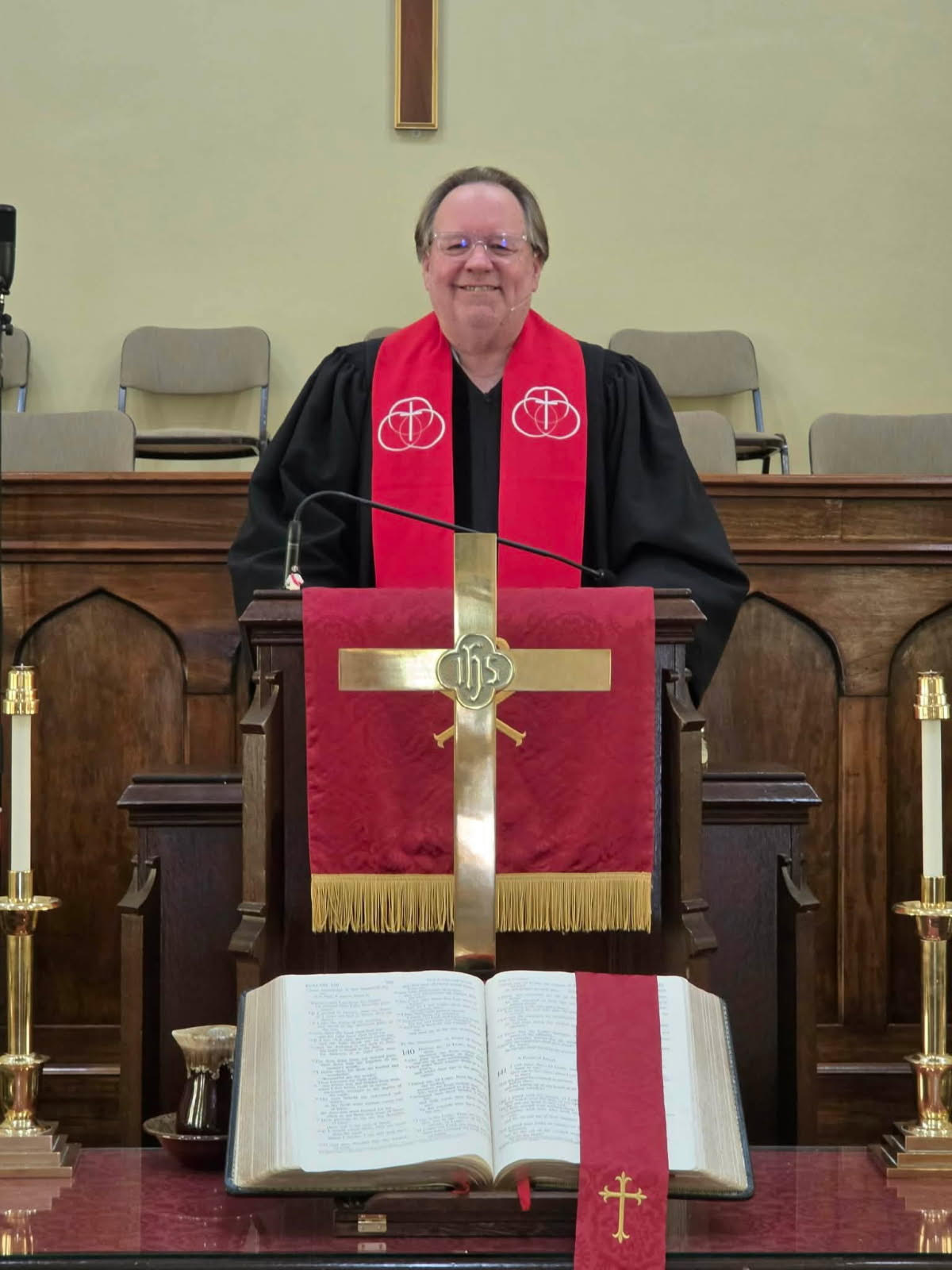
Sermon Series – “Visiting Philippi”
Philippians 4:1-9
“The Lord is Near”
Before we move on this morning I’d like to put a bow on my message from last Sunday. This is an illustration that I came across several years ago that I believe fits quite well in the context of Paul’s writing: “But one thing I do: Forgetting what is behind and straining toward what is ahead, I press on toward the goal to win the prize for which God has called me heavenward in Christ Jesus.”
There is an old legend about three men and their sacks. Each man had two sacks; one tied in front of his neck and the other tied on his back. When the first man was asked what was in his sacks, he said, “In the sack on my back are all the good things friends and family have done. That was, they were hidden from view. In the front sack are all the bad things that have happened to me. Every now and then I stop, open the front sack, take the things out, examine them, and think about them.” Because he stopped so much to concentrate on all the bad stuff, he really didn’t make much progress in life.
The second man was asked about his sacks. He replied, “In the front sack are all the good things I’ve done. I like to see them, so quite often I take them out to show off to people. The sack in the back? I keep all my mistakes in there and carry them all the time. Sure, they’re heavy. They slow me down, but you know, for some reason I can’t put them down.”
[Altar call at New Room.]
*We take things to the altar, lay them down, and then pick them back up again, or we don’t go to the altar at all for fear of being judged. So what! Let them judge you! We need a Savior; they need a Savior; and coming to the altar doesn’t mean that you have something wrong, it could be that you have good things to be thankful for. Your work, health, family, the fact that you were able to get out of bed this morning and be here to honor God.
*God moves because of confession.
*You have to go to the doctor and tell him where it hurts to experience healing.
*Jesus asked individuals often, “What do you want me to do for you.” I’ve started asking Jesus every morning what it is He would like for me to do for Him.
Jeremy [cerebral palsy] is a young man in a wheelchair and at New Room he slid out of his chair and crawled on the floor so he could lay hands on a woman who was praying for healing.
When the third man was asked about his sacks, he answered, “The sack in front is great. There I keep all the positive thoughts I have about people, all the blessings I’ve experienced, all the great things other people have done for me. The weight isn’t a problem. The sack is like the sails of a ship. It keeps me going forward.
The sack on my back is empty. There’s nothing in it. I cut a big hole in its bottom. In there I put all the bad things that I can think about myself or hear about others. They go in one end and out the other, so I’m not carrying any extra weight at all.”
What are you carrying in your sacks? What do you need to forget to move on? “Forgetting what is behind and straining toward what is ahead.” What do you need to bring to the Altar?
This will be our last Sunday in our current series: “Visiting Philippi.” If you read further in Philippians 4 you will discover: “Yet it was good of you to share in my troubles. Moreover, as you Philippians know, in the early days of your acquaintance with the gospel, when I set out from Macedonia, not one church shared with me in the matter of giving and receiving, except you only; for even when I was in Thessalonica, you sent me aid more than once when I was in need” [vs. 14-16].
So, we are moving on, starting next Sunday, we will be in Thessalonica for a sermon series I have titled, “A Model for Believers—Thessalonica.”
Philippians 4:1-9
[vs. 1]
How do we “stand firm in the Lord?” We stand firm by keeping our eyes on Jesus—remembering that this world is not our home—and focusing on the day when Christ will bring everything under His control. Standing firm means steadfastly resisting the negative influences of temptation, false teaching, and persecution. It requires perseverance, holding firm when we are challenged or opposed. Don’t lose heart or give up. If you feel like you’re in a fight—keep swinging! [John Thompson’s message at New Room about Daniel in Babylon where they tried to brainwash him and his three friends, Shadrach, Meshach, and Abednego to deny God. Wherever we are, we must fight] God promises to give us strength of character. With the Holy Spirit’s help and with the help of fellow believers, you can stand firm in the Lord.
[vs. 2-3]
Little Johathan came home from the playground with a bloody nose, black eye, and torn clothing. It was obvious he’d been in a bad fight and lost. While his father was patching him up, he asked Jonathan what happened.
“Well, Dad,” said Jonathan, “You know Eddie—that boy who’s always giving me a hard time. I challenged him to a duel. And I gave him the choice of weapons.” His father said, “that seems fair.” “I know,” Jonathan said, “but I never thought he’d choose his big sister!”
Conflict is part of life. People get into arguments. Resentment builds. Controversy erupts. Angry words are spoken. Relationships are broken. Outright fighting may ensue. Conflict happens. Even in church. Some of you may be thinking, “Especially in church.” There was once a cartoon that showed this notice on a church bulletin board: “213 days without a split!”
In our lesson this morning Paul seems to be dealing with some conflict here in the church at Philippi.
Euodia [yoo-Oh-dih-uh] and Syntyche [Sin-tih-kee] were leaders in the Philippian church—perhaps deacons or hostesses of house churches that met in their respective homes. These two women were worthy of being helped because they had rendered an important but unnamed service to Paul in the past and it is important that they be kept functioning in the church of Christ. Though we aren’t told of their dispute Paul pleads with his co-workers to adopt the mind of Christ toward each other and he calls on the community to foster their reconciliation.
He also asks another individual, “my true companion” to help. This could have been Epaphroditus, who supposedly carried this letter to Philippi. It could also be someone named Syzgus, the Greek word for “companion.” It could have been Timothy, Titus or Silas—we just don’t know for sure. Paul mentions this person specifically in their role as a peacemaker.
Paul isn’t asking them to get along despite their differences. He’s asking them to “be of the same mind in the Lord.”
Christians must pursue like-mindedness not around their own thoughts and opinions but around the Word of God. In pursuing like-mindedness, what is most needed is the mind of Christ.
[vs. 4-7]
Paul brings tremendous emphasis to this point: “Rejoice in the Lord always.” [Paul, in prison, writing about rejoicing] When we explore the Greek text, we find the meaning of this term, always, means always! There is no circumstance in life that can elude joy. While joy comes from the Holy Spirit, it comes to those who will choose, by faith, to rejoice. In case he wasn’t clear enough, he repeats it: “I will say it again: Rejoice!”
The noun “joy” occurs some seven times in this short letter. The verb “rejoice” occurs eight times. From the stem meaning “joy” Paul uses the term fifteen times. He’s asking the Philippians not to go into hiding, but that they come out openly, avow their faith, take their stand, and rejoice as they do it.
Paul writes, “Let your gentleness be evident to all. The Lord is near.” You may be wondering, “What does joy have to do with gentleness?” Joy is the surprising manifestation of the presence of God in the midst of difficult circumstances. To rejoice means to declare the confounding presence of God to your circumstances. There is truth in the cliché “Don’t tell your God how big your problems are. Tell your problems how big your God is.”
Gentleness is a prerequisite to peace. The peace of God is the presence of God, and, though He be near, He can still be far from our perception and experience.
Imagine never being anxious about anything! That may seem impossible; everyone has worries on the job, at home, at school. But Paul’s advice is to turn our worries into prayers. Do you want to worry less? Then pray more! Whenever you start to worry, stop and pray. Also, take time to listen to what God has to say to you, and thank Him for all the good work He has done—in your life, in your church, in your community, and in the world.
God’s peace is different from the world’s peace. True peace is not found in positive thinking, in absence of conflict, or in good feelings. It comes from trusting God to work everything out in a way that is best for you as you fulfill your role in God’s work in the world. Our citizenship in Christ’s kingdom is sure, our destiny is set, and we can have victory over sin. Let God’s peace guard your heart against the anxieties of this world that try to bring you down and keep your focus off Jesus. When we trust God, He gives us a peaceful perspective in a traffic jam, on a difficult phone call, in a troubled relationship, and even when death draws near.
[vs. 8-9]
What we put into our minds determines what comes out in our words, desires and actions. Paul tells us to train our minds to focus on thoughts that are true, noble, right, pure, lovely, admirable, excellent and praiseworthy.
So, let me ask you a hard question: What are you putting into practice? If you are anything like me, it’s easy to read something, think about it, ponder it, enjoy it, be challenged by it, agree with it for the most part, consider an intention to do something about it, and then, check your e-mail, send a few text messages, get busy doing other things, an all of a sudden it’s already tomorrow and the process repeats itself [wash—rinse—and repeat].
We don’t really intend to not do anything about what we are reading but we are on a planet that is moving 67,000 miles per hour, and that’s before we even get out of bed.
It’s not enough to hear or read the Word of God or even to know it well. We must also put what God is teaching us into practice. How easy it is to read the Bible and not think about what a passage means and not live out that meaning. Exposure to God’s Word isn’t enough. It must lead to obedience
Let’s give Jesus the last word on this topic: “Therefore everyone who hears these words of mine and put them into practice is like a wise man who built his house on the rock. The rain came down, the streams rose, and the winds blew and beat against that house; yet it did not fall, because it had its foundation on the rock. But everyone who hears these words of mine and does not put them into practice is like a foolish man who built his house on sand. The rain came down, the streams rose, and the winds blew and beat against that house and it fell with a great crash” [Matthew 7:24-27].
Rock or Sand?
Wise or Foolish?
What say you?

