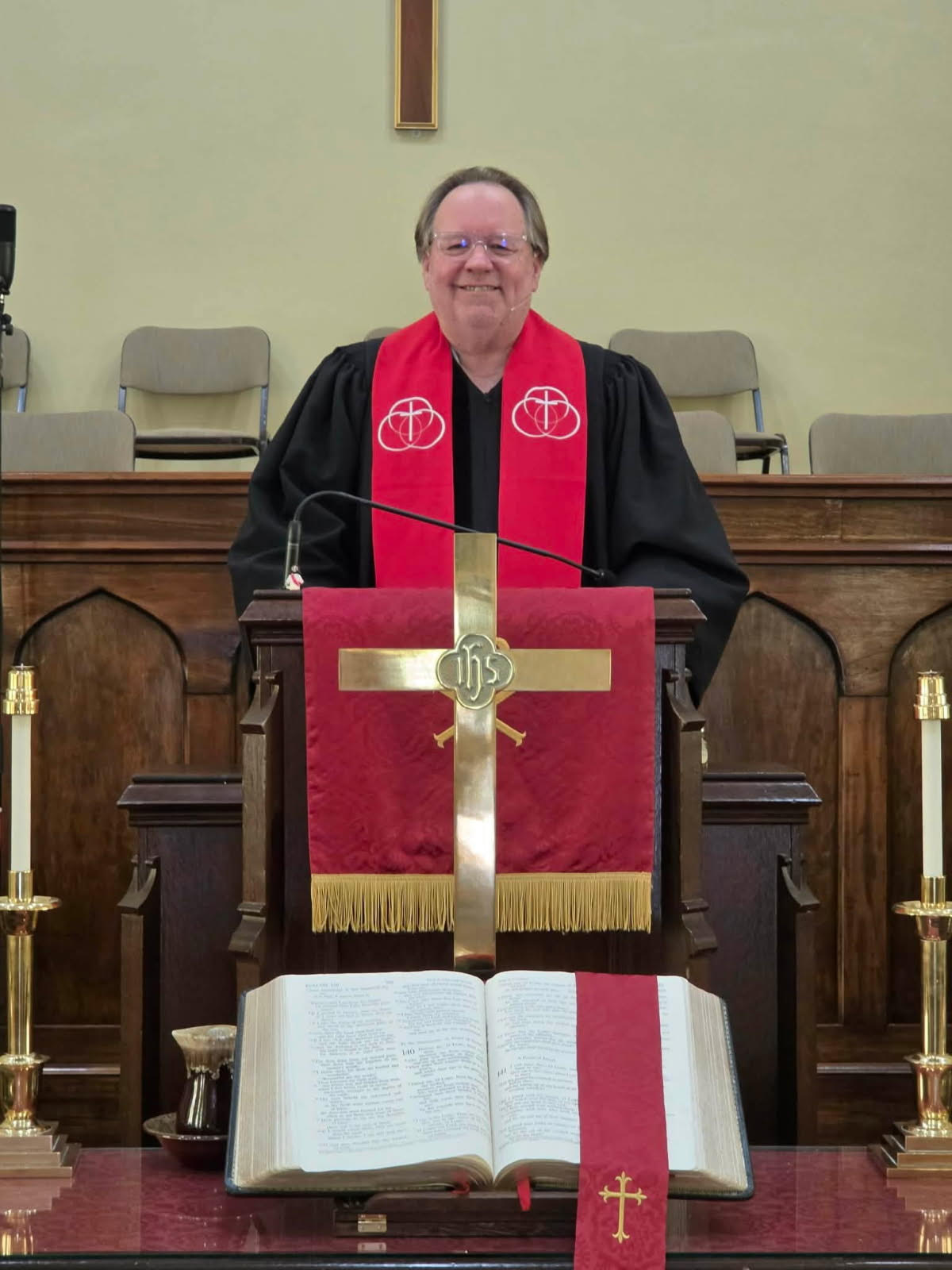
Sermon Series = “Visiting Philippi”
Philippians 1:21-30
“Dying in Christ”
Unlike the Church in Rome, where we spent the past ten weeks, which Paul didn’t plant and hadn’t even visited; Paul and his companions planted the church in Philippi on his second missionary journey: a journey of some 2800 miles from 49 to 52 AD that brought the Christian gospel into Europe for the first time. Those companions would have been Silas, Timothy, and Luke. [Acts 16:11-15]
This letter, written from prison in Rome around 61 AD, in which we’ll spend the next four weeks, was written to thank the Philippians for a gift they had sent to strengthen these believers by showing them that true joy comes from Jesus Christ alone. Scholars believe that Paul wrote this letter just six years before dying a martyr’s death by being be-headed.
Despite his circumstances, Philippians is Paul’s joy letter. It contrasts the world’s view of happiness, or joy, with God’s perspective. True joy is deep and strong, not superficial. It is the quiet, confident assurance of God’s love and work in our lives—that He will be there no matter what! Our happiness shouldn’t depend on what happens to us but on what happens in us—the transformation that takes place when we put our trust in Jesus Christ and His Holy Spirit comes to live in us, giving us God’s perspective on life and all the ups and downs that come with it.
The Apostle Paul knew all about life’s ups and downs. In a life dedicated to serving Christ, Paul had faced excruciating poverty, abundant wealth, and everything in between. I sometimes wonder if some of Paul’s problems were self-inflicted and used to prove who he had become. I wonder if in his ministry did he continue to face naysayers because of his past, as Saul of Tarsus, the persecutor of the early church? Sometimes it’s hard for us to erase or outrun our past.
I was watching Monday Night Football this week, and the Chiefs were playing the Broncos. I’m not a fan of the Bronco’s coach, Sean Payton, because of his past. You may remember that when he coached the Saints, he put a bounty on opposing players, giving his team incentive to hurt their opponents. I’ve had trouble getting past that, maybe there were still some having trouble getting over Paul’s past.
Whatever his circumstances, Paul had learned to be content, finding real joy as he focused all his attention and energy on knowing Christ and obeying Him.
Philippians 1:21-30
Human beings are a terrific source of creativity. Even at the time of death. For example, consider this epitaph on a grave from the 1880’s in Nantucket, Massachusetts:
Under the sod and under the trees…Lies the body of Jonathon Pease.
He is not here; there’s only the pod…Pease shelled out and went to God.
Or this one from a more recent burial:
Here lies my wife…Here let her lie.
Now she’s at rest…And so am I.
Or this one from the grave of a dentist named John Brown:
Stranger! Approach this spot with gravity!
John Brown is filling his last cavity.
Epitaphs normally seek to sum up a person’s life in just a few words. If you had to sum up your life in just a few words, how would you do it?
Author Ernest Hemingway was once challenged to prove his skill as an author by writing a story in only six words. Hemingway responded with these six ingenuous words: “For sale: baby shoes. Never worn.” It would be difficult to tell a heart-breaking story more succinctly than that.
Was it Loretta Lynn or B.B. King who first said, “Everybody wants to go to heaven, but nobody wants to die”?
Not Paul. On this he is clear: “For to me, to live is Christ and to die is gain.” Paul is ready to take the first bus. He doesn’t have a death wish; he has a profound vision of eternal life, which has clearly already begun for him but will go to one thousand times when his body expires.
My spiritual coach reminded me this week that our faith isn’t about believing something that happened long ago in order to get into heaven. No, it’s about getting heaven into us while we are still alive.
Those who don’t believe in God think that life on earth is all there is. Therefore, it is natural for them to strive for what this world values: prosperity, popularity, power, pleasure, and prestige. For Paul, however, to live meant to tell others about Christ, who alone could help them see life from an eternal perspective.
Paul’s whole purpose in life was to speak out boldly for Christ and to become more like Him. Thus, Paul could confidently say that dying would be even better than living, because in death he would be removed from worldly troubles, and he would face Christ face-to-face: “Dear friends, now we are children of God, and what we will be has not yet been made known. But we know that when Christ appears, we shall be like him, for we shall see him as he is. All who have this hope in him purify themselves, just as he is pure” [1 John 3:2-3].
Either way, Paul would be giving his life as a sacrifice to God. If you’re not ready to die, then you’re not ready to live. Make certain of your eternal destiny, then you will be free to serve—devoting your life to what really counts; without fear of death.
I guess you could say that Paul had the tiger by the tail. If he lived, he could continue sharing his faith in Christ. If he died, he knew he would be going home to be with Christ. Win/win!
It’s like the story that is told about the great evangelist Dwight L. Moody. Moody was traveling by boat on one of the Great Lakes when a really bad storm developed. The other passengers on the boat cowered in fear. They even started an impromptu prayer meeting asking God to deliver them from the storm. Moody didn’t join in this prayer meeting. When asked why not, he answered with these words, “I have a sister in Chicago and one in heaven and I don’t care which I see tonight.” “To live is Christ and to die is gain.”
Paul had a purpose for living when he served the Philippians and others. We also need a purpose for living that is greater than ourselves and goes beyond providing for our own physical needs. Why are we here? What is our purpose for living? Paul wrote, “Whatever happens, conduct yourselves in a manner worthy of the gospel of Christ.” What do you hear when you hear Paul say this? I guess my answer would be “Behave!” Do you remember what I’ve been saying about believing and behaving? How it should be beholding and becoming!
One thing is clear; we wouldn’t expect people who have no idea of the gospel to somehow miraculously conduct themselves in a manner worthy of the gospel. So, if conducting ourselves in a manner worthy of the gospel can’t be reduced to believing and behaving, and ranting about those who don’t, what does it mean?
What is conduct worthy of the gospel? The gospel is about becoming a new creation, a profoundly humble, pure-hearted, radically embracing person of extraordinary, holy love. It’s not so much about what we don’t do but who we are becoming together. It’s about becoming a community of people whose relationships are telling a different story, who are writing an alternative ending to an otherwise broken storyline.
If you have been listening to me on Sunday mornings and aren’t engaged in your phone or considering what you’re going to have for lunch; you’ve heard me say that the first half of the gospel flows from John 3:16: “For God so loved the world that he gave his one and only Son, that whoever believes in him will not perish but have eternal life.”
To believe is more than to give intellectual agreement that Jesus is God. It means to put our trust and confidence in Him that He alone can save us. It is to put Jesus in charge of our present plans and eternal destiny. Allowing someone else to be in charge of our plans may be the single hardest thing many of us have to do! Believing is both trusting His words as reliable and relying on Him for the power to change.
The second half of the gospel flows from 1 John 3:16: This is how we know what love is: Jesus Christ laid down his life for us. And we ought to lay down our lives for our brothers and sisters.”
Real love leads to action, not just feelings. It produces selfless, sacrificial giving. The greatest act of love is giving oneself for others. How can we “lay down our lives?” By serving others with no thought of receiving anything in return. To say we’ll die for others can be easier than truly living for them. Doing so involves putting their needs first.
We see these two movements powerfully summarized in today’s lesson: “For it has been granted to you on behalf of Christ not only to believe in him, but also to suffer for him.”
Paul considered suffering for Christ to be a privilege. We don’t naturally consider suffering a privilege. Yet when we suffer, if we faithfully represent Christ, our message and example affect us and others for good. Suffering has these additional benefits: [1] it takes our eyes off of earthly comforts, [2] it weeds out superficial believers, [3] it strengthens the faith of those who endure, and [4] it provides an example for others who may follow us. When we suffer for our faith, it doesn’t mean that we have done something wrong. In fact, the opposite is true—it may be verifying that we have been faithful. Trust God and believe that He has a purpose in it. Paul and his fellow apostles considered it a high honor to be identified with Christ in suffering: “The apostles left the Sanhedrin, rejoicing because they had been counted worthy of suffering disgrace for the Name” [Acts 5:41]. Use suffering to build your character and draw you close to your Savior. Don’t resent it or let it tear you down.
Acts 16:22-34
One of the great celebrative anthems that comes to us out of the African-American culture is the powerful spiritual Ain’t Got Time to Die. It was written by Hall Johnson, and it has these joyfully dramatic words:
Been so busy praising my Jesus,
Been so busy working for the Kingdom,
Been so busy serving my Master…
Ain’t got time to die.
If I don’t praise him,
If I don’t serve him,
The rocks gonna cry out
Glory and honor, glory and honor…
Ain’t got time to die.
In this inspiring and wonderful spiritual, the composer is underscoring and celebrating the joy and excitement of being a Christian, the joy and excitement of serving our Lord in gratitude for what He has done for us. The point that this spiritual is trying to drive home to us with great enthusiasm is…that when we really become Christians, when we really commit our lives to Christ…then, we can’t sit still…we become so excited, so thrilled, so grateful for our new life in Christ that we can’t help but love Him, praise Him, serve Him, and share Him with others!
To live is Christ and to die is gain.
 Eastman First Methodist Church