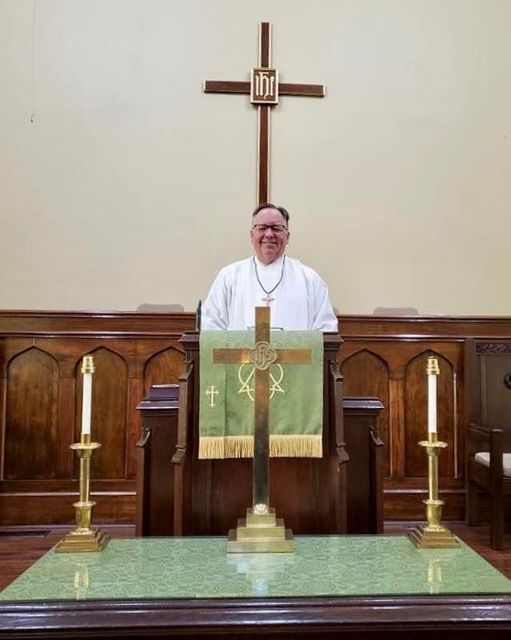
“Father—Son—Holy Spirit”
2 Corinthians 13:11-14 [Epistle Lesson]
Matthew 28:16-20 [Trinity Lesson]
I heard Daddy Rick Lanford say one time that folks in the north begin their stories with, “Once upon a time,” while here in the south y’all begin with, “You ain’t gonna believe this!” I want to open this morning with a story about a pilot and three passengers: a Boy Scout, a priest, and an atomic scientist. It’s a bit of a humorous story but I hope you will catch the religious significance as well. Here we go.
You ain’t gonna believe this but there once was a plane that developed engine trouble in mid-flight. The pilot rushes back to the passenger compartment and exclaims, “The plane is going down! The plane is going down! We have only three parachutes, and there are four of us!” Then the pilot adds, “I have a family waiting for me at home. I must survive!” With that, he grabs one of the parachutes and jumps out of the plane.
At this point, the atomic scientist jumps to his feet and declares, “I am the smartest man in the world. It would be a great tragedy if my life were snuffed out!” With that, he also grabs a parachute and exists the plane.
With an alarmed look on his face, the priest says to the Boy Scout, “My son, I have no family. I am ready to meet my Maker. You are still young with much ahead of you. You take the last parachute.”
With this, the Boy Scout interrupts the priest, “Relax, Father. Don’t say any more. We’re all right.” The priests asks, “How in the world can you say that we are all right?” The Boy Scout replies, “The reason we’re all right is that the world’s smartest man just jumped out of the plane wearing my knapsack!”
Silly joke, right, but there is an important lesson to be learned from it. Metaphorically, there are many smart people today, successful people, affluent people who are jumping out of airplanes wearing knapsacks instead of parachutes. That is, they are reaching for ideas and philosophies that are very appealing, but those ideas and philosophies will not save them. They are knapsacks, not parachutes. In other words, people today need something they can believe in, and many are looking in the wrong place.
If you were here last Sunday, you may remember me talking about how God was able to take his people out of Egypt, but His true test was taking Egypt out of His people. His true test for us is to take the world out of us.
Today is Trinity Sunday. Trying to explain the Trinity, according to one of my Pastor friends, is a fool’s errand—it’s a classroom exercise.
The word Trinity is a theological term used to define God as an undivided unity expressed in the threefold nature of God the Father, the Son, and the Holy Spirit. As a distinctive Christian doctrine, the Trinity is considered as a divine mystery beyond human comprehension to be reflected upon only through scriptural revelation. The Trinity is a biblical concept that expresses the dynamic character of God, not a Greek idea pressed into Scripture from philosophical or religious speculation. While the term “Trinity” doesn’t appear in Scripture—the Trinitarian structure appears throughout the Bible to affirm that God Himself is manifested through Jesus Christ by means of the Spirit. (Understand it better?)
So, Trinity Sunday has been celebrated yet misunderstood since the 10th century. It occurs eight weeks after Easter and one week following Pentecost. The best way I know to illustrate the Holy Trinity is water. You freeze it and you have ice, you heat it and you get steam, but regardless of the form—they are both still water.
Martin Luther once said: “To try to deny the Trinity endangers your salvation, to try to comprehend the Trinity endangers your sanity.”
In our Epistle Reading from 2nd Corinthians the letter’s closing remarks have features typically found in Paul’s other letters. There is the final farewell, brief exhortations, a peace wish, third-person greetings, a call for recipients to greet one another with a “holy kiss,” and a final benediction.
The congregation members are to be restored to a right relationship with the apostle, and, by extension, God, who speaks through him.
The very last verse of 2nd Corinthians shares a unique closing feature in a Trinitarian-like benediction: “May the grace of the Lord Jesus Christ, and the love of God, and the fellowship of the Holy Spirit be with you all.”
In our Gospel Lesson Jesus meets His disciples in Galilee [as promised] and Matthew writes that most worship Him, but some doubt [which is mind boggling to me]. But this shouldn’t be surprising since a large majority of our world may know Jesus but have very little or no faith in Him. It’s here on this mountain that Jesus gives His disciples their marching orders—their job description—better known as the “Great Commission.”
Basically, the first thing He says is “Go.” That little word “go” is interesting and a very powerful word. It is two-thirds of the word “God”, one-third of the word, “Gospel”, and one-half of the word, “good.” It’s a little word with a big punch.
And along with that word “Go,” He adds “and make disciples of all nations.” This was their job description! It wasn’t a suggestion—it was an order! To the disciples and to us!
Most of you probably remember the television series “Mission Impossible” staring Peter Graves. You younger folks are probably thinking of the movie starring Tom Cruise. Anyway, they get their job orders and then hear, “This is your mission, Jim, if you choose to accept it.” And then the tape recorder burns up. It was suggested that I put some talcum powder in my Bible and after reading this text slam the book closed so the powder would give the impression of smoke.
Dallas Williard wrote: “For at least several decades the churches of the Western World have not made discipleship a condition of being a Christian. One is not required to be, or to intend to be, a disciple in order to become a Christian, and one may remain a Christian without any signs of progress toward or in discipleship.”
What were Jesus’s last words to the Church? “Therefore go and make disciples of all nations.” Our mission is to make disciples—to tell the Good News—by our words or our actions—and we aren’t given the choice to choose or not to choose. Only disciples can make disciples. Go and make what you are and what you are becoming!
Following God is not just about showing up on Sunday morning and sitting in your normal place. It is not about attending monthly meetings and giving what is left over in your wallet at the end of the week. Following Christ means putting everything else aside and going into the unknown—leaving your comfort zone—and going and spreading the Good News of Jesus Christ.
I believe that I’ve told you before that the reaction you get to the Good News of Jesus Christ is not always going to be received well. You might have to invite someone to come to church with you several times before they say yes.
George Muller, a 19th century British evangelist had a list of five men he earnestly desired to see won to Christ. One man came to Christ after five years—two more came to Christ after 10 years—another came to Christ after 25 years—and the last didn’t come to Christ until after Muller died but he had been praying for him 52 years. Would you pray for someone that long?
In one of the Wake-Up Call entries this week, Dan Wilt shared that in His ministry of three years, “Jesus was training apprentices, not spectators. Jesus commissioned His first disciples, His apprentices, to go out into the world to do two things simultaneously. They would present the Good News of the Kingdom of God, and they would demonstrate that news through signs and wonders that led back to the love of God.”
A letter was mailed to General Electric from a little girl in the third grade who had chosen to investigate electricity for her class project: “I’m trying to get all the information on electricity I can,” her letter said, “so please send me any booklets and papers you have. Also, would it be asking too much for you to send me a little sample of electricity?”
Like this little girl—too many of us want just a little sample of the Spirit. We don’t want the Spirit to come in all its fulness. We tremble at the idea of God coming
into our lives and taking total possession of our thoughts—our feelings—our dreams—our ambitions. Thus, because we want only a sample of God’s Spirit, we never achieve that oneness of mind and purpose so necessary for effective living.
Dr. Harry Emmerson Fosdick, famous Pastor for the Riverside Church in New York City, once related from his own childhood days. His father had said to his mother, upon leaving the house one Saturday in the morning hours: “Tell Harry that he can cut the grass today, if he feels like it.”
Then, halfway down the walk, his father turned once more to add: “And tell Harry he had better feel like it.”
In that humorous story there is something about life wrapped up in it. For there is a difference between knowing we are supposed to do something, and “feeling like” doing it. There is a difference between a sense of obligation and a sense of generosity. There is a difference between obedience and desire. One of those weighs us down—the other lifts us up.
Once upon a time there was a church located in a rundown section of a large city that had gotten down to about 40 active members and those 40 were struggling to keep the doors open. They held meetings in the afternoon during the week since everyone was retired and had the time.
As they were leaving one of their afternoon meetings one of the ladies noticed a “woman of the evening” leaning up against her car, and she was singing. The lady didn’t know exactly what to do and finally she said to her, “You have a nice voice; you should sing in our choir.” She went on to say, “We have choir practice tomorrow at 2:00 and if you would like I’ll meet you here and you can practice with us.”
Well, that next Sunday, the little church of 40 had a “lady of the evening” singing in their choir. By the end of the year, they had 3 “ladies of the evening” singing in their choir. And today, that little church of 40 struggling to stay alive is now a church of 800. And it all started with an invitation.
Jesus said, “Go and make Disciples.” It wasn’t a suggestion—it was an order. It wasn’t a desire—it was a command. Go!

