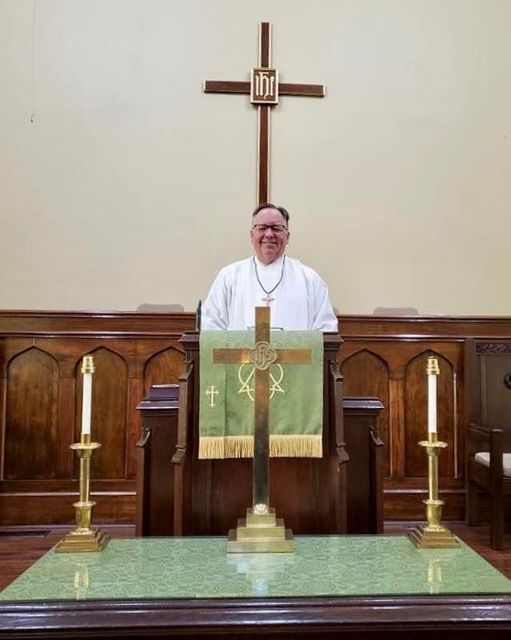
“By His Wounds We Are Healed”
John 10:1-10 [Gospel Lesson]
1 Peter 2:19-25 [Teaching Lesson]
Since the last time I was here with you I’ve done a bit of traveling. First, I went to Nashville, TN for a New Room Conference which was titled “Waking Up to the Gifts of the Holy Spirit.” It was a marvelous study led by Jon Thompson, a Pastor from Toronto, Ont. who is also a seminary professor as well as an author. He covered so much material that it was tough to keep up, like trying to drink water from a fire house, if you know what I mean. Thankfully, they handed out a cheat sheet and everything he covered should be in his book, Convergence, which was just released from Amazon.
Did you know that Spiritual gifts are divine empowerments by the Holy Spirit and they are detailed in three places in the Scriptures [1 Corinthians 12, Romans 12, and Ephesians 4]. There are 21 gifts all total. But something I learned, which has caused some deep interactions with God since then, is that we don’t get all the gifts, just some. So, in my conversations with God I’ve been asking Him to clarify the gifts that I possess, the YES gifts, and to make them stronger; and to help me accept and understand the NO gifts. The gifts He has chosen not to give me.
Next, I went to Ohio to spend a few days with my mom and younger sister, who just recently retired. On Sunday I chose to attend a non-denominational praise & worship service, having no idea what the topic of the sermon was going to be. Guess what it was: The Holy Spirit. And the preacher used the same text that I heard in Nashville to get his message started: Philippians 2:5-8. These verses tell us that Jesus voluntarily laid aside His divine rights and privileges out of love for His Father [Something to be used to his own advantage]. Jesus would say many times that He could only do what He saw the Father do, or what the Father told Him to do. He did those things in the power of the Holy Spirit; just like you and I can use our spiritual gifts in the power of the Holy Spirit.
Sunday afternoon I looked at the Scriptures I had selected for today and wondered: What was I thinking with the 1 Peter text. I could have chosen the text from John’s Gospel about the shepherd and the gate and all that stuff. I could have found lots of things to preach on with that text. But as I was reading and studying I did find a kind of central theme to John’s Gospel and Peter’s letter.
There’s an old Texas story that goes like this: A new school marm in a prairie schoolhouse asked a little boy, “If there were twelve sheep in a field and one jumped over the fence, how many would be left?”
The pupil said, “None.” The teacher said, “You don’t know arithmetic, do you?” “No ma’am, but I know sheep.”
Sheep are notorious followers. They are not known for their great intellect. A farmer once told a story about a barn full of sheep. There was one sheep who generally led the rest. One day the farmer noticed that the lead sheep was staring at a small beam of sunlight that was coming through the crack of the open barn door. The sheep thought that the beam of light was some kind of obstacle like a chain or a rope preventing exit from the barn. But the old sheep finally figured it out. He got a little running start and jumped over the beam of light. The farmer stared in amazement and amusement as each of the sheep that followed also jumped over this imaginary barrier on their way out of the barn.
I played basketball with a guy who if he thought about what he was doing he would trip over his own feet. When our coach would put him in the game he would point at the lines on the floor and say, “Watch out for the lines.”
The shepherd knows His sheep—Jesus knows His followers—God knows His children.
The Apostle Peter was writing to Christians during a time when being a follower of Jesus wasn’t a very pleasant nor a positive experience. His letters would have been considered gospels [Good News]. They were written to a group of people suffering under the regime of Rome. They were intended for these people looking for hope—to an end to their suffering. They were letters written intended to be passed around in the different communities and read to all the believers.
The Roman world was known to have upwards of 60,000,000 slaves [you heard me right]. The early Church probably had more converts among this group than any other.
I think our minds are programed that when we think of slaves we think of the slavery that separated our country. But back then slaves included doctors, teachers, secretaries, musicians, domestics and the like.
It would have been a death sentence for these slaves or servants to revolt because they would have been accused of subversion. Holy lives and effective testimonies were hopefully to be the leaven which would ultimately result in their freedom socially and politically as well as personally and spiritually.
Jesus suffered though He Himself did nothing wrong. Jesus was treated unjustly, and yet He didn’t speak out against His enemies. When He was attacked, He responded in love and not in retaliation. Like a shepherd who leads sheep to nourishment and safety, Jesus is an example to us in our day-to-day struggles with the reality of our world.
Did you know that schoolchildren in the early 1800’s were given a wax tablet to help them learn to write? The letters were grooved on the tablet so the students would have a perfect copy to follow. The form of the letter was as it should be written, and by tracing the letters, they enhanced their writing skills. The children simply copied the line to learn to write.
That’s where I ended up with our text from 1 Peter this morning—Jesus was and is the “Perfect Pattern” for our life!
Peter’s letter, or gospel, was more than a simple imitation of Jesus Christ. Christ was not only a Model or Pattern but a Mediator. Not only were these Christians to follow in His way of life, like sheep following their shepherd, but they must understand that their salvation was accomplished by a great atoning deed.
Though Peter was an eyewitness of Jesus’s suffering, he found no better language to relate its significance than Isaiah 53—better known as “The Suffering Servant.” Verses 22-25 of our text have no less than five quotations or echoes of Isaiah 53. The verses I read earlier from Philippians were probably a hymn from the early Christian church and holds many parallels to Isaiah 53.
On what is described as “Low Sunday,” April 8, 1945, Dietrich Bonhoeffer, the German theologian, was hanged by the Nazi’s for his opposition. He was 39-years-old. That morning, he had led a devotion service with his other cellmates based on the “Suffering Servant” of Isaiah 53: “But He was pierced for our transgressions, He was crushed for our iniquities; the punishment that brought us peace was upon Him, and by His wounds we are healed.”
There is a legend that recounts the return of Jesus to glory after His time on earth. Even in heaven He bore the marks of His earthly pilgrimage with a cruel cross and shameful death. The angel Gabriel approached Him and said, “Master, you must have suffered terribly for people down there.” Jesus replied that He did. Gabriel continued: “And do they know and appreciate how much You loved them and what You did for them?”
Jesus replied, “Oh, no! Not yet. Right now only a handful of people in Palestine know.” Gabriel was puzzled. He asked, “Then what have You done to let everyone know about Your love for them?”
Jesus said, “I’ve asked Peter, James, and John and a few more friends to tell others about me. Those who are told in turn will tell others about me and so on and so on. My story will be spread to the farthest reaches of the globe. Ultimately, all humankind will have heard about My life and what I have done.”
Gabriel frowned and looked rather skeptical. He knew what poor stuff people were made of. He said, “Yes, but what if Peter and James and John grow weary? What if the people who come after them forget? What if way down in the twenty-first century people just don’t tell others about you? Haven’t you made other plans?”
And Jesus answered, “I haven’t made any other plans. I’m counting on them.”
Jesus still seeks sheep He can count on. He wants sheep that will follow their shepherd anywhere. He needs sheep who will go into the thickets and swamps of the meadows, and to the top of every mountain and bottom of every valley. Twenty-one centuries later, He’s still counting on you and me. His early disciples chose Jesus’ priorities and devoted their lives to reaching the world. Christ counted on them and they delivered. Can He continue to count on us?
Jesus did only what He saw and was directed by His Father to do; and He did it in the power of the Holy Spirit. He’s counting on you, in the power of the Holy Spirit, to do as He has instructed you to do!

