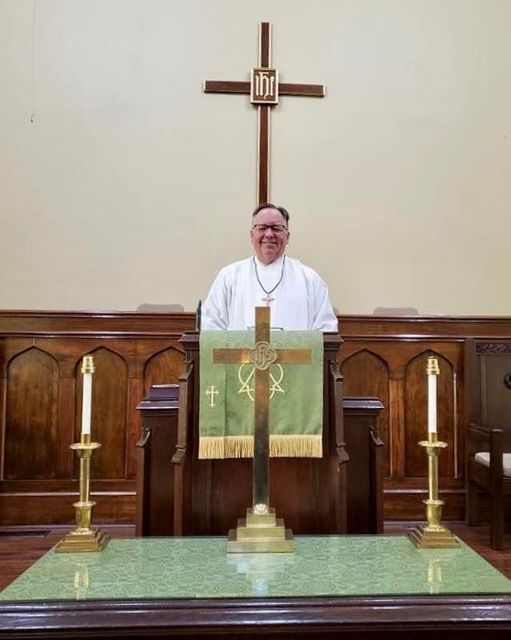
“Grace Of the One”
Genesis 2:15-17; 3:1-7 [Old Testament Lesson] — Romans 5:12-19 [New Testament Lesson]
Today is the First Sunday in the Season of Lent. Lent is inspired by Jesus’ forty days of fasting and testing in the wilderness. It’s a season of spiritual discipline and renewal inviting believers to embrace practices such as fasting, prayer, and acts of charity. These disciplines, deeply rooted in John Wesley’s emphasis on practical holiness, are not meant to be empty rituals but pathways to deeper intimacy with God. For Wesley, spiritual disciplines were tools for what he described as “scriptural holiness,” leading believers toward the ultimate goal of entire sanctification. Lent calls believers to examine their lives, confront the sin that separates them from God, and seek restoration through grace.
Lent culminates with Holy Week, which immerses believers in the pivotal events of Jesus’s passion. Beginning with Palm Sunday, commemorating His triumphal entry into Jerusalem, the week progresses through Maundy, or Holy Thursday, marking the Last Supper and Jesus’ demonstration of servanthood in washing His disciples’ feet, including those of Judas His betrayer. Good Friday brings the solemn reflection on the crucifixion, inviting believers to mediate on the weight of sin and the depth of Christ’s sacrificial love.
Easter Sunday, the culmination of this journey, celebrates the resurrection of Jesus Christ and His victory over sin and death. It’s a day of unparalleled joy, proclaiming the fulfillment of God’s redemptive promise. The empty tomb stands as a testament to the hope of eternal life and the transformative power of Christ’s resurrection.
Easter reminds believers that the despair of Good Friday is not the end of the story. [It may be Friday—but Sundays a-cumin!]
Romans 5:12-19
Blaming one another is a human trait; that’s why it’s recorded in our Bible in the story of Adam and Eve. In Hebrew, the name, Adam means “humanity” and the name, Eve, means “life.” In our Old Testament Lesson this morning after Adam ate the fruit, he blamed Eve and then went on to blame God, reminding God that Eve wouldn’t be around if He hadn’t given her to him. God then confronts Eve and she blames the crafty serpent. Adam as “humanity” and Eve as “life” portray how we humans often respond to one another and to God.
Why would God place a tree in the Garden and then forbid Adam to eat from it? God wanted Adam to obey Him, but God also gave Adam the freedom to choose. Without this freedom, Adam would have been like a prisoner, and his obedience would have been hollow. The two trees provided an exercise in choice with rewards for choosing to obey and sad consequences for choosing to disobey. When we are faced with the choice of right or wrong, remember that God is giving you an opportunity to obey Him.
As humans, along with laying the blame for our mistakes on others we also try to justify our mistakes by using others as an example. I read that in Newark, New Jersey, a lady lost a purse containing twenty-five dollars. A week later it came back in the mail but contained only fifteen dollars, plus a note from the anonymous finder explaining she had once lost a purse with ten dollars in it. The fact that she was once robbed gave justification to rob a portion from the twenty-five dollars. This justification and rationalization of wrongdoing affects us down the line. It’s not isolated, but very common.
How easy it is to justify our mistakes—to blame someone else—“I can’t help my weakness; I was born with it.” Or how easy it is to blame some imbalance on the chemistry of our body, or to blame the whole world by saying, “Everybody else is doing it.” Or, like Flip Wilson used to say: “The devil made me do it.” Now I know that the devil is a bad person or being but I’m not quite sure he or she deserves the blame for all the mistakes we make.
Why does Satan tempt us? Temptation is Satan’s invitation to give in to his kind of life and give up God’s kind of life. Satan tempted Eve and succeeded in getting her to sin. Ever since then, he’s been busy getting people to sin.
The author of our New Testament Lesson, the Apostle Paul, is without a doubt one of the giants of our faith. He planted churches everywhere he went on his missionary journey’s and converted thousands upon thousands to the new religion of Christianity. Fourteen of the twenty-seven books of the New Testament are attributed to him, and he probably influenced many of the authors of the other books. He was from Tarsus, which was renowned for its university in which students could receive a superior education. After his time there he went to Jerusalem where he studied under Gamaliel, one of the most noted rabbis in history. Paul was well versed in Classic Greek—Philosophy and Ethics—and Mosaic Law. And he writes like the educated person that he was; which sometimes makes it hard for a simple person like myself to understand him.
Sin is the symbol of spiritual death—man’s ultimate separation from God. Adam’s sin involved all of mankind in condemnation and death. We don’t start our life with even the possibility of living without sin—we begin our life with a sinful nature. Though you won’t find this term in your Bible John Wesley tabbed this as “original sin.” This original sin, or the sin that surrounds us, is the reason that as Methodists, or Wesleyans, we baptize infants, considering them the perfect candidates since we are born into a world of sin.
The “first Adam” failed. And since the entire human race sprang from Adam, all of us are incorporated in Adam and inherit what he passed on to us—death and all that leads to it. Our relationship to God is the same as Adam’s—a broken one. We have no more access to God than Adam had—and we haven’t improved all that much. We are just as rebellious today as Adam ever was. This is our predicament.
Just as sin and death came into the world through the action of one man, Adam, so the solution to sin and death come through a single individual, Jesus Christ, the second Adam. Adam is a “first” in sin and a source of it. Likewise, Jesus is the source of righteousness. Adam, through his choices caused separation from God while Jesus puts us back together with God and holds us there.
Paul says that what Christ has done can alter the character of every single person and can transform the nature of the common life which we all share. The heart of Paul’s argument is that the grace of Jesus Christ is mightier than sin. This grace is so free and effective that it is stopped by nothing except by our rejection—called by some the “possible impossibility.”
In any case, we know that grace provides for us all but can be rejected and lost. Where faith is possible, it is required as the one absolute and immediate condition of salvation. Repentance—obedience—and dedication are required and necessary in order for us to truly have faith.
The reign of death, having been traced to sin, raises a question. How can there be sin even before the law? Paul broadens the horizons; sin is not just breaking commandments; it’s a matter of rejecting God and failing to glorify Him as God. As he wrote to the Ephesians, those who have sinned are “alienated from the life of God because of their ignorance and hardness of heart” [Ephesians 4:18].
But sin is deeper than just breaking the rules. It’s a deadly attitude of rebellion that in moral order cannot bear anything other than death. Where sin is universal, death was king.
But, and in this case, we should be thankful for it. But Christ, by His perfect obedience, even death on a cross, sets in reverse the process that Adam began, but it must be accepted rather than rejected. Revelation 3:20 says, “Listen! I am standing at the door, knocking; if you hear my voice and open the door, I will come in to you and eat with you, and you with me.” Jesus doesn’t force Himself into our lives. Yes, Adam gave us sin, but he also gave us freedom of choice and it’s up to us to receive the free grace offered to us in Jesus the Christ. And when we do, He gives us the opportunity for a fresh start. He becomes the head of the justified—the redeemed—and the triumphant community. He makes it possible for us to become someone that we weren’t before He came into our life.
What can wash away my sin? Nothing but the blood of Jesus.
What can make me whole again? Nothing but the blood of Jesus.
O precious is the flow that makes me white as snow;
no other fount I know; nothing but the blood of Jesus.
Friends, it doesn’t matter how far you have strayed or how often you have fallen—our needs are enclosed in the bounds of Jesus’ offer of mercy and grace. Even when our past is stained by hideous transgressions, God’s free gift assures the sinner of acquittal. Our new status isn’t due to our own merit—nor can we in any way secure it—which is why the emphasis falls so strongly on the free gift and our acceptance.
Adam gave us sin, but he gave us a choice as well. We can choose to go down the road that leads to sin and death or we can choose the road to success. It’s our choice.
Thanks be to God!
 Eastman First Methodist Church