“The Power of God”
Isaiah 9:1-4 [O.T. Lesson]
1 Corinthians 1:10-18 [Teaching Text]
In our Old Testament lesson this morning we are reminded that the lands of Zebulan and Naphtali had been humbled in the past, but things were going to change because from those areas would come the Messiah, as quoted by Matthew 4:15-16: “Land of Zebulan and land of Naphtali, the Way of the Sea, beyond the Jordan, Galilee of the Gentiles—the people living in darkness have seen a great light; on those living in the land of the shadow of death a light has dawned.” These folks there were going to see a “Great Light.”
In our gloom and despair, we fear that our sorrows and troubles will never end. But we can take comfort in this certainty: Although the Lord may not always spare us from troubles, He will lead us safely through them if we follow Him wholeheartedly.
In our book study this past Tuesday we learned a new word: Theodicy. Theodicy, according to the Merriam-Webster Dictionary is the defense of God’s goodness and omnipotence in view of the existence of evil. If you Goole it you get a theological and philosophical attempt to reconcile the existence of evil and suffering with the belief in a God who is all-powerful, all-knowing, and perfectly good. It’s main arguments often center around free will [evil results from human choices] and soul-making [suffering builds character for spiritual growth].
The author of our book, Tish Harrison Warren, a priest in the Anglican Church, wrote: “At the end of the day—in my case, literally in the darkness of the night—the problem of theodicy cannot by answered,” or, as Flannery O’Conner wrote, “it is not a problem to be solved, but a mystery to be endured.” The five of us came to the same conclusion.
But we did tend to agree with a recent study that showed the most commonly stated reason for unbelief among millennials and gen-z’ers was that they “have a hard time believing that a good God would allow so much evil or suffering in the world.”
But I have good news! In John 16 Jesus is coming to the end of His ministry and life. He’s alone with His disciples and He says this: “I have told you these things, so that in me you may have peace. In this world you will have trouble. But take heart! I have overcome the world” (John 16:33 NIV). We can have peace in the midst of trouble by Jesus’ presence in our life. We need to get close to Jesus. We need to follow Him wholeheartedly!
In a time of great darkness, God promised to send a light that would shine on everyone living in the shadow of death. This message of hope was fulfilled in the birth of Christ and the establishment of His eternal kingdom. He came to deliver all people from their slavery to sin.
For the last three or four years now, I’ve identified a piece of Scripture that has become my First/Last Word. I recite it in the morning when I awake, and I recite it at night before going to sleep. This year I’ve chosen Matthew 6:33: “But seek first His kingdom and His righteousness, and all these things will be given to you as well.” His kingdom [Jesus] and His righteousness [God’s approval] and all these things [the unnecessary things we worry about: what we will eat, or what we will wear] will be given to us as well. If we have God’s approval that should be all that matters.
In his book, Chili Dawgs Always Bark at Night, Lewis Grizzard, a “Great American” and a man who died well before his time wrote about a dispute in a church in his hometown of Moreland, GA. The church decided to install chimes that would play hymns over the loudspeaker for the townspeople to enjoy at suppertime. One of the members happened to be a turkey farmer, and he claimed the chimes bothered his turkeys during their evening meal, and they weren’t eating and getting fat so he could sell them at the market.
Ugliness ensued. The turkey farmer began shooting at the loudspeaker on the church steeple in order to silence the chimes. Other members of the church, meanwhile, crept into the turkey pens at night, carrying hatchets, which spooked the birds, giving them yet another reason not to eat. “Only after the church steeple had been riddled with bullet holes and most of the turkey farmer’s flock had suffered complete nervous breakdowns was the matter settled,” Grizzard wrote. A solution was reached. The church agreed to play the chimes at an hour that would not interfere with the turkeys’ eating habits, and the turkey farmer called off his artillery.
The Apostle Paul was familiar with conflicts in the church. Last week he was re-introducing himself to the folks in Corinth and sharing with them his credentials, “An apostle of Christ Jesus by the will of God.” Then he pumped up the church by sharing their credentials: They are enriched in Jesus Christ—they lack no spiritual gift as they wait for Jesus to be revealed—and they will be found blameless when He returns.
Paul founded the church in Corinth on his second missionary journey. Eighteen months after he left, arguments and divisions arose, and some church members slipped back into an immoral lifestyle. Paul wrote this letter to address the problems and to clear up confusion about right and wrong so that the believers would remove immorality from among them.
It would seem that Paul was informed about a beef between the congregants of First Church Corinth as to who, or whom it was they were supposed to be following. Some claim to be followers of Paul—some claim Apollos—some Cephas—and a few claimed to be following Jesus.
A couple of weeks ago when we remembered our Baptism I quoted John the Baptizer when he said, “He must become greater; I must become less” [John 3:30 NIV]. John understood that he was sent to prepare the way. He was the warm-up act. The spotlight must, and I repeat, the spotlight must be on Jesus! He’s the star of the show. He’s the only star of the show. It’s not about the speaker, or teacher. It’s not about Paul, or Apollos, or Cephas, or whomever you have chosen to follow, it’s about the message, it’s about Jesus!
It would seem that the members of First Church Corinth may have been attracted to Christianity more as an intellectual system of beliefs rather than as the revelation of a spiritual power that reaches down with redeeming grace to the moral foundations of life. They were evidently more receptive to new ideas than to the same spiritual and moral ideas—and they were ready and willing to listen to anyone who came down the pike with some new philosophy rather than make their life measure up to the standards of Jesus Christ.
Paul asks the question: “Has Christ been divided? Have these others been crucified for you? Were you baptized in the name of these others?” Paul wants to know what we need to know—what we need to remember. Who, or what is first in your life? Did it—or they die for us? Paul puts it in perspective when he says, “For the message of the cross is foolishness to those who are perishing, but to us who are being saved it is the power of God.” None of us wants to be called a fool—but if those who don’t follow Jesus—those who don’t understand the cross and what it stands for to us who do—if they think we are foolish—then I can’t think of a better reason to be called a fool.
In his book, Stand Firm & Act Like Men, Pastor Joby Martin writes: “Why does Jesus have to be the only way to heaven? Can’t there be a bunch of ways?
“The Father’s answer was and is the cross. The only way to satisfy the wrath of God against our sin was for Jesus, who knew no sin, to become sin, and make payment on our behalf. To become the propitiation for our sin. Just to be clear, the death of Jesus is the only acceptable payment that satisfied the wrath of God on our behalf. Jesus was and is the payment that satisfies. That’s what ‘propitiation’ means. As a result, we are imputed—which means we are given something we don’t deserve—with His righteousness and His perfect life is credited to our account. And because we get credit for His sinless life, when the Father looks at us, He sees His Son’s righteousness. This is what’s so inconceivable about the cross. That Jesus, because He loves us, did for us what we could never do for ourselves in ten thousand lifetimes.
“When we follow Jesus, we follow Him to a bloody cross. Why? Because there is no glorification without a crucifixion.”
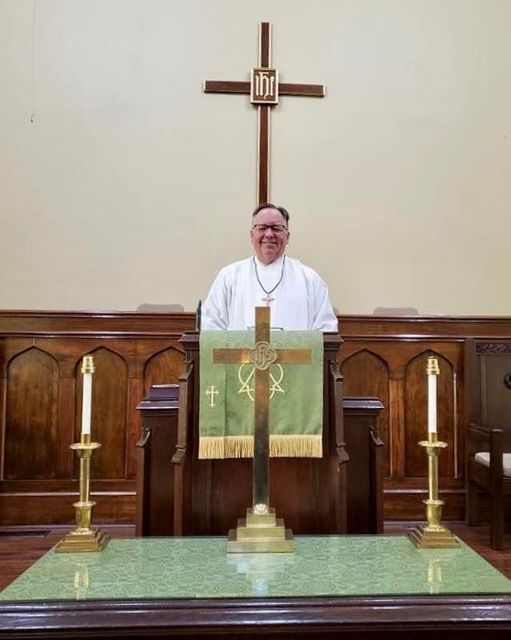
The cross, an emblem of Christianity was something that Paul put a great amount of emphasis in his writing and teaching, and it holds a special meaning for every friend of Christ. We wear crosses around our necks—they are found in churches—and in some of our homes. Whenever we see a cross, it speaks to us of Christ’s determination to do His Father’s will by dying for us on Calvary.
Jesus is our friend and when we see the cross this is what we should remember. The crucified Christ is the power that saves and the wisdom that transforms! To put it mathematically: The cross = the power of God, which = the Gospel.
To God be the Glory!
 Eastman First Methodist Church