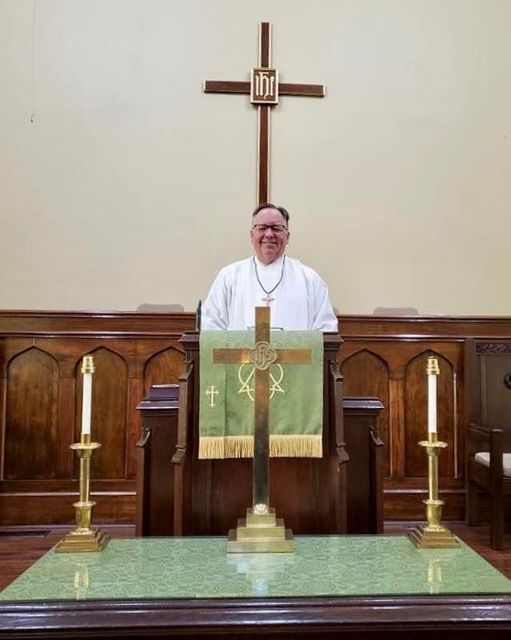
“For This Reason”
Colossians 1:9-20
If you are anything of a Bible student, you know that without the works and the writing of the Apostle Paul the New Testament wouldn’t contain much material. Though he started out as an enemy of what was then referred to as “The Way,” after his meeting with Jesus on the road to Damascus, he became the greatest advocate for which has become the Church that Jesus built and is still building.
We know that the word Gospel means “Good News” and that’s what the Gospels were for a hurting people. They were under the oppression of Rome; they were in the minority even in their own country and they were in need of some good news. The Gospels were written and used as circulars, like newspapers, to bring good news to these hurting folks. Paul’s letters were written to specific churches or communities, but they were also meant as circulars, passed around to other churches and communities.
Most of Paul’s letters were written for encouragement and instruction to churches that either Paul had planted or places he had visited. The Church in Colossae being an exception. Paul had never visited there. Evidently, the church had been founded by Epaphras and other converts from Paul’s missionary travels, so in a way, it had been remotely influenced by Paul. Hang on to that word, remotely.
Remove the head coach and the team flounders. Break the fuel line and the car stalls. Unplug the electrical appliance and it has no power. Whether for leadership, power, or life, connections are vital. The Book of Colossians is a book of connections.
Writing from prison in Rome remotely, Paul was combatting the false teaching that had infiltrated the church, thus the words which begin our text and the tile for my message today, “For this reason.” The problem was syncretism – combining ideas from other philosophies and religions [such as paganism, strains of Judaism, and Greek thought] with Christian truth.
The resulting heresy later became known as Gnosticism, emphasizing special knowledge [gnosis in Greek] and denying Christ as God and Savior. To combat this devious error, Paul stressed Christ’s deity [His connection with the Father] and Christ’s humanity [His sacrificial death as a man on the cross for sin]. Only by being connected with Christ through faith can anyone have eternal life, and only through a continuing connection with Him can anyone have power for living. Paul also emphasized believers’ connections with each other as Christ’s body on earth. And sometimes that connection is remote.
Verses 15-20 of our text make one of the strongest statements about the divine nature of Christ found anywhere in the Bible. Jesus is not only equal with God, He is God; as the visible image of the invisible God, He is the exact representation of God. One of my Theology Professors at Emory taught us that there are two revelations of God. First, there is the general revelation of God. Sunrises, sunsets, mountain vistas, the oceans, changes of season and the like. But there is only one true revelation of God, the perfect revelation, and that is Jesus Christ.
He is the firstborn over all creation
God not only created the world but also sustains it. In Jesus, everything is held together, protected, and prevented from disintegrating into chaos.
He is before all things
When questioned by the Jews in John 8 if he was greater than their father Abraham Jesus responded, “Very truly I tell you, before Abraham was born, I am!”
He is the head of the body, the Church
He is firstborn from among the dead
He was raised from death, and His resurrection proves His lordship over the material world.
Christ’s death provided a way for all people to come to God. ALL PEOPLE. It cleared away the sins that keep us from having a right relationship with our creator.
This may seem unattainable, it might sound crazy, or scary, or downright impossible; but we are made in this image as well.
This past Monday I took Samuel around town to show him some of the different ministries offered in our community. We toured the Christian Life Center, the Refuge House residences as well as the thrift store. And we ended up at the collection point for the Operation Christmas Child boxes at First Baptist. We met with Marilyn Sander, the director, and she took us around the collection point and introduced me and Samuel to the volunteers. Her and some of the others were talking about some of their experiences and Samuel said, “Yes, my church has received some of these same boxes.” Everybody was like, wow, now we’ve got a story. They were sharing about some of the things people pack these days, and one of those things is small tool kits for boys.
Samuel shared about a Muslim family in their community whose sons go to their school. Their father was a carpenter or a mechanic, I can’t remember, but he was looking for this particular tool. He looked everywhere but had no luck locating this tool. That year, the Muslim boys received their Operation Christmas Child boxes and when they got them home and opened them up, the tool their father was searching for was in one of the boxes. The following Sunday this Muslim family came to Samuel’s church to worship, they all dedicated their lives to Jesus Christ and joined the church. And they are faithful members to this day.
Somebody, somewhere, through the packing of a tool in a shoebox changed the lives for a family of five. Just like Paul remotely encouraging and teaching from a prison cell, we can change the lives of others from a distance. A letter in the mail, a phone call, a text, an email, a prayer, or a financial contribution to a ministry in a faraway place.
In the 10th chapter of the Gospel according to John, Jesus says, “I have other sheep that are not of this sheep pen. I must bring them also. They too will listen to my voice, and there shall be one flock and one shepherd.”
My friends, Jesus is counting on you to help in the gathering of these other sheep. The One who is the image of the invisible God, is counting on you, the image of the invisible God for your help so that there will be one flock and one shepherd.
 Eastman First Methodist Church