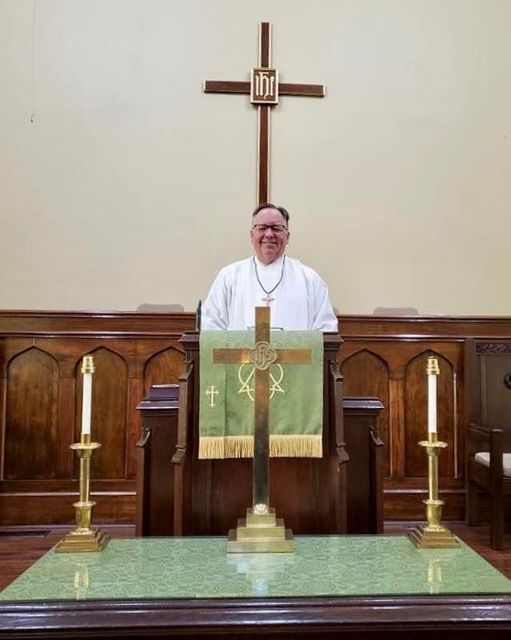
“Who Is My Neighbor”
Luke 10:25-37
I heard about an elderly woman who lived in a small town in East Texas having car trouble on the way to the supermarket one morning. Her car stalled at a stop sign and she tried everything to get it started again, but no luck. Suddenly, a man in a pick-up truck came up behind her and with obvious agitation started honking his horn at her impatiently. She doubled her efforts to get her car going. She pumped the gas—turned the ignition—but still no luck while the man in the pick-up truck continued to honk his horn constantly and loudly. I love what this elderly woman did next. Very calmly she got out of her car, walked back to the pick-up truck and motioned for the man to lower his window and then she politely said: “I’ll make a deal with you. If you will try to get my car started for me, I’ll be happy to honk your horn for you!”
That’s what I call “rising to the occasion,” which is what we find Jesus doing in our text for this morning. Luke writes that “On one occasion an expert in the law stood up to test Jesus.” I don’t know about you, but I find it really cool that Jesus had to face tests—especially given the fact that it seems like I face a new test every day, sometimes several—as I’m sure most of you do as well. [The devil has been working overtime here lately trying to steal my joy] Someone asked me once why we have to face tests, and my answer was: “We must have a test to have a testimony.” Some might say this was a test for Jesus, but I’d pose this question: “Who in this story really got tested?”
The expert in the law, or lawyer, wanted to know what he must do to inherit eternal life. Knowing what was up Jesus kind of messes with him and asks what the law says and how he interprets it.
Before Jesus came along there were 613 laws that Jews were required to know and to follow. There were 365 “thou shall not” laws and 248 “thou shalts” laws. Jesus reduced those laws down to two which the lawyer recites. First, he recites what was known as the “Shema,” a law that every good Jew repeated daily and can be found in Deuteronomy 6:5: “Love the Lord your God with all your heart and with all your soul and with all your strength.” Which is then followed by the law found in Leviticus 19:18b: “But love your neighbor as yourself, I am the Lord.”
Jesus informed the lawyer that he had answered correctly—he should have been pleased—he should have stopped while he was ahead—but he couldn’t—he had the right to remain silent, but he lacked the ability.
There was this eight-year-old boy who had never spoken a word—ever. One afternoon, as he was eating his lunch he turned to his mother and said, “Soup’s cold.” His astonished mother exclaimed, “Son, I’ve waited so long to hear you speak. But all these years you never said a thing. Why haven’t you spoken before?” The boy looked at her and replied, “Up until now, everything’s been okay.”
Up until now things have been going good for the lawyer in our story but then Luke writes that he wanted to justify himself. A lawyer looking for a loophole—imagine that!
I don’t think he wanted to justify himself as much as he wanted to know the least he would have to do and still inherit eternal life. [He posed a question about the way in while he was really looking for a way out]. He’s no different than any of us, is he? We also want to make sure to meet the minimum standards. Believe in Jesus?—Check. Been Baptized?—Check. Attend worship except when we have what we consider a good excuse [worship is boring—don’t like the music—not entertaining enough]. Thank God Jesus wasn’t tired or distracted or have a good excuse the night He sacrificed His life for our sins! [In the Garden where his sweat was like drops of blood—think about that the next time you are sweating]. But there’s nothing profound going on here, the man just wants to make certain all his ducks are in a row.
Maybe like me you’ve noticed that in our society today if we are given enough time and enough of the right words we can just about justify any of our actions. It doesn’t matter if it involves lying—or stealing—or even murder. In his book When God Redefines the Possible John Ed Mathison writes: “Man has an amazing capacity to ‘rationalize’ and begin to feel that most anything is okay.”
The expert in the law asked Jesus: “And who is my neighbor?” and the Master storyteller breaks into His Parable of the Good Samaritan. Did you know that the phrase “Good Samaritan”, meaning someone who helps a stranger, derives from this parable, and many hospitals and charitable organizations are named after the Good Samaritan? Did you know that? Aren’t you glad you came to church this morning?
Our parable has a man going down from Jerusalem to Jericho. Jesus isn’t specific about whether he is a Jew or not and He doesn’t use any names. The road from Jerusalem to Jericho is just a little bit short of seventeen miles and it falls almost thirteen hundred feet in that distance, thus the “going down” part. This was not a safe road to travel on, especially alone with its winding and rocky path. It was a prime location for robbers to hide behind the many boulders and in the caves found along the way to jump out and take advantage of unsuspecting travelers. I’ve heard from people who have been to the Holy Land that this road is still dangerous to travel on, especially at night.
The man making this journey is robbed, beaten, and left to die on the side of the road. A priest and a Levite both pass on by and refuse to stop and offer to help the man, why? Most scholars believe that it was because the man was bleeding which meant he was considered un-clean and for them to touch him or even be in his presence was a threat to them.
But along comes a Samaritan. Jesus made sure that the lawyer knew his nationality. Samaritans were despised by the Jews; they were the ones who lived on the other side of the tracks—they were half-breeds—they called them “dogs.” They didn’t keep kosher laws and were considered beyond unclean—almost dirty in every sense of the word. They were the “others” of that society. I’ll bet folks got tired of hearing Jesus makes heroes out of Samaritans in His stories!
The Samaritan didn’t know the man lying in the ditch—his nationality—his income—his religion—his education—or his diseases—he didn’t even seem to care that the robbers might still be near lying in wait for their next victim. He merely saw someone in need—took pity on him—and provided him care. He poured wine and oil on his wounds and bandaged them. The wine would act as an antiseptic and the olive oil as a balm.
Then he put the man on his donkey and took him to an inn for the night. In the morning, he gave the innkeeper two silver coins or two days wages, which would keep a man up to two months in an inn and promised when he returned that he would take care of whatever else he owed.
Notice that the priest and the Levite were “coming down from Jerusalem.” Surely, they had visited the temple there—they were surely inspired—they must have felt good about themselves—they had fulfilled their religious duties. But suddenly the hollowness of their religious commitment is exposed. They had fulfilled the first half of the commandments—they had loved God—but they refused to love their neighbor.
Who is our neighbor? Our neighbor is anyone who needs our help!
Ralph Waldo Emerson once said: “It is one of the most beautiful compensations of this life that no man can sincerely help another without helping himself.” The Samaritan in our parable saw someone in need and he met that need. He got involved and in turn got others involved as well. And the innkeeper deserves some credit here—after all—he helped in the process by allowing the man to stay in his inn—he continued to nurse the victim until the Samaritan retuned. He took the Samaritan at his word.
I think one of the greatest compliments I’ve ever received was from a co-worker, before I entered the ministry, who said to me, “You’re the only person I know who takes time off from his job to go somewhere and work to try and help other people.”
Who is our neighbor?
The people we help every day with our Blessing Box ministry
The clothes y’all donated to the Lenten Challenge [one more load to deliver]
Our support for the local Backpack Ministry
Why we do local missions
Why we are involved in the Meals on Wheels ministry
Why I would like to see us partner with the Christian Life Center in their work of loving our neighbors
I saw an interview with a rescue worker in Texas this week and when asked why he was there he said, “We’re here for our neighbors.”
I think I’ve shared this with you before but there was this guy walking down the street who fell into a deep hole. He was hollering up for help when along came a doctor who wrote him a prescription and threw it down in the hole. Not long after that a preacher came along, writes down a prayer and throws it down in the hole. Not long after that a friend of the man in the hole comes along and he jumps down there with him. “You idiot,” the man says. “Now we’re both stuck in this hole. But his friend says to him: “But I’ve been down here before, and I know the way out.”
Maybe the Samaritan had been in the same place once as a victim. Maybe he was once beaten—and robbed—and left for dead.
Maybe you’ve been a Good Samaritan, or you’ve found yourself on the flip side and needed help yourself. Jesus is telling us that our neighbor is anyone who needs us.
Love moves in three directions: from God to us—from us to God—and toward one another. We can love God only because he has first loved us; and we are able to love our neighbors in the Christian sense only because we have been first loved by God.
Love is at the center of faith for many people in the world. But it is uniquely so for Christians. Why? I don’t know of any other God in any other religion who has scars in His hands, do you? Scars from hanging on a cross. Why did Christ go to the cross? Because of love. That’s amazing. Were we deserving? No, quite the opposite. It was because we were helpless. We were lying beside the road—beaten and bloody and about to breathe our last breath and God saw us lying there and had mercy on us. How much does God love us? (Arms extended) that much! No other God has scars in His hands from stopping to help a stranger beside the road. Love is the heart of faith—particularly for the follower of Jesus.
 Eastman First Methodist Church