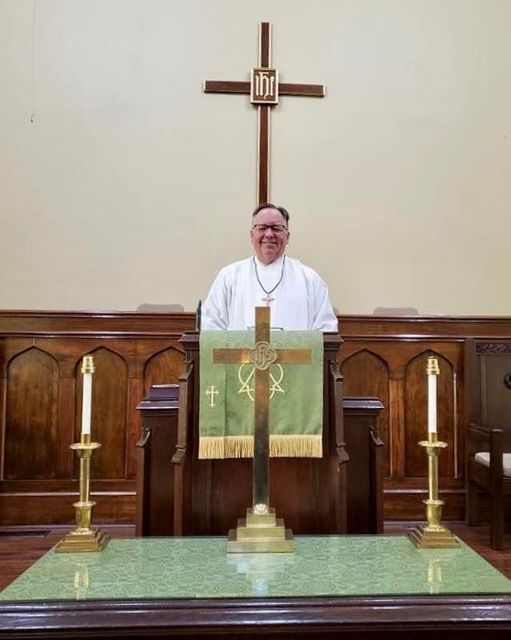
“The Church”
Acts 11:1-18
If I were to start a sentence with the words, “There are two types of people in the world…,” how would you finish that sentence? “There are two types of people in the world…,” Somebody once said, “There are two types of people in the world—those who divide the world into two types of people and those who do not.” What say you?
One way to divide folks into two types would be to say, there are rule keepers and rule breakers. Some people just have an internal compulsion to follow the rules, even if those rules are questionable. There are others who seem to only enjoy life when they are breaking the rules.
There’s an old joke about a little boy named Johnny whose mother had just returned from the grocery store. Johnny pulled a box of animal crackers out of her grocery bag and spread those animal crackers all over the table. “What are you doing?” his mother asked. “I’m looking for the seal,” Johnny explained. “It says not to eat them if the seal is broken.”
Litle Johnny is definitely a rule-keeper. You can respect that. People like him keep society from descending into chaos. But sometimes we keep rules that no longer serve any purpose. Sometimes our rules only serve to put up walls between ourselves and others. For instance, how many Christians—consciously or unconsciously—make up rules to decide who is or is not acceptable to God?
Our narrative for this morning seems to indicate that “The Church” was standing in the way of God’s oncoming kingdom and was challenging Peter’s action, “You went into the house of uncircumcised men and ate with them” [v.3]—recalling him to Jerusalem to justify himself. Wait a minute, didn’t Jesus do a little of this Himself?
Even though there was no radio—telephone—Internet—or 24-hour cable news in the first century—it didn’t take long for the news to reach Jerusalem that Cornelius and his entire household [including their slaves and servants] had become Christians. What a triumph for the movement! What a feather in Peter’s cap! “The Way,” or “The Church,” was reaching beyond its national and religious frontiers and beginning to embrace the world. We would expect something like a victory rally to greet such good news in Jerusalem. Instead—we get a meeting of protest. Instead—we get “The Church” standing in the way of God’s oncoming kingdom! I’ve said it before and quite sure I’ll say it many more times but folks—God doesn’t need us for His kingdom—but we had better be sure that we know how much we need God!
This protest was directed at Peter and the substance of it was that he had eaten a meal with a Gentile—he had violated their ceremonial law. Just how would it be possible for Christ to save a world in which one person was forbidden to eat a meal with another—the objectors hadn’t bothered to consider this. Peter had stomped on their traditions and now he would be brought to task.
A Gentile would have been anyone who wasn’t a Jew. Most Jewish believers thought that God offered salvation only to the Jews because God had given His law to them [Exodus 19-20]. A group in Jerusalem believed that Gentiles could be saved, but only if they followed all the Jewish laws and traditions—in essence, if they first became Jews before becoming Christians. You’ll remember that the Apostle Paul had a similar problem with this group. God had chosen the Jews and taught them His laws so they could bring the message of salvation to all people!
The news of the success of Peter’s mission to the Gentiles at Caesarea spread rapidly throughout Judea as the apostles and disciples heard of the mighty workings of God in the household of Cornelius and passed the good news along to others.
When he returned to Jerusalem—Peter was confronted by the anti-Gentile Jewish Christians—“The Church.”
The Jewish-Christian legalists that Peter faced didn’t attack the baptism of the Gentiles—perhaps because of the Lord’s command and God’s evident visitation of these Gentiles—but they made an issue of what they determined to be Peter’s breach of Jewish ceremonial law and custom.
The legalists wished at best to regard the Gentiles as an inferior class and require of them to subscribe to the Jewish ceremonial law. Legalism like this invariably leads to “classism” in the church, the “holier-than-thou” attitude.
People don’t think alike—and although they may agree upon some fundamental proposition—for example, Jesus is Lord—yet within that agreement there is room for more than one interpretation and for many shades of opinion. As long as people don’t think alike there will be parties in politics—in education—and yes, even in the church.
There was once a Pastor who transformed himself into a homeless person and went to the 10,000-member church that he was to be introduced as their new pastor that morning. He walked around his soon to be church for 30 minutes while it was filling up with people for the service—only 3 people even said hello to him. He asked people for change to buy food—no one in the church gave him any change.
He went into the sanctuary to sit down in the front row and was asked by the ushers if he would please sit in the back. He greeted people only to be greeted back with stares, dirty looks, and people looking down on him. As he sat in the back of the church, he listened to the church announcements and such. When all that was done, the elders went up and were excited to introduce their new pastor to the congregation. The congregation looked around clapping with joy and anticipation. The homeless man sitting in the back of the church stood up and started walking down the aisle. The clapping stopped and all eyes were on him. He walked up to the altar and took the microphone from the elders (who were in on this) and paused for a moment, then he recited: “Then the King will say to those on his right, ‘Come, you who are blessed by my Father; take your inheritance the kingdom prepared for you since the creation of the world. For I was hungry and you gave me something to eat, I was thirsty and you gave me something to drink, I was a stranger and you invited me in, I needed clothes and you clothed me, I was sick and you looked after me, I was in prison and you came to visit me.’”
After he recited this, the new pastor looked at the congregation and told them what all he had experienced that morning. Many began to cry—and many heads were bowed in shame. And then he said, “Today I see a gathering of people—not the church of Jesus Christ. The world has enough people, but not enough disciples. When will YOU decide to become disciples? And he ended the service.
What this new pastor saw that morning was the same thing Peter was forced to look at when he returned to Jerusalem. Peter defended his actions by (1) he was instructed by God; (2) the Holy Spirit spoke directly to him; (3) six Jewish-Christian men went with him; (4) he found that all the circumstances of the divine directions, both on his part and with Cornelius, perfectly corresponded; and (5) the object of his mission was the salvation of Cornelius and his household. Peter clearly saw the divine approval and reward for his obedience was the outpouring of the Holy Spirit upon them all.
I was at Walmart this week getting gas and since I had missed lunch decided to purchase a diet coke and a pack of crackers. When I went to the cashier to pay a young black man was behind the counter. He read my name tag and asked if I was the Pastor of the Eastman First Methodist Church. And then he asked something that kind of floored me. He said, “Would I be welcome in your church.” I said, “Of course you would be welcome.” And then he added, “I went to a church in Atlanta and was asked to leave.” Sometimes, “The Church” does more harm than good.
In the Steven Spielberg movie about the life of Abraham Lincoln there’s a story told that in the midst of the civil War a certain pious minister told Lincoln, “I hope the Lord is on our side.” The president responded, “I am not at all concerned about that….But it is my constant anxiety and prayer that I and this nation should be on the Lord’s side.”
God doesn’t need us—we need God! [Luke 3:7-9]
I began this message talking about two types of people in the world while actually, in the eyes of God, there’s only one type of person: greatly loved and worth dying for. In Galatians 3:28, the Apostle Paul writes: There is neither Jew nor Gentile, neither slave nor free, nor is there male and female, for you are all one in Christ Jesus.” We are not God’s bouncers; we are God’s ambassadors. It’s not our job to put limits on God’s love. It’s our job to share the love and the salvation of Jesus Christ with everyone we meet, so that all God’s children can someday be gathered into His kingdom.
So, to our graduates that we honor this morning, I say that you are greatly loved and worth dying for. And to His church called the Eastman First Methodist Church, I say you too are greatly loved and worth dying for.
 Eastman First Methodist Church