“With You I Am Well Pleased” | Luke 3: 15-17, 21-22
Maybe you have already figured this out, but the Bible was not put together in chronological order and we have some evidence of that fact in our story today. If you still have your Bible open look at verses 19 & 20—what’s happening? John the Baptist is headed to the clink for railing against Herod and the evil things he was doing. But then in verse 21 John is baptizing Jesus. Do you think Herod let him out of jail so he could baptize someone who would challenge his authority? I highly doubt it. Or do you think Luke had one of those slap your Momma moments and thought to himself, Holy Cow, Batman, I forgot that John baptized Jesus before he was arrested. Either way it probably doesn’t matter because what matters is what took place. (You can always start an argument speaking about Baptism)
Have you ever pondered the thought as to why Jesus was baptized? Jesus didn’t need to be baptized, there was no need for repentance in His life, there was no sin in His life, but He submitted to John’s Baptism, why? To identify with our sins, to become one of us so we could become like him—to “Be Like Mike” like the famous Nike commercial used to say. He joined in the popular movement of His day. It was a grass roots movement started by a desert monk named John the Baptist. John was calling for the repentance of Israel. Jesus chooses to be baptized because He wants to participate with the people in their desires to be close to God. It’s a small thing Jesus does but what a big influence. It forever marks baptism as the way we Christians publicly declare our repentance and our dependence on God’s grace.
All of the Gospels introduce the ministry of Jesus through the introduction of John the Baptist. John the Baptizer signifies what is important and world-changing about Jesus.
The people had been waiting for a long time for the Messiah; they were probably getting a little impatient. It had been 400 years since God’s people had heard or seen anything from a prophet. It was widely believed that when the Messiah came, prophecy would reappear. There are some who believe that prophecy and healing died with Jesus. I don’t believe that!
When John the Baptist burst onto the scene, our text says: “The people were waiting expectantly and were all wondering in their hearts if John might possibly be the Messiah.” They were wondering if this was the one, and they were probably thinking, “Oh my, if this is the one then we are in a lot of trouble!” But to be sure, John’s words warn the crowds that this servant Messiah will be no weakling: “I baptize you with water…He will baptize you with the Holy Spirit and fire.”
John spoke like the prophets of old, saying that the people must turn away from their sin and turn to God in order to avoid punishment and experience His mercy. This is a message for all times and places, but John spoke it with particular urgency—he was preparing the people for the coming Messiah.
What does Baptism mean for us? Just as Jesus’ Baptism signified the beginning of His ministry, ours means a beginning as well. It’s our entrance into the family of God. That’s why many churches have their Baptismal Font at the door of the church, where you might enter the building. For the Jews of the Old Testament circumcision signified their entry, their new life; Baptism takes the place of circumcision for us as Christians, as followers of Jesus Christ.
What happens at our Baptism? Probably what are most important are the covenants that take place. The covenant between God and us; the covenant between God and the Church; the covenant between the parents and their child; and the covenant between the Church and those parents. John Wesley described both Baptism and Holy Communion as an outward sign of an inward grace. They are something we can see, something we can feel, but more importantly is the change that we experience, the change that comes from within us.
Even though all four Gospels portray this scene, Luke’s version is a little different, but in each version, though, the Spirit descends “like a dove.” The Holy Spirit is not a bird. Luke and the other apostles use the dove as a metaphor for the Spirit’s coming into our lives. It is a beautiful metaphor. Have you ever seen a dove descend and land? It is graceful, gentle and quiet. That’s the point being made. That is the way the Holy Spirit will enter our lives. The Holy Spirit came to Jesus gently, quietly, and in Luke’s version, privately.
That is why Luke is different than the others. They imply that the Spirit descended upon Jesus at His baptism, apparently while He was still in the water. That’s the way this scene is often portrayed in religious art, especially those beautiful paintings from the Middle Ages. Jesus, standing waist deep in water. John the Baptist standing next to him, pointing at Jesus as if to say, “This is the One!”
That’s the way the other Gospels picture it, but not Luke. He says, “When all the people were being baptized, Jesus was baptized too. And as he was praying, heaven was opened and the Holy Spirit descended on Him in bodily form like a dove.” This means that this special presence of God could have come to Jesus when He was by Himself, praying. In other words, it may not have been a public event. It could have been a personal and private experience. He came out of the water, went off by Himself, and prayed. It very well could have happened like this. Luke, more than any other gospel, emphasizes that Jesus prayed.
And why shouldn’t He be praying? He was human just like you and me, that’s what happened on that day in the Jordon River, Jesus redefined both “humanity” and “divinity” so that never again could people think “human being” or “God” without thinking of Jesus. Never again could anybody say that humanity was without hope, rotten, and of no account after God Almighty became present in this Jew from Nazareth. Never again could anybody say that God was distant, threatening, fierce, and overpowering after God was revealed to be who Jesus is.
When Jesus was baptized, He stood in solidarity with all of us sinners, submitting to a baptism that He didn’t need, the same baptism that we must submit to and to God if we are to be brought back to God. In Jesus, divinity and humanity embraced.
When Jesus was baptized, we get our first glimpse of the Holy Trinity. Remember, you won’t find the word Trinity in the Scriptures, but we see the first evidence of it here. In this text we have the bodily form of Jesus—the Holy Spirit in the form of the dove—and the voice of God the Father.
It’s important that we understand our Baptism, especially today as we have remembered it. Most of us were very young when we were baptized for the first time. What we have done this morning is remember, but even more important, try to understand what it did for us.
John’s baptism with water symbolized the washing away of sins. His baptism followed his message of repentance and reformation. Jesus’ baptism with fire would equip His followers with power to do God’s will.
This baptism was the first public declaration of Jesus’ ministry. Instead of going to Jerusalem and identifying with the established religious leaders, Jesus went to a river and identified with those who were repenting of their sins. Jesus would officially begin His ministry as God’s beloved Son walking the dusty roads of Israel. The next time you are hurting, depressed, or broken, remember that you have a Savior who understands your humanity.
Back when the telegraph was the fastest means of long-distance communication, there was a story about a young man who applied for a job as a Morse code operator. Answering an ad in the newspaper, he went to the address that was listed. When he arrived, he entered a large, noisy office. In the background a telegraph clacked away. A sign on the receptionist’s counter instructed job applicants to fill out a form and wait until they were summoned to enter the inner office.
The young man completed his form and sat down with seven other waiting applicants. After a few minutes the young man stood up, crossed the room to the door of the inner office, and walked right in. You can imagine the response of those still waiting; he was the last one to show up and had the audacity to just walk right into the room. Surely, he wouldn’t be the one who would get the job, he couldn’t even follow instructions.
Within a few minutes the young man emerged from the inner office escorted by the interviewer, who announced to the other applicants, “Gentlemen, thank you very much for coming, but the job has been filled by this young man.”
You see, while they were sitting there, the telegraph had been ticking out the following message in Morse code: “If you understand this message, then come right in, the job is yours.”
Our entire life depends upon our ability to not only understand our Baptism but to discern the voice from heaven that Jesus heard: “You are my Son, whom I love; with you I am well pleased.” In our Brown Bag Book study this week we were discussing spiritual disciplines with one of them, of course, being prayer. The author shared that when Jesus taught the disciples to pray, He didn’t say “My Father,” rather, He taught them to begin with, “Our Father.” We know that Jesus often prayed to His Father, early in the morning, all night on one occasion. He went off to be by Himself with His Father forcing people to come and look for Him. But He reminded the disciples, and He reminds us today that we are all in this game called life together. We need to understand that the voice He heard is meant for us as well: “You are my son, or daughter, whom I love; with you I am well pleased.”
Sermon: January 12, 2025
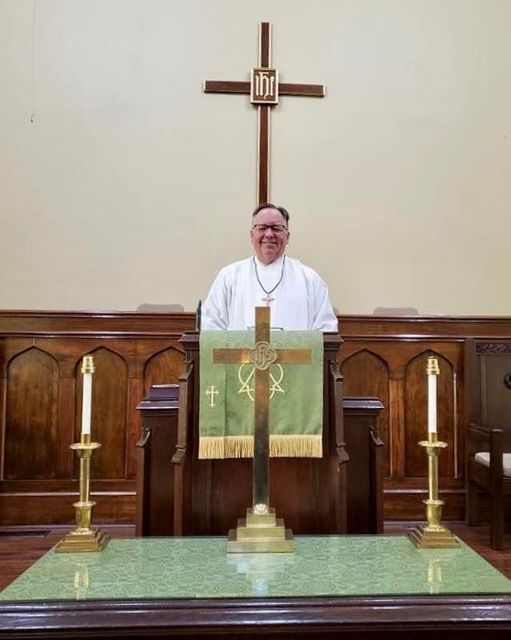
 Eastman First Methodist Church