“Have Come To Worship Him” | Matthew 2:1-12
According to ancient tradition, the Gospel of Matthew was written by a tax collector, and if this is true, the clarity and the simplicity of this Gospel comes as a surprise to anyone who reads it. Imagine, a Gospel written by a tax collector! What do you suppose a gospel written by the IRS might sound like today?
“Once there was an adult male named Joseph, a self-employed carpenter with two dependents, Mary, an unemployed housekeeper, and a minor son named Jesus. Jesus was born six days before December ended, and this provided Joseph with a full deduction for the entire year. Jesus was born in Bethlehem while Joseph and Mary were on a business-related trip, which could not be deducted. The family received considerable assets of gold, frankincense, and myrrh while in Bethlehem, and a ruling has not yet been made on whether this increase in net worth should be reported as income on line 12, page 2.”
Only Matthew and Luke saw the importance of sharing their version of the birth story but trying to compare them is nearly impossible. Matthew the Jew, writing to a Jewish audience while Luke, a Gentile was writing to a gentile audience. Luke writes about shepherds in the field watching their flocks and Matthew writes of wise men from the east. Luke writes about the shepherds going to see Jesus in a stable; Matthew has the wise men showing up at a house. In Luke, the shepherds show up shortly after Jesus is born; the wise men in Matthew take nearly two years to find Him. But one thing that Matthew and Luke agree on is the emphasis on traveling. Both stories are about people making trips: from Nazareth to Bethlehem; from the fields to the manger; from Judea to Egypt.
Not much is known about these Magi (traditionally called “wise men”) who we encounter today. We don’t know where they came from or how many were in the group. Because of the three different gifts they gave to Jesus, tradition has assumed that there were just three men on this journey, but we have no proof of that. Tradition also says that these three men were of high position from Parthia, near the site of ancient Babylon.
One wonders how they knew that this star they saw represented the Messiah. I have a few theories: (1) They could have been Jews who remained in Babylon after the exile and knew the Old Testament predictions of the Messiah’s coming. (2) They may have been eastern astrologers who studied ancient manuscripts from around the world. Because of the Jewish exile centuries earlier, its possible that they had copies of the Old Testament in their land. And (3) they may have had a special message from God directing them to the Messiah.
Some interpreters say these Magi were each from a different land, representing the entire world bowing before Jesus and fulfilling the prophecy that all nations would come to Him (Isaiah 11:10; 52:10). These men from faraway lands recognized Jesus as the Messiah while most of God’s chosen people in Israel did not.
Unless you live under a rock or have been in a coma this week you know that President Carter passed away last Sunday at the age of 100. I think most of you know that my first appointment in the ministry was in Plains, and I was fortunate to develop a friendship with the ex-president; we talked on the phone (early in the morning) and visited in person. In public, he always called my Pastor, I later figured out that he did so out of respect because he knew my name. Jimmy Carter said that “Faith should be a verb, not a noun.” He also said, “My faith demands that I do whatever I can, wherever I can, for as long as I can with whatever I have to try to make a difference.” Sounds a little Wesleyan, doesn’t it? That is how he lived his life.
These Magi traveled many hundreds of miles to see the king of the Jews, so their faith was also a verb. Herod and the so-called religious leaders weren’t willing to travel five miles to see the Messiah. When they found Him, they responded with joy, worship, and gifts. These gifts of the Magi can be interpreted as foreshadowing Jesus’ life and death. The gold, representing royalty, foretells Jesus as King. The incense, symbolic of the prayers of the high priests rising up to heaven, foretells Jesus as High Priest. The myrrh, often used as burial oils, foretells Jesus’ death. While on the cross Jesus was offered wine mixed with myrrh (Mark 15:23) probably to help dull the pain—but He refused it. When Joseph of Arimathea and Nicodemus buried Jesus in the tomb, they wrapped His body with a mixture of myrrh and aloes (John 19:39).
How different was the approach of the Magi compared to what people often take today. We expect God to come looking for us, explain Himself, prove who He is, and give us gifts. But those who are wise still seek and worship Jesus today not for what they can get from Him but for who He is. God reveals Himself to those who seek Him and rewards them with faith.
God invites us to spend less money on ourselves and more on those in need. God calls us to waste less time amusing ourselves and give more time to our family, friends, and yes, even strangers. God tries to gently persuade us to turn our attention from the temporary to the permanent—from passing time to investing in eternity. We know far more about God’s invitations than we care to admit. If we don’t listen for God, it may well be because we’ve already heard and chose to ignore.
These wise men followed this star even though it may have seemed foolish. They acted with abandon. They wanted to see Jesus more than they wanted to keep their treasures, more than they wanted to play it safe, and more than they feared the difficulties of the journey.
They hungered for God. Isn’t that why we worship—a faint hope that we will feel God’s presence? Aren’t we responding to a longing even if we can’t name or describe it? We have been called forth like the magi, led by the light of a star. We have felt the pull of God’s love.
So, in this New Year of 2025, how far are you willing to go for Jesus; what gifts will you bring? Jesus came for us all; He gave up heaven to come to this world in human form. He came to this world to live the life of a peasant, a sojourner, who never had a place to call home; and even in His childhood home and among His own people folks didn’t believe in Him. He came to this world to be called a criminal, to die a horrible death, to hang on a cross, and He did it for us, for you and for me, for our salvation. He came into our lives in a stable knowing that He was headed for a cross. He is our gift, what kind of gift will you bring Him?
Will you be faithful, even when it isn’t convenient, even when you aren’t in need, even when you don’t feel like it or the weather isn’t just right? Will you give Him your life, or only an hour or two each week thinking that you have done your part? Will you be obedient? Will you serve when and where you are called, giving of your time, your talent, and your resources?
What can I give Him, poor as I am?
If I were a shepherd, I would bring a lamb;
If I were a Wise Man, I would do my part; yet
What I can I give Him: give my heart.
Last verse of In the Bleak Midwinter (UMH #221)
On this first Sunday of 2025—Epiphany Sunday—may we be reminded of the words from Howard Thurman and his poem titled: The Mood of Christmas.
When the song of the angels is stilled,
When the star in the sky is gone,
When the king and the princes are home,
When the shepherds are back with their flock,
The work of Christmas begins:
To find the lost,
To heal the broken,
To feed the hungry,
To release the prisoner,
To rebuild the nations,
To bring peace among people,
To make music in the heart.
Will your faith be a verb or a noun?
Thanks be to God!
Sermon: January 5, 2025
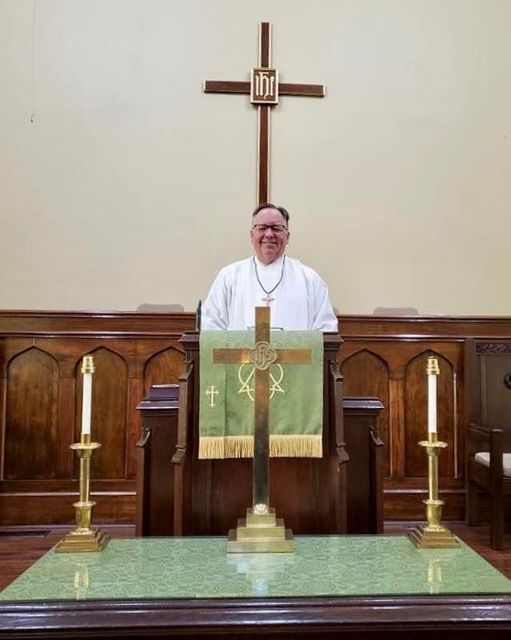
 Eastman First Methodist Church