“Proclaimed The Good News”
| Luke 3:7-18
Maybe you have heard me say this before, but it is difficult for a preacher to come up with something to say when we are talking about the same old story with the same cast of characters.
By no stretch of the imagination am I the smartest pencil in the box but allow me to share with you a few things I’ve been taught by life. If you want a good career, it’s important to get a college degree—even though in our current time this is no guarantee. I’ve been asked where I went to college and often, I say, “BYU,” which stands for “Backyard University.” Some people say they attended the “school of hard knocks,” but you get the picture.
To be able to go to college we need to get past college. I worked with a guy once who said the only thing that kept him from going to college was high school. To graduate college, you need to get through Freshmen English—to be a doctor you must get through Organic Chemistry—to be a lawyer you must pass the bar—to be a preacher you need to get through your psychological exam; not necessarily to determine if you are sane but to see how crazy you are for wanting to go into the ministry. If we want to get to Bethlehem and the joy and presence of Jesus, Immanuel, God with us, we must first get by John the Baptist in the wilderness.
Author Walter Brueggemann called John the Baptist: Checkpoint John. He was referring to that famous crossing in Berlin during the days of the Cold War called Checkpoint Charlie. It was the crossing between East Berlin and West Berlin—between godless communism and glorious freedom. Brueggeman pictures John the Baptist as standing on the border between the Old and New Testaments—checking passports. “His demeanor is not unlike those border patrol people at Checkpoint Charlie,” says Brueggemann, “rude, deliberately intimidating, mostly silent and glaring.”
So, we’re on our way to Bethlehem, a whole year has passed since our last visit, a year that brought many changes in our lives—some of them good—some of them not so good—and some of them heartbreaking. The geographic map of life has changed, and even old familiar places don’t seem the same anymore. So maybe we could use a little help in finding our way back to Bethlehem this year—maybe we need to stop for directions—not that we men want to hear such a thing. You know the old joke, if the Wise Men would have been Wise Women it wouldn’t have taken them two years to find the baby Jesus and they would have shown up with disposable diapers—bottles—and casseroles.
We need some directions to Bethlehem—and like every other Advent Season—we must go through Checkpoint John to get there.
The people of Israel had not seen a prophet or seemingly heard from God for more than 400 years. When John burst onto the scene, needless to say, the people were excited. He was obviously a great prophet, and they were sure the eagerly awaited age of the Messiah had come. John preached a message for all times and places, and he spoke it with a particular urgency because he was preparing folks for the coming of the Messiah.
“You brood of vipers! Who warned you to flee from the coming wrath?” Obviously, John had missed the sensitivity training offered at the seminary. Obviously, John wasn’t interested in being politically correct. Checkpoint John was not opposed to stirring up controversy. But then, neither was Jesus!
Some people wanted to be baptized by John just so they could escape eternal punishment, but they were not really repenting from sin, nor were they willing to change the way they were living. John had harsh words for them for sure.
Turning from sin must be tied to action. Following Jesus means more than saying the right words; it means living by what He says.
I was thinking this week about the movie “Blindside.” Most of you have probably seen it multiple times like me. If not, it’s a movie about a well-to-do white family who at their mother’s wish, extends some hospitality to a young black boy they called “Big Mike.” Anyway, the mother is played by Sandra Bullock and when she gets Mike a bed, he says it’s his first and she asks, “First What?” And Big Mike says it’s his first bed and mom kind of loses it. And then later in the movie she’s having lunch with some of her snobby friends and one of them says, “Don’t get me wrong, we think it’s great what you are doing to help this young man,” and she responds, “It isn’t helping him, it’s helping me.” Sandra Bullock has said that playing this role has changed her opinion on what it is to be a Christian.
That’s where John the Baptist or Checkpoint John wants to take us in this Advent Season—to a place where we get involved—where we get our hands dirty—where we imagine we are doing something for someone else but in reality, we are doing something fantastic for ourselves!
John is instructing three specific groups in our text this morning: the crowd or multitudes—the tax collectors (Publicans)—and the soldiers.
To the crowd he is telling them to share their clothing and food with those who lacked it. This is simply following the Golden Rule found in Matthew 7:12: “So in everything, do to others what you would have them do to you, for this sums up the Law and the Prophets.”
In his book, When The Game Is Over It All Goes Back In The Box, author and Pastor John Ortberg writes, “Serving in self-giving love is the most Godlike thing a human being can do.”
The Roman government farmed out the collection of taxes to certain individuals called Publicans. These, in turn, employed local individuals to do the actual collecting of taxes in small areas. Since each tax collector was responsible for turning in a certain amount to his superior it was common practice to extort as much as possible from the people and the collector would pocket the difference. John is telling these tax collectors to only collect what is due.
To the soldiers, and these would have been Roman soldiers, John is telling them not to strong arm anyone and don’t accuse people falsely just to lock them up.
John also assailed men who were pumping themselves up as sons of Abraham. “God can make children from the stones if he wants.” John was basically saying: “Don’t tell me about your roots—tell me about your fruit!” Don’t just talk the talk—but walk the walk as well. People, God doesn’t need us—but we sure do need Him!
The religious leaders relied more on family lines than on faith for their standing with God. For them, religion was inherited. But a personal relationship with God cannot be handed down automatically from parents to children.
This will be a lesson we will be teaching to our confirmands in the coming year. When they make their public profession of faith it must be their profession, not that of their parents, church, Sunday school teacher, youth leader, or Pastor. Their faith will belong to them and not come from somewhere else.
When the scribes and Pharisees came out from Jerusalem—the ordinary crowd made room for them—but not John. John calling them a bunch of snakes and put them in their place. The Pharisees were outraged—the people, when they caught their breath were delighted. John was an instant folk hero. So much so that the crowds wondered if he was this One who was to come. But he instantly set them straight announcing that his business was simply to “Prepare the Way.” He had done his best—but now it was up to the people to respond. Their hearts needed to be stirred—they needed to be expectant if God’s salvation was actually to appear.
Have you ever heard the story about a man named James Pierpoint? Pierpoint died in 1866 after living what most people would consider a life of failure. A graduate of Yale, a school his grandfather had helped found, Pierpoint chose education as his profession. However, he did not last. They say he was too easy on his students. And so, he tuned to the law but couldn’t make a go of it. He was too generous with his clients. He published a book of poems, but he didn’t collect enough royalties to make a living. Pierpoint decided to become a minister, but his positions on prohibition and slavery got him in trouble with the influential members of his congregation. And so, he tried politics. He ran for governor and for Congress, but, of course, he lost. The Civil War came. He volunteered as a chaplain. Two weeks later he quit. The task was too much of a strain on his health. Of course, he was 76 years old at the time. Finally, someone found him an obscure job in the back offices of the Treasury Department in Washington and he finished out his life as a menial file clerk.
James Pierpoint accomplished nothing he set out to do or be. A small memorial stone marks his grave in Mount Auburn cemetery in Cambridge, Massachusetts. The words in granite read: POET PREACHER PHILOSPHER PHILANTHROPIST.
However, in one very important sense James Pierpoint was not a failure. He wrote a song, a song not about Jesus or angels or even Santa Claus. It’s a simple song about the joy of whizzing the snow in a sleigh. James Pierpoint wrote “Jingle Bells”—a song that three or four hundred million people around the world will sing this Christmas Season.
What is there about James Pierpoint’s life that speaks to us about Jesus? James Pierpoint spent all his life working to make his life count. And all he experienced was failure. And then, in a bit of whimsy, he wrote a little chorus that will be sung by millions of people for generations. To me this is a glimpse of grace. You and I strive so hard to please God. But all our strivings are as nothing in God’s eyes. But then we say “yes” to the person of Jesus Christ. We open our hearts to His love—His peace—His joy—and suddenly with no effort of our own, we move from the losing side of life to the winning side, we move from the hopeless side of life to the abundant side of life, we move from the shadows into eternal life. All with a simple “yes.”
Checkpoint John knew who he was. He was not the Messiah—he was the forerunner. It’s never easy to play that role, forerunner, or an even lesser role by the expression, “playing second fiddle.” You know where that metaphor comes from? It comes from the orchestra. Apart from the conductor, First Violinist is the most important person in the Orchestra. Only one sits in that chair and plays that role. All the rest “play second fiddle.”
Like John, we play “second fiddle.” And just like John, as we approach Bethlehem once again, may we “Proclaim the good news” to those who don’t know it.
Dear God—let it be!
Sermon: December 15, 2024
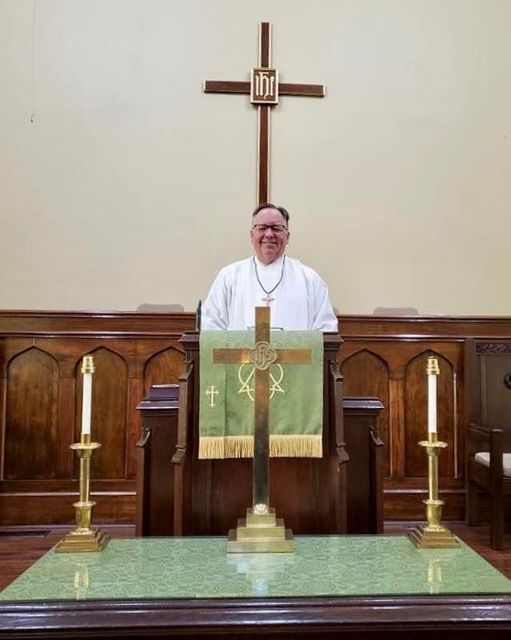
 Eastman First Methodist Church