“In The Wilderness”
I assume that most of you know I like to read. When people ask me to list my hobbies, reading is one that I include. I read, of course, for my work; but I read for pleasure as well. I am currently trying to read three different books. For pleasure I’m re-reading a John Grisham novel and late at night, when I’m struggling to get to sleep, I’m re-reading a crime novel by Michael Connelly on my iPad.
Earlier this week I was trying to finish a book titled, A Different Way by Christopher Hall. Maybe you’ve had this happen, I only had about thirty pages to read and then suddenly, seemingly like out of nowhere, I read something where I felt like God just kind of slapped me in the face. What I read was a quote from a Chinese Christian teacher named Watchman Nee. He wrote: “It is clear from the New Testament that the Lord Jesus came as a Friend, in order to help sinners to come to Him. Our coming to Him was made possible by His coming to us.”
Would you pray with me: Lord, in the busyness of this season, please help me, us, to slow down and encounter Emmanuel—God with us. I, we, are opening our ears to hear your voice, igniting our imagination to engage with your Word, and preparing our hearts for the wonder of Your coming. Amen.
Luke 3:1-6
There is a humorous story about a church having an outdoor nativity pageant using live animals. It was quite a feat, because the church was located in the very heart of downtown in a large metropolitan area. The evening of the pageant everybody was busy making preparations. The donkey that was to be used for the pageant wandered off and trotted down the street. He caused quite a commotion. Finally, he entered a nearby bar. Obviously, one of the customers was startled when he saw the donkey come into the bar. The customer pushed his glass aside and decided he had had enough. The bartender, seeing that he was startled, tried to calm him by saying, “Oh, don’t let that donkey bother you. He belongs to the Methodist Church up the street.” Thinking about that, the man decided it was time to leave.
Well, there are some donkeys in the Methodist Church, in the Presbyterian Church, in the Baptist Church and there are donkeys inside and outside the church. In fact, all of us act like donkeys at one time or another. But when Jesus of Nazareth was born in Bethlehem, all of us donkeys were raised to a new level. God has come down. Humanity has been lifted up.
Most, if not all of us have traditions that we observe at this time of the year. For the Church, especially concerning the liturgical calendar, it’s a tradition to meet John the Baptist on the Second Sunday of Advent.
For someone who wasn’t actually one of the original Twelve and probably never met Jesus, Luke the Gentile Physician does an excellent job of reporting for us. Listen to how he opens his gospel: “Many have undertaken to draw up an account of the things that have been fulfilled among us, just as they were handed down to us by those who from the first were eyewitnesses and servants of the word. With this in mind, since I myself have carefully investigated everything from the beginning, I too decided to write an orderly account for you, most excellent Theophilus, so that you may know the certainty of the things you have been taught” (Luke 1:1-4 NIV).
Luke’s reference to the high priesthood of Anna and Caiaphas seems very odd since there was only supposed to be one high priest at a time and the office was intended to be for life. But the Roman rulers during this period were appointing and dismissing high priests like their hair was on fire. In the seventy-five years between the birth of Jesus and the destruction of the temple in 70 A.D. there were no less than twenty-five men who held this office—an average of one every three years—not what one might consider to be a very secure job.
John would have been in the wilderness when God spoke to him. Don’t most of us—when we find ourselves in times that we might refer to as being in the wilderness—usually spend time talking with God.
Wilderness is a popular theme throughout Scripture and many of those with “starring roles” spend time in their own wilderness. Adam and Eve, when banished from the Garden of Eden, were forced into their wilderness. Abraham and Sarah were in the wilderness when they were visited by the three strangers announcing the birth of their son. Moses was in the wilderness tending his father-in-laws sheep when he witnessed the bush that was on fire yet not burned up and was called to lead God’s people from Egypt. King David spent time in his own wilderness protecting himself from Saul. And there are many more.
The wilderness can be a place of teaching, testing, and transformation. It teaches us a whole new order.
The wilderness teaches us that when we follow the Ruler, seeking His kingdom and His righteousness, everything else falls into place.
John’s wilderness was probably the wilderness of Judea. From there he moved to the area around the Jordan River where he started preaching about the baptism of repentance of sins.
John’s baptism represented a change of heart, which includes sorrow for sin and a determination to lead a holy life. Baptism signals one’s submission to God—profession of new or renewed allegiance to God’s will—and inclusion within the restored people of God.
Repentance is a difficult word to tie to Christmas. After all, Christmas is a warm and fuzzy holy day. At Christmastime we think of God like a jolly old Santa Claus who forgives all and accepts all and would never hold us responsible for how we live our lives. The last thing we want to think about at Christmas is repentance.
Even if it weren’t Christmastime, it’s hard to combine an image of a prophet out in the wilderness dressed in camel hair—eating locusts and honey—and calling people to repentance in our modern-day world where I’m not completely sure we even understand the concept of sin.
A few years ago, I was trying to come up with a modern day parallel to the Baptizer. I mean I was praying and meditating about it, and it may sound absolutely crazy, and please hear me out, but I came up with someone: Steve Jobs. You know who I’m talking about, right? The deceased founder of Apple.
Steve Jobs, much like John, was an introvert forced into the life and ministry of an extravert. John was a little weird—had a strange diet—and wore strange clothes. Steve Jobs was a little weird—had a strange diet—and dressed a little different. Both men—in their own way—started out in the wilderness.
Steve Jobs was adopted at an early age—he fell away from organized religion—though he did take a stab at Zen Buddhism. When he went to college, he felt like he should only have to show up for the classes he liked and when he found out different, he dropped out. He experimented with about every illegal drug that was on the market at the time and claimed that “Taking LSD was a profound experience, one of the most important things in my life.” And then, with his childhood friend, Steve Wozniak, founded what would eventually be the Apple Company. Wozniak was the electronic wizard while Jobs was the marketing guru.
If you went to a meeting with Steve Jobs and it took place in his office, you would soon learn that the man didn’t wear socks or shoes and wasn’t ashamed to prop his bare feet up on his desk. And if the meeting wasn’t going to his liking it was nothing for him to just start crying like a baby. Talk about intimidating. And if the meeting was in his house, you would be forced to sit on the floor because he was such a perfectionist and had trouble with things such as selecting furniture—so he had none.
Every time you see an Apple commercial or drive by an Apple store or purchase an Apple product or eat an apple—if you know anything about the man—you probably think about Steve Jobs. And every year when we hit the Second Sunday of Advent the Church thinks of John the Baptist.
John also prophesied that we should prepare the way. In ancient times before a king made a journey to a distant country, the roads he would travel were improved. Similarly, preparation for the Messiah was made in a moral and spiritual way by the ministry of John, which focused on repentance and forgiveness of sin and the need for a Savior.
Max Lucado tells the story of a man who had been a closet slob most of his life. He just couldn’t comprehend the logic of neatness. Why make up a bed if you’re going to sleep in it again tonight? Why put the lid on the toothpaste tube if you’re going to take it off again in the morning? He admitted to being compulsive about being messy.
Since she’s a long way from here and not able to defend herself, our youngest daughter, Katie, when she was still at home, was compulsive about being messy. She texted me one day when she was in high school asking if I would be coming to town that day. Actually, she knew that if she needed me to come to town for her I would whether I was planning to or not. She said she had left something in her room that she needed. Well, she had this sign on the door that read, “Knock before entering,” so I made sure I knocked before entering. I could barely get the door open but after putting all of my weight into it I was able to enter the room. Then I sent her a text that read, “Okay, I’m in the room, where shall I start digging?”
But something happened to Lucado’s guy—he got married. His wife was patient. She said she didn’t mind his habits…if he didn’t mind sleeping on the couch. Since he did mind, he began to change. He said he enrolled in a 12-step program for slobs. A physical therapist helped him rediscover the muscles used for hanging up shirts and placing toilet paper on the holder. His nose was reintroduced to the smell of Pine Sol. By the time his in-laws arrived for a visit he was a new man.
But then came the moment of truth. His wife was scheduled for an out-of-town trip, and he would have the house to himself. Whenever Connie goes out of town for the weekend, I have what I call “Pants Optional” weekends at the Parsonage. I know, TMI. But something strange happened to our guy. He could no longer relax with dirty dishes in the sink or towels flung around the bathroom or clothes on the floor or sheets piled up like a mountain on the bed.
What happened? Simple. He had been exposed to a higher standard of living. That’s what confession and repentance do for us. That’s what Jesus does for us. He raises us to a higher standard.
As John’s message reminds us today: When we confess the need for a baptism of repentance—we are exposed to a higher standard of living, we are changed, and we have forgiveness of sins which Jesus delivered by dying on the cross. So, what are we called to do with this? Simple. Prepare the way for Christ to be a part of our life and to shine His Light into the darkness of our world so that all mankind will see God’s salvation. Not just us—not just some—not those who look like us or dress like us or think like us—but all mankind will see God’s salvation!
In the course of history men have built all sorts of roads—roads of commerce and roads of conquest. But the one road that desperately needs to be built is the way of the Lord, a highway along which His holiness and truth shall find their access to all areas of human life. This road can help fill up the valleys of ignorance—bring down the mountains and hills of stubborn prejudice and pride—straighten men’s crooked thinking—and smooth the rough ground of instinctive resistance. In this Season of Advent and in the days that will follow; may we be found building this road that will lead us to the feet of God!
The Lord Jesus came to us as a Friend, in order to help sinners to come to Him. Our coming to Him was made possible by His first coming to us.
Thanks be to God!
Sermon: December 8, 2024
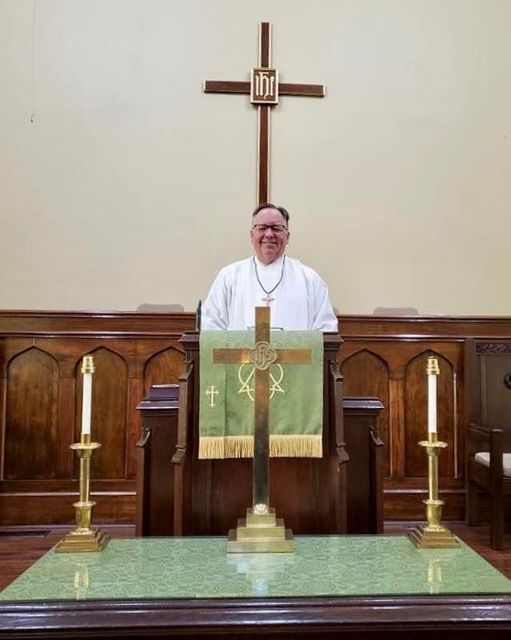
 Eastman First Methodist Church