“All She Had To Live On”
I heard from a Pastor friend of mine a few weeks ago who was just ecstatic that one of his church members asked if she could have copies of his sermons. But his curiosity and pride got the best of him and this week he told me that he finally asked the woman why she wanted the copies of his sermons. “Oh,” she said, “they are the perfect size for the bottom of my bird cage.” Ouch!
Before we dive into this lesson, I think it’s important that we put things into perspective. First, where does this take place? Jesus is in Jerusalem for the Passover Celebration. In essence, His last week in human form. In my studies over the years, I’ve come to understand that on Monday and Tuesday of that week Jesus taught in the Temple. On Wednesday there’s nothing written about any activities, so we assume Jesus took this day off to rest. On Thursday, He celebrated what we think of as The Last Supper with His disciples. And on Friday, He was crucified for our sins. So, our story for this morning takes place early in Holy Week.
The verse right before our text begins says, “The large crowd listened to Him with delight [verse 37].” What exactly was it that delighted them. If you go backward a few more verses you read, “And from then on no one dared ask Him any more questions [verse 34].” Now realize, this is me thinking out loud, but I believe the crowd was delighted because Jesus has just shut up the Pharisees, Sadducees, and the teachers of the law. All the big wigs had finally been put in their place.
And how did He do that, you ask. Well, He did it by answering the question, “Of all the commandments, which is the most important?” [verse 28]. We know the answer to that question, don’t we? The first is to love God and the second is to love our neighbor.
In my morning devotions we are walking through the Exodus story. Starting at the end of last week and the beginning of this week, we camped out for about four days around the giving of the Law, or the Ten Commandments. Maybe you already knew this, but the first five commandments concern our relationship with God while the second five concern our relationship with others. But it’s important that we don’t try to compartmentalize them because if our relationship with others isn’t working then our relationship with God is broken.
Where there is love, there is no need for law. Breaking the law is the failure of love. Law isn’t about us but about others.
The same can be said about the two greatest commandments Jesus gives as His answer: We can’t love others if we don’t love God. And we can’t love others if we don’t love ourselves.
The man who posed the questions to Jesus says in verse 32: “You are right in saying that God is one and there is no other but Him.” How about that? This teacher of the law is telling Jesus that He answered well. This teacher of the law is telling the Messiah, the One who was in the Temple answering questions at the age of twelve that He answered well. This teacher of the law is telling the answer that He answered well.
My friends—Jesus IS the answer. I don’t care what the question is. I don’t care what the circumstance is. Jesus of Nazareth, our Lord and Savior, IS the answer to whatever it is we are seeking!
That’s why the crowd was listening to Him with delight.
I used to enjoy a sport I called “People watching.” I don’t do it as much as I used to. At one time malls were great places for people watching. Connie and Katie would be busy shopping, and I would be sitting looking at the way some of the young folks were dressed and wondering, “Did they leave the house looking like that?” Before 9/11 airports used to be an excellent place to observe people; without all the beefed-up security you could walk all the way to the gate without a ticket. You could sit and watch people walking by wondering where they had come from or where they were going—were they on a business trip or was it for pleasure that they were traveling. I can remember as a child every time my mom took me to the doctor’s office I would look around and think: what’s wrong with the rest of these sick folks? I still do that today.
I believe that God is a people watcher. Is that scary or what? God is watching us all the time. How do we respond, or do we even think about God watching us? Do you think it pleases God to see how we live—how we act? Jesus did a lot of observing as well—and in our text for this morning He is warning those willing to listen about the scribes and temple authorities. He’s warning them to beware of these authorities because their worship and their religion aren’t authentic.
The long robes that Jesus speaks of were supposed to indicate wealth or nobility. The “chief seats” refer to a bench before the ark in the front of the synagogue—facing the audience. The “chief places” were the couches for reclining at the head table.
Jesus observed the behavior of the temple authorities and scribes, but He observed something else in our lesson—a poor widow—the kind those mentioned authorities were taking advantage of. Jesus observes her putting what she could into the Temple treasury—two small coins worth about a quarter of a cent each. Those two small coins equaled about half an American penny—but it represented all that she had.
The temple had several boxes scattered across the grounds where money could be placed. Some were for collecting the temple tax from Jewish men; the others were for freewill offerings. This collection box we read of this morning was probably located in the Court of Women.
You see, back then, there was no folding money—only coins. In the temple where the offerings were presented was a trumpet-shaped offering box so that when people threw in their coins, the clanging announced the generosity of the giver.
The wealthy men would make a big show of presenting their offerings. They wanted the people to be aware of their charity. They used large coins so that when the pieces of money fell into the box an impressive clanging sound could be heard by all. The two small coins that this poor widow offered were probably barely heard. But they were heard and seen by Jesus and He was deeply moved.
Whether rich or poor we must recognize that one of the fundamental tenets of the Christian faith is giving. First in the giving of ourselves and then the giving of our resources. God measures not how much you give, but how much you have left over. If your giving isn’t sacrificial God is not impressed.
I’m afraid that we have too many people these days walking through life with their eyes closed and their blinders on. Why? If you don’t know there is a need—if you don’t see the need—than you don’t have to worry about meeting that need. At least that’s what we think isn’t it? Does God think this way? Probably not!
The same is true for the church is it not? Those who don’t volunteer to serve just imagine that someone else will do it. If we don’t become involved and see how committed others are to their church, then we won’t have to step up ourselves.
The widow woman in our story this morning is never identified yet she has the attention of Jesus. She has impressed Jesus. Of all that Jesus speaks of in our lesson for this morning I think it’s obvious which behavior He endorses!
Early in my life, before my Grandparents moved back out to the farm, they lived in Ashland, Kentucky where Grandpa was working a factory job. Ashland, Ky. is the hometown of one Billy Ray Cyrus of Achy Breaky Heart fame. Billy Ray also wrote and recorded another song that went like this:
I knew a man, called him Sandy Cane
Few folks even knew his name
But a hero, yes was he
Left a boy, came back a man
Still many just don’t understand
About the reasons we are free
I can’t forget the look in his eyes
Or the tears he cried
As he said these words to me
All Gave Some, Some Gave All
We’ve honored our Veterans this morning and this song reminds us that some who have served our country never returned home. All gave some, some gave all. In our text this morning Jesus speaks of a poor widow who has given everything she had to live on. All gave some, some gave all. In just a few days from when this took place someone else will give His all—in the Messiah—Israel’s God has given Himself totally—given all that He had and all that He was.
Because He is our answer!
Thanks be to God!
Sermon: November 10, 2024
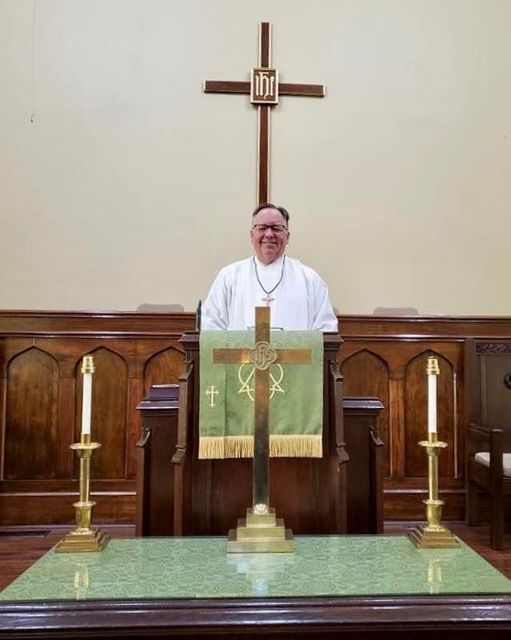
 Eastman First Methodist Church