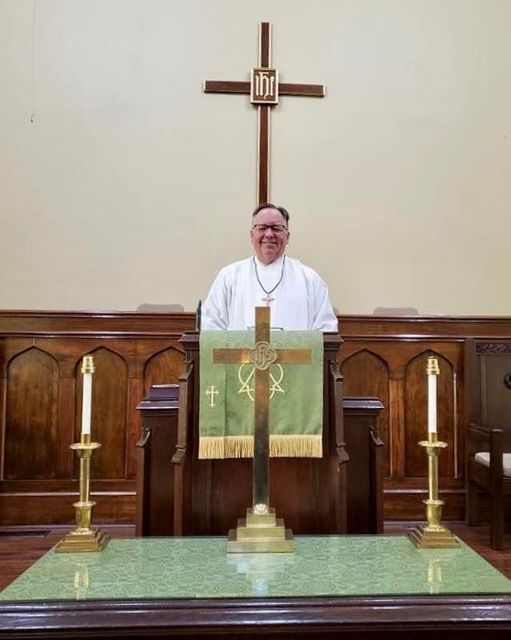
“I Want To See” | Mark 10:46-52
Of the many lessons learned from the aftermath of our recent storms, I have purchased a couple of battery charged lanterns and a jam-up battery powered fan (closing the barn door after the cows got out). Something that today’s text reminded me of is how we don’t miss something until it isn’t there anymore. For those of you who spent a few days without power, how long did it take you to skip flipping on the light switch when you entered a room? How many never got used to it? Or how many of you, when you got comfortable in your recliner reached for the television remote?
At the parsonage there is a door on the back porch that enters our sitting room, and it has a screen door. Connie said, if that door is safe, we could open the storm door and get some air flow. In other words, I had a project. So, I got busy and moved stuff away from the door so I could open it, swept down some cobwebs and removed the leaves and debris stuck between the doors. This moved me into a mini cleaning frenzy, so I moved some things and dusted off the table and the lamp that sits on it; it’s an old lamp that we’ve had for several years. When I got done, I plugged the lamp in and turned it on and thought, “This stupid thing doesn’t work anyway,” forgetting of course that we didn’t have any electricity. We don’t know how much we miss something till it isn’t there anymore.
Most of you know that we recently moved my dad into a nursing facility. After returning home from one of my recent visits I told Connie that going home isn’t much fun because it’s not like it used to be. My dad isn’t the dad that I remember growing up around. He’s not the dad who worked hard every day, took every shift that was offered, and then tinkered on things when he arrived home. And when I go home this next time, I’ll have to get used to him not being there. Not sitting in his chair listening to his Bluegrass Music at full blast because he doesn’t have his hearing aids in, or they weren’t working properly. We don’t know how much we miss something till it’s not around anymore.
In our text this morning Jesus and His disciples are still walking and talking on their way up to Jerusalem and the sequel brings us to Jericho, a popular resort city in the Judean desert rebuilt by Herod the Great, not far from the Jordan River crossing. Remember, this was the first city conquered by the Israelites on their entry into the Promised Land.
I recently saw a hand-lettered sign on a telephone pole that read: “Lost dog with three legs—blind in the left eye—missing right ear—tail broken—and recently neutered. Answers to the name of Lucky.”
Jesus and His travelling companions come on someone who was probably never referred to as “lucky.” The name that Mark gives this unlucky blind beggar is Bartimaeus. Maybe you already knew this but in Scripture when you see a name that begins with “Bar,” that means they are the son of whatever follows. So, Bartimaeus would have been the son of Timaeus, but we don’t know his given name. We also don’t know how old he is—where he’s from—how long he’s been blind [from birth or by accident]—or anything else about his family. If he lost his sight by accident, then he knows what it is like to miss something because it isn’t there anymore.
Beggars were a common sight in the times of Jesus. Because most occupations of the day required physical labor, anyone with a crippling disease or disability was at a severe disadvantage. Even though God’s law commanded care for such people (Leviticus 25:35-38), they were often ignored. Blindness was considered a curse from God for sin (John 9:2), but Jesus refuted this idea when He reached out to this blind beggar.
For the blind or disabled back then begging would be the only way to care for your family. There were no Goodwill agencies committed to helping the blind. No Social Security Disability checks. You were on your own, you lived in a world of darkness, and your relatives would take you just outside the city gate every day. The presence of the blind beggar at the city gate on a road the pilgrims followed on their way to Jerusalem would have been a very common site in those days.
Most of us don’t like beggars, do we? They make us feel uncomfortable. If we pass them by, we feel guilty. If we give them something we wonder if we have been taken advantage of and in our financial times, we see them everywhere, don’t we—beside the entrance and exits of the interstate—in the parking lot at Wal Mart or other stores, almost anywhere. Always remember, if you give to someone you have done your part. If they don’t use it for what it was intended for that’s on them.
When Bartimaeus heard the crowd, and we assume that someone told him it was Jesus of Nazareth, well, he just went off. Old Bartimaeus might have been blind, but it seems that there was nothing wrong with his voice. He started hollering, “Jesus, Son of David, have mercy on me!”
How do you suppose that he knew who Jesus was and what He could do for him? Once again, he may have been blind, but he had a great memory. I can imagine someone telling him about this man from Nazareth—maybe someone who was present when Jesus preached in Nazareth. Do you remember what He said in His first sermon? “The Spirit of the Lord is on me, because he has anointed me to preach good news to the poor. He has sent me to proclaim freedom for the prisoners and recovery of sight for the blind, to release the oppressed, to proclaim the year of the Lord’s favor” (Luke 4:18-19). And then He said, “Today this scripture is fulfilled in your hearing” (Luke 4:21b). You know, you don’t have to be blind to be blind (More on that later). I’ll bet Bartimaeus knew all about that sermon.
When Bartimaeus cried out to Jesus the crowd around him tried to quiet him—but he yelled even louder. Maybe they wanted to keep Jesus for themselves!
With the crowd telling him to be quiet and Bartimaeus yelling even louder our text says that Jesus stopped. What wonderful words of hope these are—Jesus stopped! Jesus turned His attention away from His journey to Jerusalem—His disciples—and the large crowd travelling with them—to this one individual.
And then Jesus said, “Call him.” Notice that He doesn’t call Bartimaeus but instructs those who just finished trying to quiet him down to do so—Jesus wants His followers to welcome beggars—He doesn’t want His church to go forward until it hears the voice of the poor. Only Mark records the story in this way.
By stopping and telling the crowd to call Bartimaeus Jesus has demonstrated that all human need is His business—and thank God it still is. It doesn’t matter who you are or who you think you are when it comes to Jesus—His love, care, and concern is for us all.
This is the last healing recorded before Jesus reached His destination of Jerusalem and it taught His disciples that they must learn to stand still and stand at attention before their brothers or sisters in Christ!
Notice what Jesus said to Bartimaeus, “What do you want me to do for you?”
Bartimaeus tells Jesus that he wants to see—and because of his faith it was done. (Faith must be present for healing)
I had planned on using a video to introduce this message, but it was going to be too much and took up too much time, so I’ll share some of the lyrics with you. They are from a song titled, River of Dreams by Billy Joel and it was released in 1993 on an album of the same name. In the song he keeps referring to this river that is wide and deep and I guess it’s possible that he referring to life in general. Remember, we were talking about not missing something until we don’t have it anymore.
I’ve been searching for something
taken out of my soul
something I’d never lose
something somebody stole
I know I’m searching for something
something so undefined
that it can only be seen
by the eyes of the blind
in the middle of the night
Bartimaeus was physically blind before he met Jesus—but the disciples were blind as well—they were spiritually blind to just who this Jesus was—and it continues today with us as well.
Helen Keller once said, “There are none so blind as those who refuse to see.” The disciples weren’t physically blind but spiritually blind so there remains hope for us. The disciples were blind to who Jesus was until the stone was rolled away on Easter morning—it was then that they finally understood the man and His message. It was then that they became apostles instead of disciples. It was then that they brought people to Him and moved mountains for Him. It was then that they went into the streets preaching the gospel and bringing the world to His feet.
Are we any different? We don’t see life—we don’t see the needs of others. We are so busy that we don’t take the time to stop and to care—to be a friend.
We need to start kicking out all the junk of our lives and start making room for people. There are too many lonely people in the world—too many sick people in the world—too many lost souls in the world. And yet, somehow, we don’t see it all.
- Burning 3×5 cards to make ashes for Ash Wednesday
- Considered giving out 3×5 cards to you today to write down what you would like for Jesus to do for you
What if Jesus were to ask you what He could do for you? What would your response be? Would it be something for you or maybe for your children or grandchildren? Maybe even for a neighbor or one of your brothers or sisters in Christ?
William Barclay once said there are three things which cannot come back: the spent arrow, the spoken word, and the lost opportunity. Bartimaeus couldn’t know what lay ahead for Jesus in Jerusalem. He could not know that the Master would be crucified there, and that this opportunity would never come again. He did know, however, that the opportunity was here, now, and he wasn’t going to allow it to pass him by.
What do you need Jesus to do for you?
Don’t let the opportunity go by.
“Son of David, have mercy on me!”
Thanks be to God!
 Eastman First Methodist Church