“The Question Never Asked”
| Mark 9:30-37
I heard about an officer of the law who stopped at a ranch to talk with the owner, an old farmer. He told the farmer, “I need to inspect your property for illegally grown drugs.” The old farmer said, “Okay, but make sure you don’t go in that field over there.”
The officer verbally exploded saying, “Mister, I have the authority of the Government with me.” Reaching into his rear pants pocket and removing his Police badge, the officer proudly displayed it to the farmer.
“See this badge? This badge means I am allowed to go wherever I wish…on any land. There is nothing to stop me—this badge gives me the right. No questions asked or answers given. Have I made myself clear? Do you understand?” The farmer nodded politely and went about his chores.
Within minutes, the farmer heard loud screams and saw the officer running for his life. Close behind was the farmer’s bull. With every step the bull was gaining ground on the officer. The officer was clearly terrified.
The old farmer immediately threw down his tools, ran to the fence and yelled at the top of his lungs—“Your badge! Show him your badge!!!
When I was growing up and got a little full of myself, like the officer in that story, my mother had a statement that she would trot out for me, “Gotten a little too big for our britches haven’t we.” That was an indication that I was in for what Hank Williams, Jr. called an “attitude adjustment.” Anybody here this morning need one of those from time to time when you were younger. Or maybe even later in life?
The Book of Mark, where we are currently camped out, is believed by many scholars to have been the first Gospel written. They also believe that Matthew and Luke had a copy of Mark to help them write their Gospels. Matthew, a Jew, was writing to a Jewish audience while Luke, a Gentile, was writing to a Gentile crowd. It is also believed that most of Mark’s writing was inspired or dictated by his good friend Peter. Our story for today can be found in all of the Synoptics but the wording may be a little different. The point being that Matthew and Luke must have thought the story was important.
Our lesson begins by saying “They left that place and passed through Galilee.” They were passing through Galilee because Jesus’ ministry there was complete, and He was now on His way to Jerusalem to suffer and die.
At this particular point in His ministry Jesus was spending His time with the disciples—privately teaching them their role in the kingdom once He is gone—which is why our text says, “Jesus did not want anyone to know they were there.” But we know how well that one is working.
What we have next is Jesus’ second of three predictions about His death and resurrection but the disciples—as has been their history—don’t understand and are afraid to ask any questions. So many things we need to ask about, but don’t—for fear of looking dumb? For fear the answer might not be our preferred answer. That the truth might cost us something? My Mama used to tell us that the dumbest question ever asked was the one never asked. Are you with me!
In their defense, let’s remember how things turned out the last time we were with them—they got scolded or rebuked. The disciples were thinking of a political kingdom. They were worried about their positions in that kingdom, and they were worried about what was going to happen to them when Jesus died, and consequently, they preferred not to talk about His predictions. In fact, in their minds, Jesus may have seemed morbidly preoccupied with death.
The house in Capernaum that Mark refers to was probably the house of Peter and Andrew and in the beginning was Jesus’ home base. You see, our travelers have returned to the spot where Jesus had first called them to be His disciples—they have come full circle you might say.
When they are at the house Jesus asks the disciples what it was they were arguing about while on the road but they were quiet. I suppose, like the disciples, we too would keep quiet. What the disciples were talking about was who among them was the greatest.
Would you consider yourself a competitive person? Or maybe I should ask, in what area are you most competitive? Maybe you’re competitive in getting the best grades in your class or the best parking spot at work. Maybe you compete to make the best pancakes in your family or tell the funniest knock-knock joke or get up the earliest on Christmas morning. Humans are naturally competitive. We like to have an edge over those around us.
I heard about a woman who had been trying for years to persuade her egotistical husband to change his ways. He was obsessed with being number one. He never stopped talking about being first in sales at the office. He proclaimed that he was first on the list for the next promotion. He had to be first in line to buy tickets for a game and also the first to hit the parking lot after the game.
One day this man’s long-suffering wife watched with interest as he stepped on one of those fortune-telling scales. He dropped a coin in the slot and out came a little fortune-telling card that read: “You are a born leader, with superior intelligence, quick wit, and a charming manner. You have a magnetic personality and are attractive to the opposite sex.”
“Read that,” he said to his wife with a hint of gloating. She did, and then turned the card over and said: “It has your weight wrong too.”
Questions of rank and status were normal and played an important role in the life of Jewish groups at this time—but they had no place in Jesus’ value system. One of the main and most frequently recurring themes in Jesus’ teaching was on the supreme importance of humility. He came back to this again and again. There is no such thing as Christ-likeness without deep and sincere humility.
An inflated self is the common thread that runs through all sin. That may be the defining characteristic of the deadly seduction we know as “pride.” Self is large—others are small—and God is smaller still. Pride flourishes in the soil of self. The more expansive the habitat, the more deep rooted our pride.
Which brings us to the difficult lesson that Jesus wants us to learn this week. “Anyone who wants to be first must be the very last, and the servant of all” (Mark 9:35 NIV). What!!! Try selling that in our culture and society today.
In a society where we have credit card advertisements on television telling us to go for the best, that “we have earned it” or that “we deserve it” while we have people living on the street and eating out of our garbage cans. In a society where everyone wants to be #1, try selling “If you want to be first you have to be last.”
To drive His point home, and seeing how childish the disciples were acting, Jesus brings a child into their circle of conversation. In a society where children were considered second-class citizens, Jesus uses a child to teach the disciples an important lesson. Here stands an innocent boy or girl representing the ways the disciples have behaved and looking to them as adults—role models—Jesus’ closest companions. Jesus embraces the child to show how serious He is about caring for the little ones and explains His message to the disciples in a way they cannot ignore. “Whoever welcomes one of these little children in my name welcomes me; and whoever welcomes me does not welcome me but the one who sent me.” It doesn’t get much simpler or clearer than that. Greatness isn’t about our grand deeds or adhering to the letter of the law. Greatness in the eyes of Jesus is about welcoming the small—the often ignored—the insignificant. Greatness is about taking notice of those who are often slighted or misunderstood.
Suppose Jesus were to come to our community to pick out the “leading citizens.” Who would they be? Would they be the ones we might consider? Jesus’ leading citizens would probably be those that we consider to be the nobodies of our society.
How do we grow from the point that we stop measuring people by their successes and start regarding people for their service—their sacrifices? When we can do this, we will see what true greatness is in the kingdom of God!
There was a tribe of Indians who lived a long time ago in the state of Mississippi. They lived next to a very swift and dangerous river. The current was so strong that if somebody happened to fall in or stumbled into it, they could be swept away downstream.
One day the tribe was attacked by a hostile group of settlers. They found themselves with their backs against the river. They were greatly outnumbered and their only chance for escape was to cross the rushing river. They huddled together and those who were strong picked up the weak and put them on their shoulders; the little children, the sick, the old and the infirm, those who were ill, or wounded were carried on the backs of those who were strongest. They waded out into the river, and to their surprise they discovered that the weight on their shoulders carrying the least and the lowest helped them to keep their footing and to make it safely across the river.
Serving others is real leadership. Instead of using people we should serve them. Jesus’ mission was to serve people and give His life for us.
“For God so loved the world that He gave His one and only Son, that whoever believes in Him shall not perish but have eternal life” (John 3:16) – the first half of the Gospel. The Apostle Paul’s teaching on our position (who we are) and our condition (what we do with it)
“This is how we know what love is: Jesus Christ laid down His life for us. And we ought to lay down our lives for our brothers and sisters” (1 John 3:16) – the second half off the Gospel.
Jesus is trying to teach the disciples, and us, an object lesson this morning about greatness, about servant-hood, about leadership. He is saying to them and to us, “Have you lost the childlike joy and love and faith that once were yours?” He is also saying to them and us, “If you want to walk on secure ground in this world it helps to carry someone with you.”
Thanks be to God!
Sermon: September 22, 2024
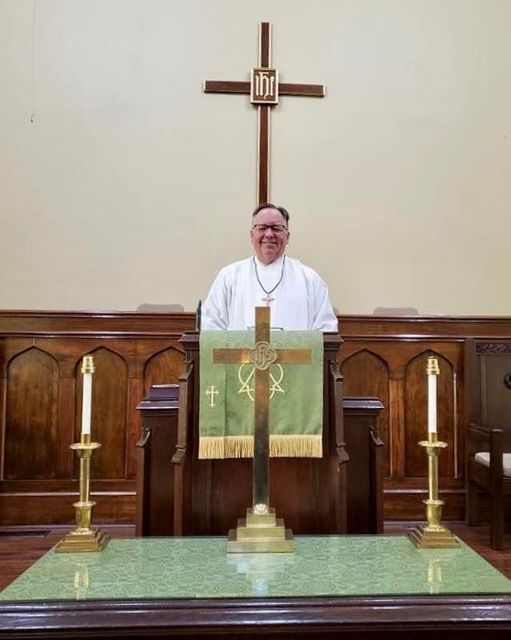
 Eastman First Methodist Church