“Body Building”
I know that a few of you get the daily Wake-Up Call in your email every morning and some others of you follow what I share every day on my Facebook Page. For the past several months we have been following the exploits of the Apostle Paul in the Book of the Acts of the Apostles. For the last couple of months, for my morning Bible study I have been reading and ruminating on Paul’s writings and as of today finished his 2nd letter to the Thessalonians. It’s in this spirit that I decided a couple of months ago to spend the entire month of August on his letter to the Ephesians.
Many of Paul’s letters, though addressed to a specific church or community, were actually what we might call circulars. In other words, they were written to be shared with an entire community or maybe even several communities, such as our letter today.
Traditionally named Ephesians, this letter may not actually have been written to the believers in Ephesus. Some of the best early copies of the letter don’t include the phrase Ephesus in the greeting. While Paul spent two years there, this letter may have been addressed to people Paul had never met.
Paul is cautioning his readers that they are entering a spiritual battle, much the same as we are in the year of our Lord, 2024. They must arm themselves with all the resources God has provided, until the Messiah brings unity to all things in heaven and on earth.
Ephesians 4:1-16
Paul begins our lesson with the word “prisoner.” Not a very inviting title. It was no big deal for Paul because we believe he was in prison in Rome when he wrote this letter. But a prisoner, really?
The Greek word for “prisoner” literally means “one who is bound.” A Christian is someone who is bound to the Lord Jesus Christ so that to truly follow Him means we become a prisoner whether we are in jail or not.
One mark of a prisoner is that he has no will of his or her own. A prisoner goes where they are told to go. A prisoner does what they are told to do. A prisoner eats when they are told to eat—and sleeps when they are told to sleep. They live in a 24-hour state of absolute surrender.
As prisoners of Jesus Christ, we have no will of our own. We are to willingly—gladly—voluntarily do what He wants us to do, go where He wants us to go, and be what He wants us to be. But there is one major difference between being a prisoner of the state and a prisoner of the Lord. If you are a prisoner of the Lord Jesus Christ—you never want to escape for it is only then, only when you are a prisoner that you are truly free.
Together, we are the church this morning. We all come here for different reasons and what we come looking for is probably different as well. One of Paul’s favorite themes is “Unity,” and he uses it in our lesson this morning. “Make every effort to keep the unity of the Spirit through the bond of peace. There is one body and one Spirit, just as you were called to one hope when you were called; one Lord, one faith, one baptism; one God and Father of all, who is over all and in all” (Ephesians 4:3-6 NIV).
To build unity is one of the Holy Spirit’s important roles. He leads, but we have to be willing to be led and to do our part to keep the peace. We do that by focusing on God, not on ourselves.
In the last few days of His life on earth with the disciples Jesus touched on the very same subject: “My prayer is not for them alone. I pray also for those who will believe in me through their message, that all of them may be one, Father, just as you are in me and I am in you. May they also be in us so that the world may believe that you have sent me” (John 17:20-21 NIV).
The young authors that I have found myself drawn to over the last year or so quote Dallas Willard like he is Christ himself. It didn’t take me long when reading my first book Willard wrote why they quote him so often. Dallas Willard was an American philosopher also known for his writings on Christian spiritual formation.
Someone once asked Willard how he would define a “mature Christian” and his reply was this: “I think a mature Christian is someone who is very difficult to offend” (Olympic uproar). He wrote that “The apprentice (his term for a disciple) is able to do, and routinely does, what he or she knows to be right before God because all aspects of his or her person has been substantially transformed.”
For Willard, practical and observable benchmarks that indicate a person is growing into Christ-likeness go as follows.
Mature Christians don’t defend themselves when found to be wrong. “Rebuke the wise and they will love you” (Proverbs 9:8).
Mature Christians don’t feel like they are missing something by not sinning. “Better the little that the righteous have than the wealth of many wicked” (Psalm 37:16).
Mature Christians find is easier and more natural to do God’s will than to not do it. “Take my yoke upon you and learn from me, for I am gentle and humble in heart, and you will find rest for your souls. For my yoke is easy and my burden is light” (Matthew 11:29-30).
In closing, ever since I can remember since I learned to write my mom would make me sit down and write a thank-you note for any kind of gift I received. I can remember that I always trusted the Post Office to deliver my note. Just this week, while complaining to one of our congressman’s office about the Post Office I told them that I no longer trusted or had faith in the Post Office since I have two checks for payments floating around since last month and our IRS refund check that was mailed in April hasn’t been received.
I thought to myself, what would Paul say about this. “One Lord, one faith, one baptism; one God and Father of all, who is over all and through all and in all.” That’s where my trust and faith should be!
Thanks be to God!
Sermon: August 4, 2024
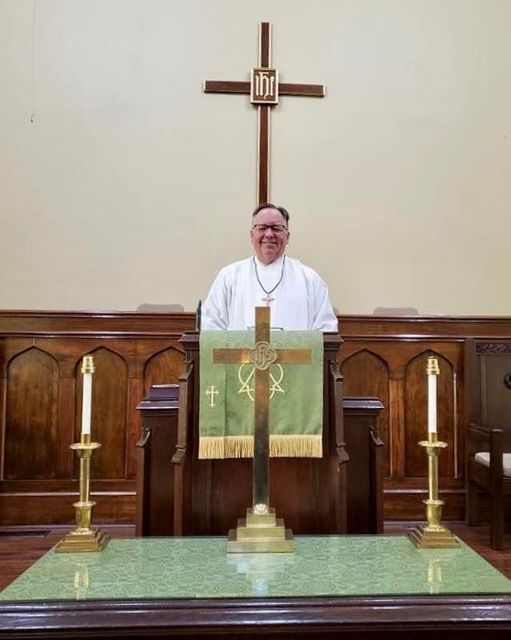
 Eastman First Methodist Church