“Jesus’s Fame Led To John’s Demise”
Mark 6:14-29
Three women die and all reach Heaven at the same time. There they meet St. Peter. He tells them he has some other important business to transact and asks them to wait outside. Finally, he returns and calls the first woman into his office. He apologizes for making her wait so long. “Oh, I don’t mind at all,” the woman says. “I’m so thrilled just to be here in Heaven.” St. Peter is delighted by her attitude. “Well, then, if you can answer just one question for me, we can finish processing your papers. Now tell me, how do you spell God?” The woman spells it for him, then she goes on into the celestial realm. St. Peter calls in the next woman and also apologizes to her for making her wait. “It will be worth it I’m sure,” she answers. “I am willing to wait one thousand years, if necessary, in order to see God face to face.” St. Peter is very pleased. He insists, though, on asking her one more question for the records. “Tell me, dear lady, how do you spell God?” The woman spells it perfectly, then enters the Pearly Gates.
Finally, St. Peter calls in the third woman. He also apologizes to her, but she refuses to accept his apology. “It was quite rude,” she says angrily. “All my life on earth I had to wait in lines. Wait at the checkout counter, wait at the bus stop, wait for the kids to get home from school, wait for my coffee break. And now you expect me to wait to get into Heaven? Well, I just won’t stand for it!” St. Peter said, “I’m so sorry. If you will answer just one more question for our records, then you can go in. Tell me, how do you spell Czechoslovakia?” Life is what we make it to be!
Jesus made it clear throughout the Gospels that to be His disciple, to be a Christian, is tough. In the book you are going to hear a lot about, Invitation To A Journey, A Road Map for Spiritual Formation, author Robert Mulholland Jr. writes, “Once we begin to realize that genuine spiritual growth is a continuous and sometimes difficult process, we may be tempted to think it is an option we can take or leave.”
In all the synoptic Gospels Jesus talks about having to carry our own cross, does this sound easy? When I went on my first international mission trip Rev. Bobby Gale kept telling us to “count the cost.” Reminding us of what we had given up to serve the Lord.
When we attempt to live a life worthy of the Gospel it is because our understanding of “worth” is far different from the world’s. John the Baptist was not beheaded because he went along with the status quo. John gave his life because of his commitment to truth as he understood it, much like Dietrich Bonhoeffer and his struggle with Hitler and his Nazi party. Being a pastor in the German Lutheran Church, Bonhoeffer was forced to choose between his loyalty to God or to an insane ruler. He was executed in 1945 for the opposition he voiced to the satanic rule of Hitler. He actually earlier had the choice of staying here in America where he was a professor at Union Theological Seminary in New York or returning home. He made the difficult choice to return home, join in the fight, and suffer the consequences.
As G.K. Chesterton so concisely wrote: “It is not that Christianity has been tried and found wanting but tried and found difficult.” Life has many roads to travel. However, we choose the road on which the shadow of the cross falls. It always leads to freedom and to victory when the final lap of the race is run. Some 2000 years later, we sit here and speak of the reigns of the Herods and Caesars with pity and disdain, but the names of John the Baptist and Jesus Christ live on as those for whom life was lived with devotion and courage.
Today, Christians face a world of moral compromise. Secular power sets standards that correspond to majority vote, but Christian standards begin and end with God’s Word. To be faithful to God’s Word, we must stand up against what is morally wrong. Responsible Christians must choose their battles.
All of the Gospels begin with John the Baptist—the forerunner of Jesus, the prophetic figure who preaches in the wilderness, preparing the way for the advent of the Messiah. John baptized Jesus and His ministry began. Yet, few people wear WWJBD (What would John the Baptist do?) bracelets. We aren’t too sure that we would want to be quite as odd as John with his strange diet and his strange clothing. Going out in the wilderness to preach doesn’t excite too many preachers who would rather find themselves in a growing—prosperous congregation—and we especially don’t want to follow John the Baptist when it comes to the way he died.
John’s was a powerful voice. From the wilderness he preached strong, fierce sermons proclaiming the coming judgment of God. And now his voice is silenced by a more politically powerful voice. The voice of Herod is more powerful than the voice of John the Baptist. In fact, it wasn’t even the voice of Herod that leads to John’s execution—it was the whim of a woman who had been scorned and her dancing daughter.
After making an oath to this pretty young girl that she could have up to half of his kingdom, she surprised him with the request for the head of John. We read today in our text that Herod was thrown into great distress, he knew it was wrong, but because of his oath and his dinner guests, he didn’t want to refuse her. Do you think it was easy for Herod to do what he did?
Herod, like Pilate with Jesus, wished to protect John but ends up killing him. Mark writes that Herod enjoyed listening to John while we know that Pilate seemed intrigued by Jesus and did everything he could think of to free Him. Herodias in John’s case and the religious authorities in Jesus’ case didn’t have the authority to take a man’s life so they duped those who did (Herod and Pilate). Much like Pilate later, Herod regrets what he has to do but would regret even more violating his oath in front of his subjects.
What did Herod do to get John all stirred up? Well, while married himself he fell in love with his half-brother’s wife and they both divorced so they could get married. Now this is the kind of thing that goes on every day in our culture, but Herod was a man of great ambition, and he wanted the Jews to recognize him as their king. But John was launching a very different kind of kingdom movement, and he told his followers that Herod was out of line—that God’s anointed would never behave in such a way—that the true Messiah would never marry his brother’s wife. I think you’ll agree that it took a lot of guts for this little preacher to stand up and call this adulterous politician to account.
John the Baptist, a man driven be God, called by God, is silenced by Herod Antipas, a man who possesses the power of the sovereign Roman State. So once again, governmental violence has triumphed. The king has silenced the preacher. Once again, a good person has been wiped out by the evil power of the State. You didn’t have to come here this morning to hear a story about that did you? When it comes to power the one with the largest guns or the biggest bomb or the sharpest stick wins.
Herod executed John in order to shut him up, or so he thought. But here we are this morning, still talking about John the Baptist, still talking about his prophetic words, still remembering his courage. We wouldn’t be talking about Herod Antipas except for the fact that he plays a bit part in the drama of our salvation in Jesus Christ. He couldn’t shut up the Gospel just by executing some of its preachers. The word goes on. This story is being told.
The Rolling Stones had a hit recording titled “You Can’t Always Get What You Want.” The chorus to this song goes like this: “No, you can’t always get what you want, but if you try sometime you’ll find you get what you need.” What John did was not easy, what we must do as followers of Jesus Christ is not easy. But we are reminded in several places of Scripture that “Nothing is impossible with God.”
John loses his head but gains the kingdom. Herod saved his face but lost his soul. Within a decade Herod would be banished to faraway Gaul, left to die in disgrace in a distant land. Within a generation, John’s story had been written by Mark, honoring him as a fearless witness to the kingdom of God. What we have here is another triumph in the midst of suffering. John’s martyrdom is not a defeat! Even in so solemn and ugly a story there can be found real encouragement to faithful witness and constant hope. Ironically, even Herod suspected that John would ultimately triumph when he said, “John, whom I beheaded, has been raised from the dead.” Herod seems to have believed in the resurrection from the dead and explains Jesus’ power by seeing Him as the resurrected John.
You see, this morning as I look out over this congregation, I may not see many people that the world would regard as important, powerful people and yet, I see people that still demonstrate the power of the resurrected Jesus, that the story still goes on. Every time you speak up for love in the face of hate—every time you tell the truth about injustice and reach out to try and do something about it—you are showing power—not the governmental power that Herod used—but the power of God in Jesus Christ—the true power! The promise that gathers us together today is that because of who Jesus is and who we are as His followers there is nothing, and no power on earth that will be able to defeat us!
A woman and her grandmother—a very forgiving and religious soul—were sitting on the porch discussing a member of the family. “He’s just no good,” the young woman said. “He’s completely untrustworthy, not to mention lazy.” “Yes, he’s bad,” the grandmother said as she rocked back and forth in her rocker, “but Jesus loves him.” “I’m not so sure about that,” the younger woman persisted. “Oh, yes,” assured the elderly lady. “Jesus loves him.” She rocked and thought for a few more minutes and then added, “Of course, Jesus doesn’t know him like we do.”
Does Jesus know you? Do you know Jesus or just know of Him? Are you taking up your cross daily and following Him? Or have you chosen to be of the world and follow it? John the Baptizer lost his head but gained the kingdom. Jesus lost His life for your soul. What is it that you need to lose to gain your life, which will you choose?
Deo Volente
Thanks be to God!
Sermon: July 14, 2024
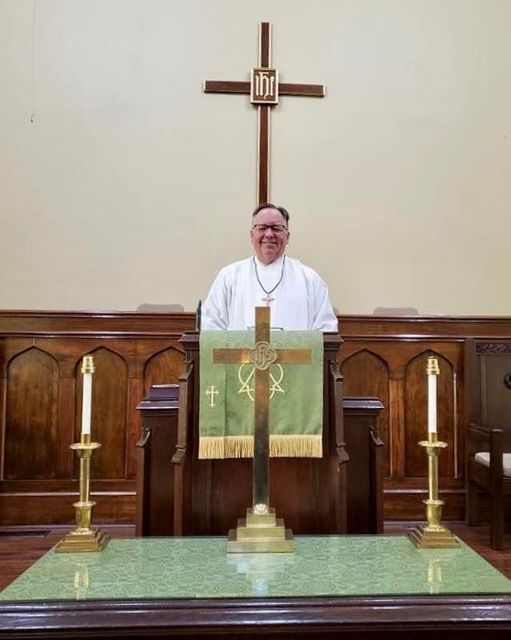
 Eastman First Methodist Church