“They Took Offense At Him”
Mark 6:1-13
Steven was a young man who felt the call of God on his life. He came from a really close family. He finished college and then went off to seminary. After finishing seminary, he came back home before going to his first church. He visited with all of his relatives for about a week. He stopped by the church and talked to his hometown pastor. The pastor asked him if he would like to preach that upcoming Sunday. Steven felt honored and took the pastor up on the invitation. Sunday morning came and after hours, yes, even days of preparation he stepped up behind the pulpit, looked out at the congregation of friends and relatives and started to expound the knowledge that he had learned.
Well, he had hardly begun, when his young niece, Kathleen, about six years old, stepped out into the aisle and put her hands on her hips, her left foot out in front of the other, her head cocked to one side. Then she said in a very loud voice for her age, “Uncle Steven, you don’t know what you are talking about!” I don’t know how Uncle Steven finished that message. But undoubtedly, it was an experience he will never forget.
It’s hard to impress the people at home, isn’t it? The whole world may be singing your praises, but at home, folks see you as the shy kid with two left feet. Or as the wild and crazy guy who was always in trouble.
It seems that Jesus is having a bit of a problem with His re-entry to His hometown of Nazareth. He claims that a prophet is never honored in his hometown.
Mark writes that when the Sabbath came, Jesus, as per usual, went to the synagogue; and while there He began to teach. At first, everything was just flowing. The folks were amazed at His teaching, and they were wondering where He got all of His knowledge. But then things began to turn dark when they remembered who He was, as a child, growing up around them, and the scripture says, “They took offense at him.”
Last weekend I had the great fortune to attend my 50th class reunion. I’ve not attended any of the other reunions but am glad I went to this one. I saw some friends that I have seen periodically over the years but also some I haven’t seen since we walked out of our gym on graduation day in 1974. I was touched by those who shared how proud they are of me for going into the ministry.
I was reminded of the time I preached in front of family and friends in the church where I grew up. It was about fifteen years ago now. I wore my robe so I would at least look like a preacher. I don’t remember the text I used but as I began preaching, I said the word y’all. I could see the smiles, the giggles, the looks shared between them. And then I used the word fixin’, and it was on. I shared that Jesus was from the south and He talked like that. They bought it, I think.
Following the service one of my cousins said she had never laughed that much in church ever. My former high school band director, who was at some of our functions last weekend, said, “Not the Rick Hamilton I knew.” But thankfully, they didn’t take offense at me.
Comedian Rodney Dangerfield made a career out of not getting any respect—from his wife, his kids, from his parents. He said, “I don’t get any respect. My father carries around the picture of the kid who came with his wallet.” It happens in families, in communities, in the workplace, in churches. No respect. And it’s happening to Jesus in His hometown.
This serves as a tipping point for Jesus’ ministry, for He has now been rejected by family, Jewish leaders, and His hometown. This would be the last time we find Him welcomed as a teacher in a synagogue, and their rejection and lack of faith limits His ability to perform mighty acts of power. This should not read that God’s power is restricted by people’s lack of faith. Rather, God’s power will not be poured out where it is unwanted.
Jesus was amazed at His friends and relatives but not in a good way. He was amazed at their lack of faith and Mark writes: “He could not do any miracles there, except lay his hands on a few sick people and heal them. He was amazed at their lack of faith.” How sad for them!
In the second half of our Gospel Lesson Jesus is proposing something new. He’s sending His disciples out to do His work. He’s sending them out in pairs and He’s telling them to take only their walking stick. No cellphones—no laptops—no I-Pads—no Gameboys; not even a change of clothes or extra flip-flops. And they are to rely on the generosity of those who welcome them into their home.
Traveling in pairs was a common custom in ancient times (two are stronger than one) and it went with the Jewish practice of having two witnesses from Deuteronomy 17:6. Jesus turned the world upside down, but He didn’t forget the customs of His people. When I went on my first foreign mission trip we were sent out to the worksite in pairs. Jehovah Witnesses travel in pairs.
Our strength comes from God, but He meets many of our needs through our teamwork with others. As you serve Jesus, don’t try to go it alone. Christianity is not for lone rangers.
They were to stay in only one house in each community, lest they be accused of carrying gossip from one house to another. Paul and Barnabas did this very same thing on their mission journeys.
Jesus reminds us that we have a life to live and a mission to fulfill. He nudges us when we have outgrown our circumstances, our current condition, our past. And gives us courage not to fear the future and the unknown. But Jesus doesn’t stop there. He stays with us—behind us—ahead of us—around us—and He encourages us to take that leap of faith. How does Psalm 23 go? “He renews my strength.” When we get trampled on—when we feel weak, tired, and fearful; He renews our strength. And in the power of the Holy Spirit, He gives us a little push.
Jesus made it clear that all who heard the gospel were responsible for what they did with it. The disciples were not to blame if the message was rejected, as long as they had faithfully and carefully presented it. We are not responsible when others reject Christ’s message of salvation, but we do have the responsibility to share the Good News clearly and faithfully.
Sadly, I’ve had to shake the dust from my feet a few times. It’s not a good feeling to know that you have failed in some way. Failed to comfort—failed to convert; but do we really fail? Though it may feel that way we are still planting seeds. And we must remember that the growth isn’t up to us—that God will take care of that—and that we are never left alone—that He will be with us even until the end of the age.
Deo Volente!
Thanks be to God!
Sermon: July 7, 2024
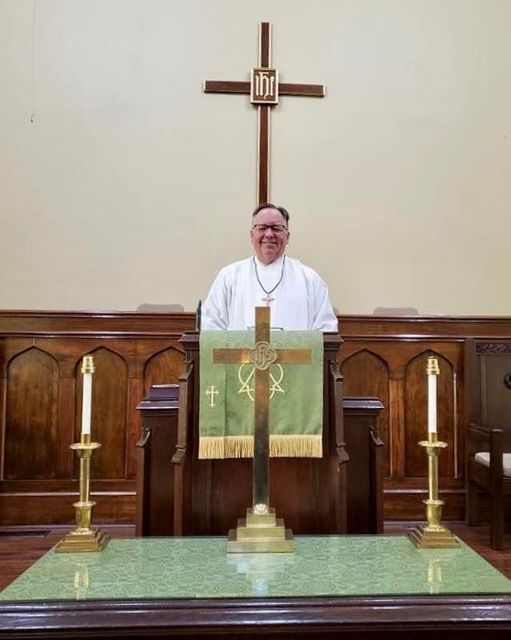
 Eastman First Methodist Church