“Children Of God”
Let’s begin with a short quiz this morning. For you dyed in the wool Methodists, can you tell me what we recognized this past Friday? (Aldersgate Day)
My own Aldersgate experience. (Felt my entire body warmed)
I’ve experienced this feeling more than once in my life, as I’m sure Brother Wesley did as well. I heard at a conference one time, “There is one transformation (Born Again) but many new births.” We could experience a new birth daily, and even multiple times daily.
So, this morning we are celebrating Aldersgate Day today, but we are also celebrating Trinity Sunday. I’ve had several parishioners complain to me over the years that they just don’t understand the Trinity and wonder why we celebrate it.
You can read the entire Bible from cover to cover—from Genesis to Maps as my mentor Larry Bird likes to say; and you will never find the word Trinity. The first mention of the doctrine of the Trinity was in the early 3rd century by the early church father Tertullian. The Trinity, of course, as Tertullian defended it, is the Father, Son and Holy Spirit. (The first time it was seen was at Jesus’ Baptism)
In his book, Until Unity, author Francis Chan speaks of the Trinity. He wrote: “It seems that we were created in such a way that we are capable of attaining oneness with God and each other.”
And from Jesus’ prayer in John 17 that we studied a few weeks ago: “In some real way, I am currently in Jesus, the Spirit is in me, and the Father and Son make their home in me. The prayer of Christ is that His creation would enjoy what they were created for—a perfect unity between Father, Son, Holy Spirit, and all whom Jesus saved. And in the words of Forrest Gump, “That’s all I’m gonna say about that.”
Romans 8:12-17
It’s not long until some of you will be heading out for a summer vacation. I hope you won’t take a vacation from God. Some of you undoubtedly will be camping. You may appreciate the story of a couple who were vacationing in Yosemite National Park.
The wife expressed her concern about going camping because of bears and said she would feel more comfortable in a motel. The husband said he’d like to camp. To calm her fears, he said they’d talk to the park ranger to see what the likelihood was of an encounter with a bear.
The ranger told them, “Well, we haven’t seen any grizzlies in this area so far this year, or black bears, for that matter.”
The wife shrieked, “You mean there’s two types of bears out there?” she asked nervously. “How can you tell the difference? Which one is more dangerous?”
The ranger replied, “Well, that’s easy, see, if the bear chases you up a tree and it comes up after you, it’s a black bear. If it shakes the tree till you fall out, it’s a grizzly.” The motel room was quiet that night.
Some of you can sympathize with that woman’s fear. Fear is one of the most common characteristics of what it means to be human.
At the end of the day, I like to get comfortable and watch YouTube podcasts or sermons. The other night, like God knew exactly where to point me. I came across a sermon by Kyle Idelman, one of my favorite authors who wrote the book Not A Fan. His church is spending the entire year in Paul’s letter to the Roman Church and last Sunday he was here in the 8th Chapter like we are today. I was introduced to a formula or concept that Paul uses in all of his letters, and it blew me away.
I hope I can explain to you as well as he did. Here goes: The Apostle, in all of his writings, liked to inform his readers of their position (who we are), and the condition which comes from that position (how we live). Does that make sense? You can’t have a condition without a position, and you can’t have a position without a condition. Any better? Sort of like understanding the Trinity!
Paul like to use the term, “In Christ.” In fact, he uses it more than 160 times in his letters. That would be our position. Because we are “In Christ” we have forgiveness from our sin, eternal life for all who believe, and as we celebrated last Sunday, we have the Holy Spirit that resides in us.
Here in chapter 8 our position would be “Led by the Spirit.” And because of our position our condition is that we are no longer slaves, we are children of God, and we can put to death all the misdeeds of the body. This is really neat stuff!
Living in accordance with the Spirit means that, while we depend wholly and implicitly on Christ for our salvation, we will struggle to the utmost to obey His Word. Paul is very explicit that the grace of Christ does not release us from the obligation to do everything in our power to live right.
On the other hand, living according to the flesh means giving in to the gratification of the desires of our sinful nature. Some desires are perfectly natural and necessary, such as the desire for food (especially Blue Bell ice cream). Some are wrong. Those that are wrong we must abstain from altogether. The others we may enjoy, but we must always be careful to keep our true affections focused on Christ.
The flesh that Paul refers to is the part of us that wants more than we have—that thinks we deserve more—that wants what we want and when we want it. From the desires of the flesh come our fits of anger, or jealousy. We need to get beyond the desires of our flesh.
Living according to the flesh is doing what we want and thinking the way we want. Living according to the Spirit is doing what God wants us to do and to think about. Our obligation—because of our position—is to the Spirit and not to the flesh.
St. Paul isn’t speaking to the world—but to the church. That tells me that defeating fear is a spiritual priority. Think of how often in the scriptures we read the words, “Fear not.” The call to follow Christ is a call to boldness. It is a call to let our light shine for all the world to see. It is a call to courage. The opposite of faith is not doubt—the opposite of faith is fear. Fear is our enemy—because our fear can distort reality.
Some people live in constant fear that somewhere “out there” is something tragic that is going to happen to them or someone they love. A man was awakened by his wife. She heard a burglar downstairs. He slowly got up, went grumpily downstairs, and found himself staring into a gun. The burglar ordered him to hand over all the household valuables, then started to leave. The husband stopped him. “Before you go,” he said, “I’d like you to come upstairs and meet my wife. She’s been expecting you for over 30 years.”
As followers of Jesus Christ, we aren’t to simply bide our time awaiting the resurrection but are instead to join the Spirit in an assault against sin and fleshy selfishness. With the help of the Spirit, we are to eradicate the sinful habits of the body. Those habits focus upon the selfish gratification of sinful desires. Thus, Paul’s critique of “body” should not be read to broadly as a rejection of all aspects of bodily life. Much to the contrary, his emphasis on the resurrection—not only of Jesus’s body but ultimately the bodies of all people—illustrates his respect and value for bodies. Nevertheless, the “body” at times stands as a theological metaphor for the powers of this world that tempt us, powers we cannot overcome through our own wills. To live rightly, then, we must be led by the Spirit.
In one of my devotions this week I read these words from St. Luke: “And they can no longer die; for they are like angels. They are God’s children, since they are children of the resurrection” (Luke 20:36). As Paul writes to the Romans, because we are “Led by the Spirit” (our position) we are “The children of God” (our condition).
In the Frances Chan book I quoted earlier he writes: “We worship a God who desires unity with His children and between His children. He sent His Son to bring His children together under His care.” As parents, many of us know what it means to be separated from our children. Have you ever tried to imagine how God feels when His children choose to separate from Him?
If I were to say the names: Leonardo da Vinci, Babe Ruth, Edgar Allan Poe, John Lennon, Eleanor Roosevelt, James Baldwin, Steve Jobs, Leo Tolstoy, Lafayette, the Roman emperors Trajan and Hadrian, Aristotle, Confucius, and Nelson Mandela—what would you think they all had in common? (other than being deceased). They were all adopted. St. Paul uses the theme of adoption to close our text this morning.
In Roman culture, an adopted child lost all rights in his or her old family and gained all the rights of a legitimate child in his or her new family. Such a child became a full heir to his or her new father’s estate. Likewise, when a person becomes a Christian, he or she gains all the privileges and responsibilities of a child in God’s family. One of those outstanding privileges is being led by the Spirit. We may not always feel as though we belong to God, but the Holy Spirit becomes our witness. His inward presence reminds us of who we are and encourages us with God’s love.
A Sunday school superintendent had two new boys in her Sunday school. In order to register them she had to ask their ages and birthdays. The bolder of the two said, “We’re both seven. My birthday is April 8, 1976, and my brother’s is April 20, 1976.” “But that’s impossible!” answered the superintendent. “No, it’s not,” answered the quieter brother. “One of us is adopted.” “Which one?” asked the superintendent before she could curb her tongue. The boys looked at each other and smiled, and the bolder one said, “We asked Dad awhile ago, but he just said he loved us both, and he couldn’t remember any more which one was adopted.”
A child who is adopted is not unwanted, but in fact chosen and loved. I believe that society as a whole is coming to this understanding. Families are formed in different ways, and adoption is nothing short of a miracle of grace—for both the parents and the children. Perhaps we could learn something by embracing this truth in our spiritual lives as well.
We are no longer like fearful slaves; instead, we are the Master’s children. What a privilege! Because we are God’s children, we share in great treasures as co-heirs. God has already given us His best gifts; His Son, His Holy Spirit, forgiveness, and eternal life.
Thanks be to God!
Sermon: May 26, 2024
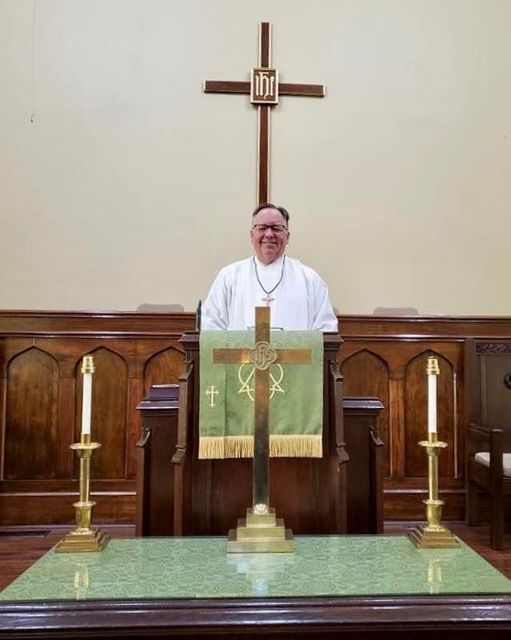
 Eastman First Methodist Church