“Here I Am”
1 Samuel 3:1-10
One summer while Max Lucado was in high school he worked laying pipe in a West Texas oil field. At lunch time the workers in the oil field would tell jokes and play cards. “For thirty minutes in the heat of the day,” Max says, “the oil patch became Las Vegas” complete with foul language, dirty stories, blackjack, and barstools that doubled as lunch pails.”
One day during lunch a supervisor walked toward the workers. They wondered if he had a job for them that just couldn’t wait. “Uh, fellows,” he said. The workers turned and looked up at him. “I, uh, I just wanted to invite…” The workers could tell he was uncomfortable with whatever he was trying to tell them. “I just wanted to tell you that,” he tried again, “our church is having a service tonight and…”
“What?” Max thought to himself in disbelief. “He’s talking church? Out here? With us?”
“I wanted to invite any of you to come along,” the supervisor said. There was a silence among the workers. Several stared at the dirt. Others just looked at each other. No one said anything. “Well, that’s it,” he said, “if any of you want to go…let me know.” After saying that he left. Max and the other workers began to laugh.
Five years later Max was a college sophomore struggling with a decision. Max admits he drifted from faith. He wanted to know Jesus again. But the price was too high. His friends might laugh. That’s when he thought of the supervisor in the oil field. That supervisor’s love for God had been greater than his concern for his reputation and what others might think about him. “So, I came home,” says Max.
Throughout the pages of the Bible, we find a God who loves us and wants the very best for each of us. Sometimes God speaks directly to us. At other times God speaks through other people, like Max’s supervisor. In either case, we need to respond one way or another to the voice of God. My friends, GOD DOES SPEAK!
The purpose of the book of 1st Samuel was to record the life of Samuel, Israel’s last judge; the reign and decline of Saul, Israel’s first king; and the choice and preparation of David, Israel’s greatest king (Not perfect in any way but the greatest).
Samuel was dedicated to God’s service by his mother, Hannah. He became one of Israel’s greatest prophets. He was a man of prayer who finished the work of the Judges, began the school of prophets, and anointed Israel’s first kings.
1 Samuel 1:1-2
1 Samuel 1:7-8
1 Samuel 1:10-17 (Travailing Prayer)
Although God had spoken directly and audibly to Moses and Joshua, His word became rare during the three centuries of rule by the Judges. By Eli’s time, few prophets were speaking God’s messages to Israel. Why? Many at this time chose to ignore God or allowed greed to get in the way of any communication with Him (Imagine that).
What we are told is that the “Word of the Lord” was prized just because it was so rare in those days. At this time the people of Israel seemed to have drifted far from any concern with God’s laws or will. There were few people who were deeply concerned either to listen for his voice or to express his will in society (sounds familiar).
In our O.T. Lesson this morning Eli, the high priest of Shiloh, and Samuel, his young protégé, were asleep in their usual place, the Temple (and it wasn’t Sunday morning). It’s believed that Samuel was sleeping in the same room or chamber where the Ark of the Covenant was kept. The Ark was a box, or a chest which contained the Ten Commandments, Aaron’s budded staff, and a jar of manna—and it was the belief back then that this Ark, or box, represented the very presence of God.
Our Scripture says, “The lamp of God had not yet gone out.” You see, back then, this lamp would have been the one next to the Ark and would have been filled with oil every night, so it stayed lit all night. For us this morning I wonder if we can’t put a little different spin on this. Despite what the world wants us to believe. Despite all the fussing and fighting in and out of the church. “The lamp of God has not gone out yet.” Can I get an “Amen!”
My friends, God is still on the throne! God is still in charge! God is still speaking to us when we can get quiet enough to listen!
Listening and responding is vital in a relationship with God. Although God doesn’t always use the sound of a human voice, He always speaks clearly through the Bible. To receive His messages, we must be ready to listen and to act upon what He tells us. Like young Samuel, our response should be, “Here I am,” when God calls us to action, and quite often, it will be uncomfortable.
God requires a response from us. Do you know what love that isn’t returned is? Lust or infatuation. Love doesn’t exist unless it is returned. A relationship with God doesn’t exist unless we respond to His invitation.
Episcopal Priest Barbara Brown Taylor once said: “Does anyone really want to hear the voice of the living God? I wonder, I wonder, as I said before, which is worse: to hear it or not to hear it—to face fainting at the power of it or to be oblivious to it—eaten up by the thousand little fears that may prevent its ever getting through…Sometimes I think all my worrying about the bills, my health, my family, my life, death, and the universe—all that is what I worry to avoid saying in the middle of the night, “Speak Lord, for your servant is listening.” I am so afraid that I will hear something, or that I won’t. But all the evidence points toward hearing something, at least eventually. It is our faith and our hope that, since the beginning of time when God’s word created heaven and earth, through the word He gave to Abraham and through the Word made flesh in Jesus, God has been speaking to us and speaking to us still. But He has never forced us to hear.”
“Here I am! I stand at the door and knock. If anyone hears my voice and opens the door, I will come in and eat with him, and he with me” (Revelation 3:20). He’s knocking folks—do you hear Him? He’s speaking—do you hear Him? Our prayers every day should begin with, “Speak, for your servant is listening.”
Thanks be to God!
Sermon: June 2, 2024
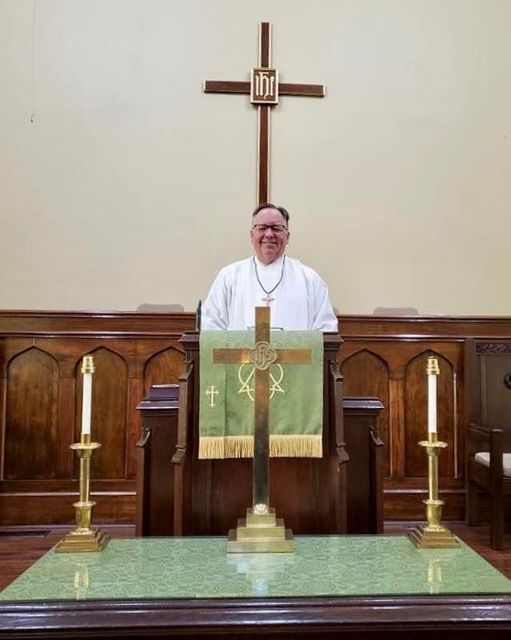
 Eastman First Methodist Church