“Protection From The Evil One” | John 17:6-19
What did God say after he created Adam? “I can do better than that.” And so, He created woman.
The year is 1711 and the man of the house is away. In his absence his wife establishes “reading time” on Sunday afternoons for their children. She selects material carefully from her husband’s library and faithfully reads an “awakening sermon” with drama and flair.
Before long, her Sabbath day gathering includes servants and neighbors—eventually numbering over 200 people. The assembly draws the notice of the local chaplain, and he soon brings up charges against the event saying, “How can an un-ordained, ordinary woman be allowed to proclaim the holy gospel of Christ?” The brave wife and mother stood her ground, insisting she must be allowed to speak because there are so many intent on listening.
Susanna Wesley’s teaching is considered the cornerstone upon which her sons John and Charles Wesley founded what would become the Methodist Church and evangelized their world. John Wesley often credited his mother with building his faith despite the fact that his father was an Anglican Priest, and it was most likely Sunday afternoons which led Wesley to support the appointing of women to the pulpit.
Today, as you know, is Mother’s Day, a day when we honor our moms. It’s also one of those days that can be a bit dicey for a Pastor. How much time do you spend honoring Mothers when the real reason we are here is to honor God? How do you get around the fact that not everyone has the greatest of relationships with their mother? How do you deal with the fact that some folks don’t even know their birth mother—having been given up for adoption and never offered the opportunity to know or meet them? Or how do you get around the fact that there may be some here this morning who have never been a mom—who tried desperately to have children but medically weren’t able to?
But one thing is for sure—we can learn a lot of things from our mother’s or those mother figures we’ve had in our life. I was reminded this week of Paul’s letter to young Timothy where he wrote: “I have been reminded of your sincere faith, which first lived in your grandmother Lois and in your mother Eunice and, I am persuaded, now lives in you also” (2 Timothy 1:5).
My mom taught me religion: She used to say things like, “You better pray that comes out of the carpet.”
My mom taught me medicine: “If you don’t stop crossing your eyes, they’re going to freeze that way.”
My mom taught me how to be a contortionist: “Will you look at the dirt on the back of your neck!”
My mom taught me to appreciate a job well done: “If you’re going to kill each other, do it outside. I just finished cleaning.”
My mom taught me about genetics: “You are just like your father!”
My mom taught me about logic: “Because I said so, that’s why.”
I could go on like this for hours remembering all the things my mom said to me and all those things that I have said to my kids that make me sound like my mom.
I hope that all of you had a mother that you have learned something from. But I also hope you all had a mother who prayed for you every day. I know that many of you here today fit into this category. If you’re like me your mom still prays for you every day.
Actually, we are celebrating two important occasions this morning. On our civil calendar we celebrate Mother’s Day but on our Church calendar we are celebrating something else. Can anyone tell me what significant event happened this past Thursday (40 days after Easter)? Other than the fact that it was the day that came before Friday. This past Thursday was “Ascension of the Lord Day” which we remember and celebrate today.
Now you may be asking, “What’s so important about that and why should we celebrate it?” Well, without it, we wouldn’t have the Holy Spirit living inside of us—or as Jesus put it to the Samaritan Woman at the Well: “Everyone who drinks this water will be thirsty again, but whoever drinks the water I give him will never thirst. Indeed, the water I give him will become in him a spring of water welling up to eternal life” (John 4:13-14). Jesus isn’t speaking of every day drinking water. No, Jesus is speaking of the Holy Spirit that He promised all along to His followers, but this couldn’t happen without His return to the Father—His ascension.
What a powerful image our text this morning offers us—what a hopeful image for those of us who try to be faithful to the gospel—to serve the risen Christ—to be the church in the world. You see what’s going on here, don’t you? Jesus, in His most difficult hour (He’s fixin to be arrested, tried, tortured, and hung on a cross)—when the disciples should have been praying for Him—Jesus is looking toward heaven and praying for them.
This entire chapter is Jesus’ prayer. From it, we learn that the world is a tremendous battleground where the forces of Satan’s power and those under God’s authority are at war. Satan and his forces are motivated by bitter hatred for Jesus Christ and His forces. Jesus prayed for His disciples, including those of us who follow Him today. He prayed that God would keep His chosen believers safe from Satan’s power, setting them apart and making them pure and holy, uniting them through His truth.
There are three reasons for Jesus’ prayer for His disciples that evening: (1) because they are God’s—God’s gifts to Him (I belong to my beloved and His desire is for me). All through the prayer He keeps speaking of His disciples as a gift of God to Him. We speak of Jesus as God’s unspeakable gift to us and here
He is claiming the disciples as His gift from God. Jesus considers us a gift from God as well! (2) Because Jesus is glorified in them; and (3) because they will soon be left without guidance and protection of the Son on His return to the Father.
Jesus is praying for unity, that His disciples be united in harmony and love as the Father, Son, and Holy Spirit are united—in the strongest of all unions.
But, and there always seems to be a but. It’s important for us to remember that though unity is essential, we must never abandon or compromise truth simply to be unified. As we all grow closer to God together, we should find that our perspectives on the truth do the same.
The world hates Christians because Christians’ values differ from theirs. Without God, the world slides into Satan’s agenda, and Satan is the avowed enemy of Jesus and His people.
For they—and us for that matter—not of the world yet were in the world, surrounded by its enmities and influences. And what does Jesus ask for them concerning this? He has no fear for them at all, given the aid and grace of God—He doesn’t propose that they shrink back into a secluded corner of life, refusing to take part in the game. He wants His followers to live in the world! Jesus didn’t ask God to take the believers out of the world but instead asked to use them in the world.
And finally, Jesus is praying that His disciples might be sanctified—that they may be kept out of the clutches of the ruler of this world. Sanctification comes from the truth—which is the Word of God. As Wesleyans we believe that Sanctification is a process. We talk about Sanctifying Grace—how we are saved and yet being saved every day—and the Holy Spirit is the final agent for sanctification.
A follower of Jesus becomes sanctified or set apart by believing and obeying the Word of God. Daily application of God’s Word has a purifying effect on our minds and hearts. Scripture points out sin, motivates us to confess it, renews our relationship with God and guides us back to the right path.
Jesus isn’t promising the church a life free from hardship and suffering. Rather, Jesus demonstrates that although the world might hate us, the presence and power of the Holy Spirit and the church’s intimate relationship with God and with one another, through Jesus, will enable and empower us to persevere in faithfulness. He prays that our lives might each day come to resemble His own. He prays that our hearts might be one—one with Him and one with one another.
Many years ago, when you were traveling to a foreign country and going through customs, it was common to hear a uniformed officer ask you, “Have you anything to declare?” If you said yes, you knew you were in for some questioning! So, many people who actually had some illegal product to declare actually said, “No”, to save themselves the trouble. Some got away with it, and some didn’t.
Today I often wonder if in some way the world is asking this same question of the church: “Have you anything to declare?” In other words, in the face of all the pain in the world, do we have a strong Word from God to declare, a Word that will make a difference and bring hope to people’s lives? Because a church with nothing to declare has no reason to exist, except to be a kind of spiritual country club to its members. A strong church needs a strong message to declare to the world.
Jesus loves His church like a mother loves a child—something positive for us to take with us on this Mother’s Day. And what is it that He most wants for us? To be united but to never abandon the truth. To be sanctified by, or set apart by our faith—by our love for Christ and by our outreach to the world for whom Christ died. By believing and obeying the Word of God. And by being in the world but not of the world!
Thanks be to God!
Sermon: May 12, 2024
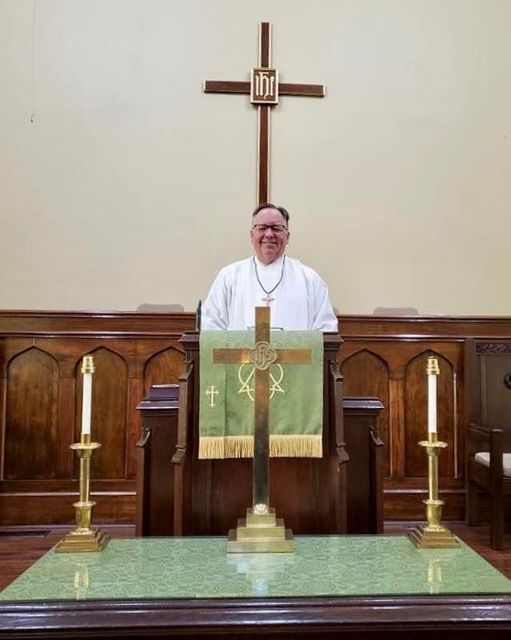
 Eastman First Methodist Church