“Coming Into The Light”
Numbers 21:4-9 (O.T. Lesson) | John 3:14-21 (Gospel Lesson)
A couple of weeks ago I made the statement that if you asked a room full of Christians what their favorite Bible verse is you would get several answers. For sure, I would venture, at least one person or more will answer John 3:16; which is part of our Gospel Lesson this morning: “For God so loved the world that he gave his one and only Son, that whoever believes in him shall not perish but have eternal life.”
While I’ve still got your attention this morning, I’d like to float a theory to you that I was presented with a few years ago by my spiritual coach. John 3:16 can be looked at as the first half of the Gospel. We see John 3:16 everywhere. On billboards, tee shirts, even on signs held up in football stadiums by guys with orange hair.
You know, John 3:16 was never really THE verse until the modern American revival moment—so we can chalk that one up to Billy Graham I suppose.
Maybe you’ve noticed this before or for the first time this morning but the text doesn’t say: “For God so loved you, you religious person, that He gave His Son—that is, had Him crucified in your place—so that if you believe in Him, that is, whoever confesses his sin and agrees that Jesus saves him or her, they won’t perish, but have life eternal.” No, the text says, “God so loved the world.” That would be the cosmos, the whole thing!
This is what God and His Son do for us; and I think we can agree that God and Jesus do all the heavy lifting here. Reminds me of the conversation between a chicken and a pig about the breakfast meal. The pig says to the chicken, “You get off easy. All you do is offer a donation. For me, I make a sacrifice.”
That’s the first half of the Gospel, what the Godhead does for us. The second half of the Gospel is how we are to respond and can be found in 1 John 3:16: “This is how we know what love is: Jesus Christ laid down his life for us. And we ought to lay down our lives for our brothers and sisters.”
I don’t believe that John is telling us that we have to die for our brothers and sisters, but there will be times when we must put our own life on hold to come to their aid. Mike McAfee was a giant in our South Georgia Annual Conference and has gone on to be with the Lord. I thought of Mike as a friend, and he preached a revival for me in Plains and shared the story of he and his family coming home one night to the sight of their parsonage and all their belongings burning to the ground. As they stood there in shock and dismay, Mike felt the hand of someone touch his shoulder. It was the hand of one of his best friends who had heard what was happening and came to their aid; offered his home for them to stay in and helped them get back on their feet. As Mike said, “We all need someone to touch us sometimes.”
So, the first half of the Gospel is what God and Jesus do for us and the benefits of our belief in them. The second half concerns what we are to do with our faith.
We are reminded in our Old Testament Lesson this morning that the Israelites weren’t free from their bondage in Egypt very long before they started complaining, or their faith was waning. Oddly, I guess, was that their complaints were leveled at Moses, who put his life on the line to lead this rag-tag group to freedom.
Reminds me of the young man who entered a very strict monastic order. It was so strict that members were permitted to speak only two words per year to the abbot. At the end of the first year the young man appeared before the abbot and spoke his two words, “Bad food.” At the end of the second year that young man appeared before the abbot and said, “Hard bed.” At the end of year three he came to the abbot and spoke his last two words, “I quit.” The abbot responded, “Well, it’s about time. All you’ve done since you got here is complain.”
In their complaining, the Israelites clearly exaggerate their hardships, saying they have no food while also saying they have “miserable bread.” They longed for the nights sitting around the fire in Egypt enjoying their potted meat (spam) and vegetables. Forgetting, of course, that they were still slaves.
So, God gets upset and sends poisonous snakes, which begin killing people. Humbled, and it didn’t take much to humble these people, they turn to Moses, who prays for them. I’m not so sure that I could have uttered many prayers for these hard to please folks. But God tells Moses to mount a snake on a pole. Kind of a strange answer wouldn’t you agree?
So, Moses makes a snake out of bronze—puts it on a pole—parades it around the camp—and everyone who had been bitten by a snake and looks at it survives.
The bronze snake is a foreshadowing of the Gospel. Just as those who were bitten by the poisonous snakes looked to the bronze snake and were healed, so we, who have been wounded by sin, if we look to Jesus, if we profess our faith in Him, will not only live, but live eternally.
Jesus begins our Gospel Lesson by teaching about the people’s ancestors and their experience with the bronze snake on the pole. This “lifting up” will occur when He is nailed to the cross which makes an announcement at the beginning of Jesus’ ministry that the cross would become His messianic throne.
A thought that crossed my mind this week is that there may be some folks who aren’t really interested in the idea of eternal life because their lives are miserable, and they can’t stand the thought of them continuing. If that makes any sense to you. You know, we’re told that in heaven all we will do is sit around the throne and worship. Sounds boring doesn’t it. That’s what one of the professors at Asbury said in the videos that I recommended to you last week. But after the outpouring her mind was changed. She said, “I’m looking forward to it now.”
In reality, eternal life can be entirely different from the life you are living now. But you will need to ask Jesus for the new life He offers and follow Him in order to receive it. Then you will begin to evaluate all that happens to you from an eternal perspective.
To believe is more than to give intellectual agreement that Jesus is God. It means to put our trust and confidence in Him that He alone can save us. It is to put Jesus in charge of our present plans and eternal destiny. Believing is both trusting His words as reliable and relying on Him for the power to change. If you have never trusted Jesus with your whole life, let this promise of everlasting life be yours.
The problem seems to be that many people don’t want their lives exposed to God’s light because they are afraid of what will be revealed. We are a people of darkness, who love to hide, as Adam and Eve did the first time God sought after them after they had eaten the forbidden fruit. We are afraid of being seen (Like God can’t see us already). Afraid of being authentic. Afraid of being vulnerable. Afraid of the truth and exposing the untruths within us, even if it means we can be healed. We are a people who love the status quo.
Light and darkness are prevalent themes in John’s Gospel. The best definition I ever saw for darkness is an absence of light. Ever try walking around in a motel room or unfamiliar place with the lights off. Stubbed your toe a few times I suppose. Without Jesus, the light of the world in our lives we’ll continually stub our toes.
But those who step into the light, who are unashamed to be seen in all their weakness, illness, sinfulness, incompleteness, will in turn by healed by God—saved by Jesus—restored—made whole.
To follow Jesus is to do the exact opposite of what our humanness might cause us to want to do—to hide ourselves, to keep things the way they are, to avoid any risk. And yet, by avoiding risk, we take the greatest rick of all—we risk our very lives, and condemn ourselves to an eternity of darkness, sin, and ultimate death.
There was a young man who was suffering in the last stages of terminal cancer. It was a dark night of the soul for him. He was filled with anger and bitterness. He had read too many books promising health to believers. He had met too many well-meaning Christians who had promised him a miraculous healing from his disease. As he continued to get sicker and sicker, he grew more and more uncertain.
His parents loved him dearly and took him to one faith healer after another. Each one prayed for his dramatic healing. The young man had prayed and fasted, he sincerely believed in Jesus, but nothing happened. Instead, he was dying. They took him to a Billy Graham crusade which would be the last meeting he would ever attend. At the crusade that night there was a youth emphasis. The speaker was Joni Eareckson Tada. Maybe you know her story. At the age of 17 Joni was paralyzed in a diving accident. She too had prayed for healing. Yet she remained confined to a wheelchair as a quadriplegic. Sitting there in that wheelchair, Joni spoke from her heart, confessing her early anger at remaining crippled after praying and believing a miracle would occur. But a miracle did take place in her life, though not the one she had been praying for. Instead, God met her in her pain and gave her life new meaning and a new direction in spite of her suffering and disappointment.
Joni’s honesty set the young man free. He was able to let go of his bitterness and anger. He stopped seeing himself as one who didn’t have enough faith. Instead, he came to see Christ in a new way. Not long after the crusade the young man died, but his parents were able to rejoice. Why? Because he didn’t die angry and bitter. He simply gave his life back to his loving Father by giving himself completely to Jesus Christ. He was set free from his dark night of the soul and experienced new life.
Look to the cross and you will see love in its purest form. You will see healing and life there. When we look to the cross, we discover a God who loves and cares deeply for each of us; a God who carries each of us near His heart.
Such is the love that God showed the world. Such is the love of our Savior for us. He left heaven, lowered Himself to us, and covered us with the sacrifice of His own body to save us!
In the Gospel—we discover we are far worse off than we thought—and far more loved than we ever dreamed.
Thanks be to God!
Sermon: March 10, 2024
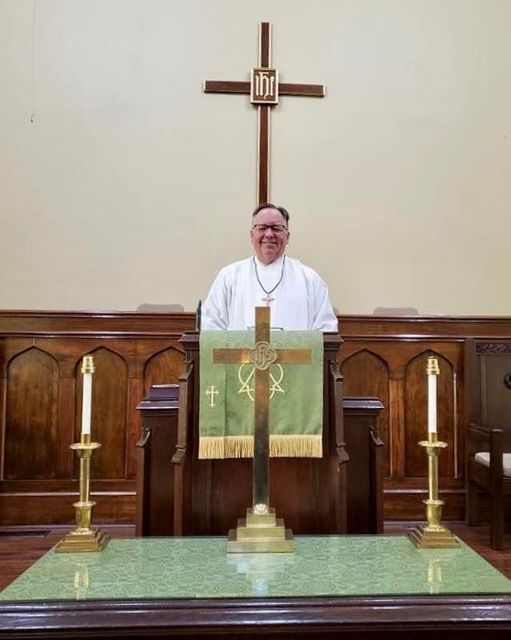
 Eastman First Methodist Church