“Plain Spoken”
Genesis 17:1-7, 15-16 (O.T. Lesson) | Mark 8:31-38 (Gospel Lesson)
According to that great font of wisdom, Yogi Berra, “If you come to a fork in the road, take it.” Mark 8 is a kind of theological fork in the road. This chapter is the hinge of Mark’s gospel. Not only is this the exact middle of Mark in terms of chapters and verses, but it is also theologically the center point at which the ministry of Jesus takes a decisive turn toward the cross. Jesus seems to know what He is doing and also where He is going, or, better said, where He must go whether He wants to go in that direction or not.
The word “began” there in the first verse is significant because it marks a new departure in Jesus’ ministry. From this point on in Mark’s gospel Jesus will be spending less time among the crowds and more time with His disciples—teaching them about their role in the Kingdom—especially after He is gone.
In our Old Testament Lesson this morning God told Abram to, “Walk before me faithfully and be blameless.” God has the same message for us that He had for Abram back then. We are to obey the Lord in every respect because He is God.
God was making a covenant, or contract, between Himself and Abraham. The terms were simple: Abraham would obey God and God would bless Abraham with heirs, property, power and wealth. Most contracts are even trades: we give something and, in turn, receive something of equal value. But when we become a part of God’s covenant family, the blessings we receive far outweigh what we must give up.
God would change Abram’s name (which means “exalted father”) to Abraham (which means “father of many”). From that point on, the Bible calls him Abraham. God would also change Sarai’s name to Sarah, which means “princess.”
Our Transfiguration Sunday text from a couple of Sunday’s ago began with the words, “After six days,” which was pointing us back to the Scripture right before our text this morning when Jesus asked the disciples who people were saying He was and who the disciples said He was. It was Peter who boldly announced, “You are the Messiah.” It doesn’t say so but one would imagine that Peter got an atta-boy for that one from Jesus.
This morning, our Gospel Lesson reports that Jesus was “Plain Spoken” about what was going to happen—how He would die and then rise on the third day. This was the first of three predictions of Jesus’ upcoming Passion. All three Synoptics (Matthew, Mark and Luke) emphasize this phase of Jesus’ ministry.
And poor Peter, who what seems a mere few seconds ago with the right answer sticks his foot in his mouth once more. Mark records that Peter took Jesus aside and rebuked Him. In this moment, Peter was considering not God’s purposes but only his natural desires and feelings. Peter wanted Jesus to be king, but not the Suffering Servant that was prophesied in Isaiah 53. He was ready to receive the glory of following the Messiah, but not the persecution. Remember what I said a couple of weeks ago about the kingdom? In the kingdom, our way up is actually down.
Now, in Peter’s defense, he was often the spokesperson for the disciples so is it possible that this is how they all felt and only Peter was brave enough to speak his mind? Our Scripture does say, “But when Jesus turned and looked at his disciples, he rebuked Peter.” Was Jesus thinking the same thing? Were they all in agreement with what they expected from Jesus concerning His and their future?
I like how Mark records for us what Jesus said next, “Get behind me, Satan.” This “Get behind me” is a Semitic idiom for “go away,” or “get out of my sight.” But, and maybe this is just me thinking, if we want to follow Jesus is it not true that we need to get behind Him?
If I were to ask you your favorite Bible verse, there would be several different answers in a group this large. But I’m sure one that would be mentioned and the Bible verse that is quoted the most is John 3:16: “For God so loved the world that he gave his one and only Son, that whoever believes in Him shall not perish but have eternal life.” Comforting words aren’t they? Familiar words. But this morning I want you to be reminded that you can’t have John 3:16 without also having Mark 8:34—or Matthew 16:24—or Luke 9:23. We can’t follow Jesus without denying ourselves and taking up our cross and those comforting words become uncomfortable!
To deny ourselves involves ceasing to make self the object of our life and actions. It is making ourselves not an end, but a means, in the kingdom of God. It’s to get rid of our preoccupation with “I,” “me,” and “mine,” its concerns for self-assertion, its insistence on comfort and prestige.
Denying ourselves is the same thing as dying to ourselves so we can live for Christ. Dying to ourselves is not a one-time decision—it’s a daily decision. Not when it’s convenient or when we feel like it or it fits our schedule. That’s the most challenging part of dying to self.
Several years ago, during an edition of the ABC network television program, “Good Morning America,” Charles Gibson was interviewing a jewelry designer about a new line of crosses designed by pop star Madonna. We’re probably talking about the mid-90’s. The crosses were called “The Madonna Cross.” The designer said that Madonna had brought a new dimension to the cross. She said, “Never has wearing a cross been more popular than today.”
Gibson challenged that statement by saying he understood the cross to be a Christian symbol. “Not anymore,” his guest responded. “It’s a fashion statement today. No one wears the cross for religious reasons anymore.”
I attended the Dodge County Basketball game the other night and noticed a couple of players with a cross tattooed on their body and I wondered, did it represent the cross for its Christian meaning or was it a fashion statement? What a depressing thought. For many people today—the cross is only decorative.
For Jesus, the cross was a symbol of humiliation = If we are going to follow Him it means humbly taking up a cross and making ourselves nothing.
The cross was a symbol of suffering = Taking up your cross and following Jesus can and will bring pain and suffering. The biblical reality is that when people say yes to following Jesus, they are agreeing to carry a cross, and that will be painful at times.
The cross was a symbol of death = We die to our own desires—our pursuits—and our plans.
Unfortunately, many churches have developed what some call the “prosperity gospel,” where they try and make sure everyone is as comfortable as possible. The prosperity gospel promises health and wealth to all who follow Jesus. Instead of promising you a cross to carry, they promise you a luxury car and a beautiful home.
The sermons in these churches are often about salvation—but never surrender. Often about forgiveness—but never about repentance. Often about living—but never about dying. Dietrich Bonhoeffer, the German Pastor jailed and then executed for being a part of the resistant movement against Adolf Hitler, called this “Cheap Grace.”
The cross for Jesus was His choice of giving His life as a ransom for many. Taking up the cross for the disciple means the deliberate choice of something that could be evaded—to take up a burden which we are under no compulsion to take up—except the compulsion of God’s love in Christ. It means the choice of taking upon ourselves the burdens of others lives—of putting ourselves without reservation at the service of Christ in preparing a way for the kingdom of God—of putting ourselves in the struggle against evil, whatever the cost.
The difference between wearing a cross and bearing a cross is the willingness to give your life for others. Please understand. I’m not against wearing crosses. I’m against wearing them if you have never thought through the sacrifice represented by that cross. In a sense it represents Jesus holding the door open so that we can walk through to life—eternal life.
Jesus seems to be confirming that He is going to lose. And worse than that, He is inviting the disciples and us to come along beside Him.
There were once two brothers who were playing on the sandbanks by a river. One ran after the other up a large mound of sand. Unfortunately, the mound was not solid, and their weight caused them to sink in quickly. When the boys did not return home for dinner, the family and neighbors organized a search. They found the younger brother unconscious, with his head and shoulders sticking above the sand.
When they cleared the sand to his waist, he awakened. The searchers asked, “Where is your brother?”
The child replied, “I’m standing on his shoulders.”
With the sacrifice of his own life, the older brother had lifted the younger to safety. The tangible and sacrificial love of the older brother literally served as a foundation for the younger brother’s life.
“Whoever wants to be my disciple,” said Jesus, “must deny themselves and take up their cross and follow me. For whoever wants to save their life will lose it, but whoever loses their life for me and for the gospel will save it.”
A few years ago, while visiting a church member at Shands Hospital in Gainesville, FL, I was driving on Asher St.—a very busy thoroughfare with three lanes going in both directions—with buses—and college students (Gator fans) on scooters—and lots of other folks in a hurry to get somewhere. And if you don’t pay attention to where you are going you might end up in the wrong lane and then headed in the wrong direction. But out of the corner of my eye I spotted a sign for a business that read: UBREAKITIFIXIT. I thought, wow, that will preach. And I hung on to it till I could stop my car and write it down.
Jesus could be saying that to you right now. You break it and I fix it! Your life is broken—you seem to be in a rut—you’re on a dead-end road to nowhere—you have no hope—but Jesus denied Himself and gave His life so that your life can be fixed—that’s how much He loves you!
Deny yourself—take up your cross—and follow Him. UBREAKITIFIXIT
Thanks be to God!
Sermon: February 25, 2024
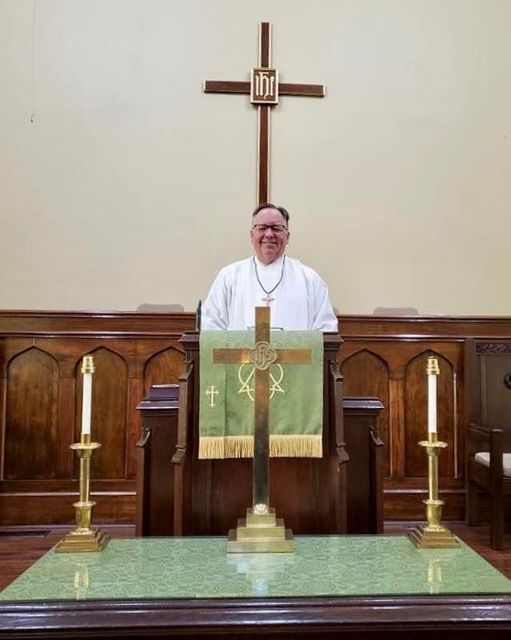
 Eastman First Methodist Church