“Believing Without Seeing”
Acts 4: 32-35 (First Reading) | John 20: 19-31 (Gospel Lesson)
A Minneapolis couple decided to go to Florida to thaw out during a particularly icy winter. They planned to stay at the same hotel where they spent their honeymoon 20 years before.
Because of their hectic schedules, it was difficult to coordinate their travel schedules. So, the husband left Minneapolis and flew to Florida on Friday and his wife was to fly down the following day.
The husband checked into the hotel, and unlike years ago, there was a computer in his room, so he decided to send an e-mail to his wife. However, he accidentally left out one letter in her e-mail address, and without noticing his error, sent the e-mail to the wrong address.
Meanwhile…somewhere in Houston…a widow had just returned home from her husband’s funeral. He was a Minister who was called home to glory after suffering a heart attack. The widow decided to check her e-mail, expecting messages from relatives and friends. After reading the first message, she screamed and fainted. The widow’s son rushed into the room, found his mother on the floor, and then glanced up and saw the computer screen which read:
To My Loving Wife,
“I know you are surprised to hear from me. They have computers here now and you are allowed to send e-mails to your loved ones. I have just arrived and have checked in. I see that everything has been prepared for your arrival tomorrow and look forward to seeing you then. Hope your journey is as uneventful as mine was.
PS: It sure is hot down here!”
Not what this poor widow expected is it? I would venture to say that what happens in our Gospel Lesson this morning wasn’t what the disciples expected, still huddled in the Upper Room for what John describes as, “For fear of the Jewish leaders,” where they were with Jesus for the Last Supper.
A couple of times since last Thursday in my journal I pondered on the question: What were the disciples doing from Thursday night after Jesus was arrested until Sunday morning when they received the unexpected news from the women that Jesus wasn’t in the tomb? Were they sharing the stories and memories of their time spent with Jesus? Were they trying to recall His teachings? Were they comforting each other? Were they accusing each other? Or were they just hiding in fear?
On my Facebook page this past Wednesday a post came up on my memory page from April 3, 2020. It was a picture of our mailbox in Lakeland which Connie had put a nice bow on and a sign that read, “Thank you! Stay safe! Praying for you and your family!” Any guesses as to why the bow and note? If you said Covid you are correct. We were in the middle of the Covid lockdown.
Doors were shut, businesses closed, and communities became ghost towns. People became shadows of themselves, as they hid away from a virus that could kill them and their loved ones and friends. The world drew in and shuttered itself from danger. And lethargy set in. Professionals are calling it covid burnout: low-grade stress—depression—lack of focus—lack of energy—faulty memory—lack of enthusiasm and purpose. People were less engaged, felt less successful, and felt fried. Many lost inspiration and motivation. Productivity and creativity were down—weight was up. Some became glued to a computer screen or television for days on end. Some lost their sense of engagement and excitement for the future. Others became downright disillusioned and disoriented.
Maybe this I what the disciples were dealing with those days holed up in the Upper Room after the crucifixion. Thousands felt their hope had been dashed and destroyed. Others felt disillusioned and betrayed by someone they put their trust in. He had promised change. Now everything felt just the same. Jesus’ inner circle was hit the hardest.
From now until Pentecost (Season of Easter is 50 days – Eastertide) one of our readings every Sunday will be from the Acts of the Apostles. Our reading this morning is Post-Pentecost. The Holy Spirit, the gift that Jesus had promised and was His final teaching to the disciples has come. Jesus said that the Holy Spirit would be better than His bodily presence with us.
The early church was able to share possessions and property as a result of the unity brought by the Holy Spirit working in us and through the believers’ lives. The spiritual unity and generosity of those early believers attracted others to them.
None of those Christians felt that what they had was their own, so they were able to give and share, eliminating poverty among them. How do you feel about your possessions? Do you possess them, or do they possess you? We should adopt the attitude that everything we have comes from God, and we are only stewarding what is already His.
And we meet a man named Joseph who was called Barnabus (son of encouragement). We all need a Barnabus in our life! He was the first to befriend Paul after his conversion and we might be without a major portion of the New Testament without the two of them. He was drawn to people he could encourage. He encouraged Christians and non-Christians flocked to become believers because of him. Who is your Barnabus?
It goes without saying that Jesus was a much better man than me. Holy Week was a grind for me—four different messages to prepare and deliver. Holy Week is a grind for all Pastors. But Holy Week was no picnic for Jesus either. My Easter afternoon plans centered around a nice lunch and hopefully an even nicer nap. The lunch thing came through. I wasn’t so lucky with the nap.
In our Gospel text, which is Pre-Pentecost, we read: “On the evening of the first day of the week (Easter Sunday), Jesus came and stood among them (the disciples) and said, ‘Peace be with you!” Jesus went right to work that Easter Sunday; He wasn’t hoping for a fine meal and a nap. But in my defense, He was a lot younger than me, and He had taken a dirt nap for three days.
Jesus showed them the scars on His hand and side and then the disciples were overjoyed that they saw the Lord.
In His final teaching, Jesus said, “But the Advocate, the Holy Spirit, whom the Father will send in my name, will teach you all things and remind you of everything I have said to you. Peace I leave you; my peace I give you. I do not give to you as the world gives. Do not let your hearts be troubled and do not be afraid” (John 14:26-27).
On that Easter afternoon not only does Jesus offer His followers His peace, He offers His shalom, a Hebrew word meaning peace but can also be used to mean hello.
And He breathed on them! The breath of God has life. The first Adam was created but didn’t come alive until God breathed into him the breath of life (Genesis 2:7). God’s first breath made humans different from all other forms of creation. Now, the second Adam, Jesus Himself is breathing “new life” into His frightened disciples!
And then He gives them a special filling of the Holy Spirit, a foretaste of what all who believe will experience at the time of Pentecost (Acts 2) and forever after. To do God’s work we need the intimacy, love, direction, and enabling power of the Holy Spirit. We can’t do it on our own strength.
Parakletos, translated “Helper”, is a Greek word Jesus used in reference to the Holy Spirit. Parakletos, translated most literally, means “one called alongside to help.” Today in the Mediterranean, this word can still be used in reference to a rescue boat that finds a vessel lost in desperation and leads frantic passengers back to safe harbor. The Holy Spirit is the one called alongside to help, who comes and finds me when I’m lost, alone, in desperation, and draws me back to the heart of the Father.
My friends, we need a fresh outpouring of the Holy Spirit on our hearts—homes—churches—and community! This isn’t something you’ve not heard from me already. We need this outpouring so we can be planting seeds for a Great Awakening! We need to get seeds in the ground! So we can fulfill our Spirit-powered and Spirit-guided mission—to preach the Good News to a world that has never needed it more!
In closing, I saw a story by Leslie Flynn who told of a small boy being raised in a frontier city by his grandmother. One night their house caught on fire. The grandmother, trying to rescue the boy who was asleep in the bedroom upstairs, was overcome by the smoke and died in the fire. This frontier city didn’t have much of a fire department. A crowd gathered around the house, and they heard a small boy crying for help. The lower floor was a wall of flames, and no one seemed to know what to do. Suddenly, a man pushed through the crowd and began climbing an iron drainage pipe which ran to the roof. The pipe was hot from the fire, but he made it to a second-floor window. The man crawled through the window and located the boy. With the crowd cheering encouragement, the man came back down the hot iron pipe with the boy on his back and his arms around his neck.
A few weeks later, a public meeting was held to determine whose custody the boy would be placed. Each person wanting the child would be allowed to make a brief statement. The first man said, “I have a farm and would give the boy a good home. He would grow up on the farm and learn a trade.”
The second person to speak was the local school teacher. She said, “I am a school teacher and I would see to it that he received a good education.”
Finally, the banker said, “Mrs. Morton and I would be able to give the boy a fine home and a fine education. We would like him to come and live with us.”
The presiding officer looked around and asked if anyone else would like to say something.
From the back row, a man rose and said, “These other people may be able to offer some things I can’t. All I can offer is my love.” Then, he slowly removed his hands from his coat pockets. A gasp went up from the crowd because his hands were scared terribly from climbing up and down the hot pipe. The boy recognized the man as the one who had saved him and ran into his waiting arms.
Jesus showed Thomas his scars and his response was, “My Lord and my God.” And Jesus told him that day and He’s telling us today, “Blessed are those who have not seen and yet have believed.”
Thanks be to God!
Sermon: April 7, 2024
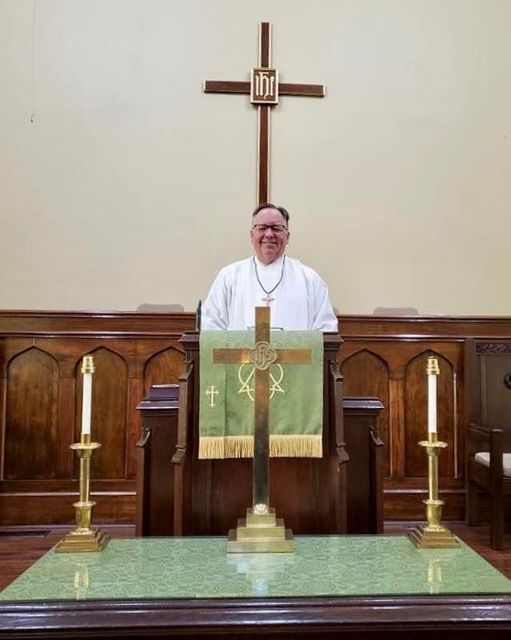
 Eastman First Methodist Church