“Here’s Your Sign”
1 Peter 3:18-22 (Epistle Reading) | Genesis 9:8-17
I can’t say for sure but would imagine that sis weeks ago when I was picking out my scripture and sermon title for today, I may have been thinking about Bill Engvall and his comedy bit that he also calls, “Here’s Your Sign.”
Maybe you’ve seen or heard it. About the time he had a U-Haul truck in his driveway and his neighbor asked, “Are y’all moving?” Bill answered, “Nope, we like to move everything out of our house every six months.” Or, when the family was going skiing, and they had the skis on one of those carriers on top of the car. They stopped for gas and the guy at the next month asked. “Going skiing?” Bill said, “Nope, we put the skis up there in case the car flips over and we can just keep sliding down the highway.” Or when he and his wife went to Europe for vacation and purchased a very nice painting. They didn’t want it damaged, so they didn’t check it on the plane, so he was carrying it when they went through customs. The customs officer asked, “Did you and your wife purchase that painting outside the country?” Bill said, “Nope, I painted it while I was waiting in line.” Here’s your sign!
The story of Noah and the Ark—the great Flood—and the animals taken two by two is probably one of the most famous stories from the scriptures because it’s a story that many can recall even if they are nominal Christians—especially children who’ve attended a Vacation Bible School sometime in their young life.
There’s a more modern story of Noah and the Ark on the internet. The Lord speaks to Noah and says, “Noah, in six months I’m going to make it rain until the whole world is covered with water. But I want to save a few good people and two of every living thing on the planet. So, I’m ordering you to build an Ark.”
“Ok,” Noah said, trembling with fear. “I’m your man.” Six months passed, the sky began to cloud up, and the rain began to fall. The Lord looked down and saw Noah sitting in his yard. There was no Ark. “Noah!” shouted the Lord, “where is My Ark?”
“Lord, please forgive me!” begged Noah. “I did my best, but there were some big problems. First, I had to get a building permit. My neighbors objected, claiming that I was violating zoning ordinances by building the Ark in my front yard. I spent months trying to get a variance from the city planning board. After all that, I had a big problem getting enough wood for the Ark, because of the endangered species act.
“Then the carpenters union started picketing my home because I wasn’t using union carpenters. Next, I started gathering up the animals but got sued by the animals rights group. Just when the suit got dismissed, the EPA notified me that I couldn’t complete the Ark without filing an environmental impact statement for your proposed flood. Then the Corps of Engineers wanted a map of the area to be flooded. I sent them a globe and they went ballistic! Lord, I’m sorry, but I don’t think there’s any way I can finish the Ark in less than five years if ever.”
With that, the sky cleared, the sun began to shine, and a rainbow arched across the sky. Noah looked up and smiled. “You mean you aren’t going to destroy the world?” he asked hopefully. “Wrong!” thundered the Lord. “But I’m going to do it with something far worse than a mere flood. Something far more destructive. Something that man himself created.”
“What’s that? Noah asked. “Government!” said the Lord.
Noah was the great grandson (times seven) of Adam. He was somewhere between the ages of five hundred and six hundred when told by God to build the Ark. The Bible says he was five hundred when he began to have sons and six hundred when the flood actually came. Depending on your source it is believed that it took Noah between 100 and 120 years to construct God’s Ark.
The reason for the flood and the need of an Ark was the fact that even though He created man and everything else and originally saw that it was good he had become sick of how corrupt the world had become and He called upon Noah to build an ark. Genesis 6:9 says: “Noah was a righteous man, blameless among the people of his time, and he walked with God.”
The ark that he was told to construct was a little longer than a football field (end zones included) and half as wide. The inside equaled the storage space of about 370 railroad boxcars. The ark’s dimensions were: 150 yards long—25 yards wide—15 yards high. And Genesis 6:22 tells us: “Noah did everything just as God had commanded him.”
What has always stood out to me about this story is how detailed God was in instructing Noah exactly what to do—from the measurements of the ark and the loading of the animals. And add to that the fact that God instructed Noah to take both the clean and the unclean animals with him. Why, if they were considered unclean, was Noah supposed to take them with him? This shows me the grace of God!
Something else that always stands out to me in the whole story of Noah was that he was supposed to be the best God could find at that time—doesn’t say much for humanity—because if you keep reading in Genesis 9 you see that after the flood Noah became a farmer, planted a vineyard, built himself a liquor store and became the first human on record to get drunk—though there must have been others before him!
Noah lived another 350 years after the Flood, making him 950 years-old when he died—humanity’s number three for longevity, after his grandfather, Methuselah, and his great-great-grandfather, Jared (962).
As painful as it is for a parent to discipline a child, so too, in the flood, we see judgment come from God; but that judgment comes with a broken heart. In the end, we see God’s commitment to creation. God makes a one-way covenant with Noah, his descendants, and every living creature to never again use His power to destroy. God’s power—from this point on—will always be used to create and build up—not to tear down.
We might think that evil has been eliminated from the earth, but as we continue to read in Genesis, humans continue to sin and we see that evil is still at work in creation—and still is today. Humorist Will Rogers once said, “God made man a little lower than the angels. Man has been getting lower ever since.” Mark Twain once said, “Man is the creature made at the end of the week’s work when God was tired. This, said Twain, explains everything.”
Do you ever wonder why people do some of the crazy things they do? People are amazing! Ask Dr. Tucker Montgomery. Dr. Montgomery spent fifteen years as an Emergency Room doctor at the University of Tennessee Hospital in Knoxville, TN. Dr. Montgomery has seen a multitude of injuries that resulted from simple stupidity. He tells the story of one man who was brought in to the ER with serious injuries to his face and teeth. Dr. Montgomery was appalled to learn how the man had injured himself.
While drunk, this man had been driving around his neighborhood lighting firecrackers off his cigarette and then throwing the firecrackers out the window. He was having a grand old time until he accidentally threw his cigarette out the window and stuck the firecracker in his mouth. Ooh, that must have been painful!
Whether from our flawed nature or from pure stupidity, we as a species—even the best of us—can certainly disappoint our Creator. The story of Noah and the flood is the culmination of that disappointment.
But thankfully, what has changed is God’s resolve to be committed to creation. The promise of God will never be revoked, and the rainbow is a sign that God will never again use such a weapon to destroy creation.
The first covenant mentioned in the Scriptures was that established between God and Noah and his descendants. It was promised before the flood (Genesis 6:18) and now initiated after the flood.
What is a covenant? It is an agreement between man and man—an oath-bound promise where one party pledges to bless or serve another party in some specified way. The covenant concept is a central and unifying theme of Scripture—establishing and defining God’s relationship to man in all ages.
In the Old Testament, the Hebrew word translated “covenant” is berit. The term probably derives from the verb bara, “to bind.” The noun berit originally denoted a binding relationship between two parties in which each pledged to perform some service for the other.
In this particular covenant, God promised that never again would the earth and all flesh be destroyed by a flood—He graciously granted a sign to remind man of God’s promise—His bow in the cloud. This bow, the rainbow, would remind Him of His promise and secure the safety of all the earth.
We don’t know for sure if there was ever a rainbow before the flood or if this was the first time anyone had actually seen one.
Ever try to follow a rainbow from one end to the other? The “end” always moves, shifting onward—westward—eastward—or somewhere. No one can find the end of a rainbow and whatever is supposed to be there.
As you come closer and closer to what looks like is going to be the end point, that shiny summit keeps shifting. Light, reflections, the curvature of the earth, keep transmitting that “end” perpetually forward. The global nature of our world, the roundness of the earth, keeps the end point from ever becoming a final “end point.”
On the other end of the flood, we can expect certain things from God. We can expect a Creator that is ever committed to the creation. We can expect a God who uses His power to create and not to destroy. We can expect a God who judges with a painful and broken heart. We can expect a God who is not cold or unfeeling, but who goes beyond all measures to try to save humankind, even when we don’t deserve it. We can expect God to never break covenant. We can expect a God whose heart is deeply moved by our worship. We can expect a God who remembers and honors faithfulness. We can expect a God who is not preoccupied with God’s self, but rather who selflessly gives Himself to His covenant partner—us. The fascinating thing to me is that we see a God who is not coercive, but rather one who bids creation to live up to the “good” it was created to be. The choice is left up to us…to follow God’s will or not.
God remembered Noah and he remembers us as well—the story of the flood went from judgment to redemption. There comes a time when we all really need to see a rainbow—and when we do see a rainbow—or something like it (the light at the end of the tunnel), we can, like Noah, take up life again.
Noah didn’t make the rainbow—God put it there. So, our ground for hope is always in God—and the man who will most certainly have hope in God for the future is the man who has been conscious of God in the past. That was true of Noah. He might not have seen the rainbow or trusted what it meant unless he had learned through obedience that God was carrying him on.
My Honduras rainbow story
It took forty days and nights of rain to wipe away the sin of the world. We are in the middle of a forty-day season called Lent. If it’s raining in your life—look to the sky—look for the rainbow—and know that your hope is in God!
Thanks be to God!
Sermon: February 18, 2024
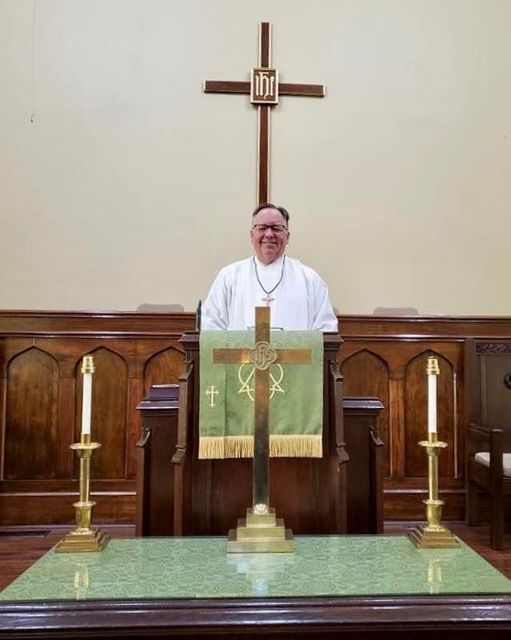
 Eastman First Methodist Church