“Teaching With Authority”
Deuteronomy 18:15-20 (O.T. Lesson)
Mark 1:21-28 (Gospel Lesson)
Have you heard the story about the bride who was extremely nervous on her wedding day? She confided to her minister that she wasn’t sure she could make it all the way down the aisle without shaking or crying. So the minister, a seasoned veteran of weddings, gave her a bit of advice.
“When you begin your walk,” he said, “just remember this three-point formula: First, look straight ahead down the aisle; second, when you get about half-way, look straight up at the altar; and third, when you get near the front, look straight at your groom. First the aisle, then the altar, then him. I think that will help your nervousness.”
The trembling bride agree to his advice. And it worked beautifully. She walked with a radiant glow on her face and poise and confidence in her step, with no sign of nervousness. However, there was one small problem. Imagine the surprise of the congregation as they heard her rhythmically repeating three words over and over and she performed her bridal walk, “Aisle, altar, him! Aisle, altar, him!”
The truth is, most brides don’t have a lot of luck in altering their husbands. But the good news of the Christian faith is that God can alter us!
Our Old Testament lesson this morning begs the question, “Who is this prophet?” The text expresses a promise of a great prophet to come—not a prediction of Jesus but most certainly a promise Jesus lived into thoroughly.
Stephen used this verse to support his claim that Jesus Christ is God’s Son, the Messiah: “This is the Moses who told the Israelites, ‘God will raise up for you a prophet like me from your own people’” (Acts 7:37 NIV). The coming of Jesus Christ to earth was not an afterthought but part of God’s original plan.
In our Gospel Lesson Jesus and His four new running mates: Andrew, Peter, James and John have come to Capernaum, which most scholars agree would serve as His ministry base in Galilee for what would be a period that covered about a year and a half. Capernaum was an important city on the busy highway leading from Egypt and the south to Damascus and the north. It was a fitting location for Jesus to be able to make contact with the multitudes.
When the Sabbath came Jesus, as was His custom, went to the synagogue but on this occasion, he wasn’t there simply to attend a service, He was there to preach and teach. Beginning in the days of Ezra, around 450 BC, a group of ten men could start a synagogue. There, during the week, Jewish boys were taught the Old Testament law and Jewish religion. Each Saturday, the Sabbath, the Jewish men would gather to listen to a rabbi teach from the scriptures. Because most synagogues didn’t have a permanent rabbi or teacher, it was customary for the synagogue leader to ask visiting teachers to speak. This is why Jesus often taught in the synagogues in the towns He visited.
If you go to the Holy Land today part of your tour will probably include the city of Capernaum. The first thing you will see is a sign on the outside of the city gate that reads: “Capernaum, City of Jesus.” In the city there is a church where it is believed Peter’s house once stood and directly across the street is a synagogue, believed to be the one where our story takes place today.
The Jewish Sabbath starts on Friday evening at sundown and lasts until sundown on Saturday evening. Today, if you want to attend a Jewish Temple service you would go on Friday evening as the sun is setting. But in the first century it looks as if the Sabbath service was an all-day event (sunrise to sunset).
Jesus didn’t teach like the rabbis—scribes—or the teachers of the law. They would have taught the Torah, the rabbinical law of the Old Testament, or the do’s and don’ts of their religion. Jesus, on the contrary, as a lay teacher of religion, not educated in the scribal manner but inspired by the divine Spirit spoke with immediate and personal authority. Jesus’ authority was not derived from tradition—His authority was unique. Jesus was unique—Jesus was real—He WAS authority (E.F. Hutton). What Jesus taught was something new, while the rabbis would say things like, “Moses said this or that,” Jesus was saying, “I say unto you.” The people were amazed at His teaching.
Are we amazed at Jesus’ teaching? Has it become so familiar—have we taken it so much for granted that we no longer see it in amazement? Maybe the reason we don’t amaze the world as Christians is that we aren’t sufficiently amazed ourselves.
Most people are going to believe what they have always believed regardless of the facts. But something different is happening here in the life of Jesus. The crowds were amazed at His authority. He taught, not as the scribes taught, but as one having authority—but the question remains: will they believe? Do we believe?
So, as we see in our story for this morning Jesus backed up what He taught with action. As He was teaching a man possessed with an evil spirit cried out, “What do you want with us, Jesus of Nazareth? Have you come to destroy us? I know who you are—the Holy One of God!” You would think it would be smart or prudent for the demons to keep a low profile; but they seem to have a “fatal attraction” to Jesus.
This man didn’t burst in off the street screaming and disrupting the service. Mark tells us that this was a man within their synagogue. It’s possible that he was someone who was there for worship every Sabbath—possibly a respected lay person and a productive member of society.
The demon knows Jesus’ identity. This knowledge, which most of the demons in Mark seem to have can either be interpreted as an attempt by the demons to fight Jesus, since knowledge of someone’s identity was often thought to give power over them, or as evidence of the cosmic world’s full recognition of Jesus’ authority—an authority which in the human world is continually challenged.
Considering all of this I was thinking this week about the Wise Men and their visit to Jesus. They followed that star in the sky, and we don’t know how many miles they hiked to find Jesus and then they go to Herod to inquire, and he asks the religious folks where to find Jesus, and they have to quote scripture because they’ve not been there themselves. These Gentiles, outsiders, have come all this way while the religious experts hadn’t bothered to go the eight miles or so to Bethlehem to see God in the flesh.
The demons recognized Jesus – do we recognize Jesus?
“What have you to do with us Jesus? Mind your own business—our business is our own—get back to Palestine—get back to the Bible—get back to the church—get back anywhere, so long as you don’t interfere with our life.” When we say we have the right to our own life what we are saying is “What have you to do with me Jesus of Nazareth?”
Jesus has to do with everything that affects people. Nothing human is foreign to Him. He is concerned with every burden that rests heavily on human shoulders and cuts cruelly into them—all that concerns the welfare of God’s children.
This is the first of many times that Jesus tries to silence those with knowledge of His true identity. Why He does so is much debated and is sometimes referred to as the “Messianic Secret.” Jesus didn’t want folks following Him for the wrong reasons: He wasn’t simply a miracle worker—He wasn’t a seeker of fame—and He was banning any public proclamation of His messiahship lest there should be a political revolution against Rome.
The world into which Jesus came was “a demon-haunted world” and His first healing or miracle recorded by Mark is this exorcism of a demon—something these people had never seen before. Some people dismiss all accounts of demon possession as a primitive way of describing mental illness. Although throughout history mental illness has often been wrongly diagnosed as demon possession, clearly a hostile outside force controlled the man described in our lesson this morning.
Even today, there are folks still forced to deal with their own demons. We are haunted by fear, which often times is the fear of something that will never happen. We are also haunted by worry—anxiety—insecurity—inordinate self-concern—and all the ills these can bring.
Fear is a terrible thing. For some it’s the fear of being attacked. For others it can be the fear of being rejected or being laughed at. Some people are haunted by the fear that somehow, they don’t belong—that they don’t measure up. Do you have that feeling from time to time that something’s wrong with you—that you don’t somehow measure up—that you don’t belong? That’s a demon that holds many good people back.
And I’ve had some personal experience with another demon that can possess us and that’s depression. I never really understood it until I had to deal with it myself. I feared the nights and sleep because sleep brought with it terrible nightmares. I feared the day because the day brought me into contact with other people. I feared the medicine my doctors prescribed for me because it made me into a zombie: I had no emotion—no feeling—I was numb. And nobody knows or understands what’s going on inside of you—the war that is taking place inside. Reading the Bible was a lost cause and prayer, well, prayer was a struggle plain and simple. But the entire time I struggled with my depression I felt a keen sense of Jesus closer than I had ever felt Him before, especially the night that I considered suicide.
Jesus cares y’all! Jesus restored the soul and renewed a right spirit in the man in the synagogue that day and He can still renew a right spirit yet today. He can still speak in the power of God to minds burdened—distressed—or sick. Jesus still cares!
Do you have an impure spirit or demon troubling you? Do you feel unnoticed or unloved? If there is one impure spirit that the gospel of Jesus Christ should dispel it is this one. In Jesus’ world you are noticed, and you are loved. Only Christ can cast out an impure spirit. He can do that by filing us so full of the love of God that there is no room for any other spirit to torture us. Are you afraid—angry—feeling unnoticed or unloved? Open your heart to God and let God create a new heart and a right spirit within you. “Turn your eyes upon Jesus, look full in His wonderful face, and the things of earth will grow strangely dim in the light of His glory and grace.”
Thanks be to God!
Sermon: January 28, 2024
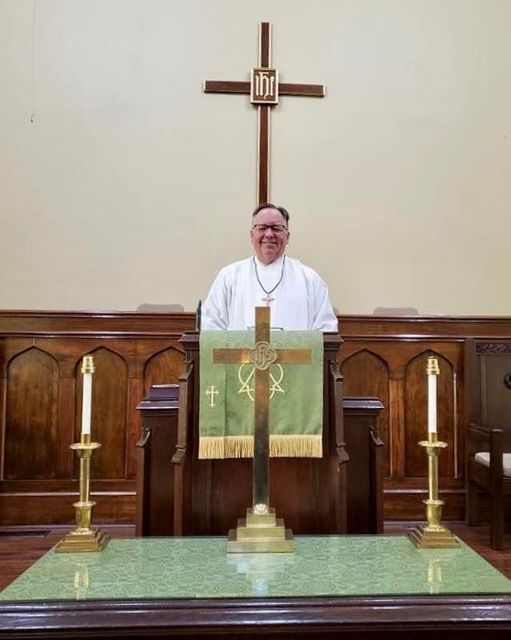
 Eastman First Methodist Church