“Time To Get-Er-Done”
Jonah 3:1-5, 10 (O.T. Lesson)
Mark 1:14-20 (Gospel Lesson)
I read once about an older lady sitting on an airplane holding her Bible in her lap. A strapping young man sitting beside her asked, “Do you believe everything you read in there?”
“Yes, I do” was the lady’s response. The young man asked if she believed that Jonah was really swallowed by a whale to which she said, “Yes, I do.” Then the young man asked how she will be able to know for sure.” She responded, “I’ll ask him when I get to heaven.”
“What if he isn’t there?” asked the young man. To which she responded, “Then you can ask him!”
Intriguing Scriptures for our lessons this morning. Jonah, swallowed by a great fish, and Jesus, calling His first four disciples, fishermen by trade, telling them that He will teach them to fish for people.
After Jonah is spewed out of the whale, the Word of the Lord comes to him once more. As before, God tells him, “Go to the great city of Nineveh and proclaim to it the message I give you” Jonah gets up and goes, but this time, rather than heading for the sea, he indeed goes to Nineveh.
In announcing judgment on the city, Jonah does not detail specific accusations as most prophets would have done. Rather, he simply declares that Nineveh will be overthrown.
Much to Jonah’s surprise the citizens of Nineveh, including the king himself, believe in God immediately upon hearing his words. They declare a fast and put-on sackcloth which was used then for times of mourning. The pagan people of Nineveh believed Jonah’s message and repented—even the animals were involved.
Chapter 3 of Jonah ends with a clear description of God’s response to the residents of Nineveh. When God sees their acts of repentance, God stops planning to destroy them, or, more precisely, God “relents” or “changes his mind.” God’s relenting from threatened punishment is a consistent response to repentance throughout the Old Testament.
To be honest, Jonah went to Ninevah with his own agenda in mind. He didn’t like those folks and he looked forward to God wiping them out. But this little parable once again reminds us that God is God and we are not. It was God’s agenda which was carried out and not that of Jonah.
God forgave Nineveh just as He had forgiven Jonah. The purpose of God’s judgment is correction, not revenge. He will always show compassion to anyone willing to seek Him.
Jonah had run away from God but had been given a second chance. Maybe you feel disqualified from serving God because of past mistakes. Serving God is not an earned position—none of us are qualified for God’s service. But God still asks us to carry out His work and you may yet get another opportunity. Maybe you’ve heard, when God closes a window, He opens up a door.
Following the end of John’s short lived prophetic ministry, the One who is stronger succeeds him. Mark writes, “After John was put in prison.” This was Jesus’ que that it was time to go to work, time to “Get-Er-Done.” John had been doing the bulk of the work to this point but now things would change.
Jesus summarizes His ministry, announcing the new rule of God, in both temporal: “The time has come.” And locative: “The Kingdom of God has come near.” And His next statement, “Repent and believe the Good News” will connect the reader to the prophets of the Old Testament, calling Israel back to God. That word, “repent,” is not a favorite for Mark, used only twice in his Gospel.
Many of the people who would have heard or read this message, even people today, have been oppressed, poor, struggling to make ends meet, and without hope. Jesus’ “Good News” offers freedom, spiritual blessings, and more importantly, the promise of eternal life in a perfect world where justice and peace prevail.
It could have been up to a year between the time of Jesus’ baptism and the beginning of His Galilean ministry which occupies about one-half of Mark’s Gospel. I’ve probably said this before but just because only a sentence or paragraph of the Bible separate events that doesn’t mean you can think of it as chronological.
The words of Jesus and His personality seem to have a magnetic effect. “Come, follow me, and I will send you out to fish for people,” was enough for the first four listeners to become followers.
Kyle Idelman, in his book Don’t Give Up writes: “The disciples had to walk away with Jesus, then and there. And everything about life as they knew it had to change. Fishing nets, a tax collector’s booth, family and friends—these were the things they knew. They had to give themselves completely to a whole new world that Jesus set out for them.”
Although it took time for Jesus’ call and His message to get through, the important thing is that the disciples did follow Him. In the same way, we may question and falter, but we must never stop following Jesus.
We are representatives of the kingdom of God. No matter what world events or political realities or economic pressures we face, we are called to be ambassadors of hope. And not just to share the good news of the kingdom of God, but to put the values and priorities of the kingdom of God into action here and now.
According to the United Nation’s World Happiness Report the country that has held down the #1 ranking for a few years has been Finland. And guess what they did? Their leaders took advantage of this prestigious title by creating an ambassador program of sorts to share the secrets of happiness with the rest of the world. That’s what you do when you’re on to something good.
The program, called “Rent-A-Finn,” encourages people to visit Finland under the guidance of a local Finnish tour guide. Included in the tour is training on the culture and food and health practices that contribute the most to the happiness of Finnish citizens. In 2020, in response to the coronavirus pandemic, the “Rent-A-Finn” program moved online, with live-streamed classes on the art of happiness from Finnish experts.
So, the Finns may be recognized as the happiest people on earth—but Jesus followers are—hands down—the most hopeful people on earth. We are the recipients of abundant life—in this world and the world to come. And Jesus wanted to make sure that as many people shared in that hope as possible. That’s why He called those disciples to follow Him. That’s why He called them to be fishers of men. Spread the hope! Spread the joy! Sow the seeds! We can’t keep the Good News of God’s love to ourselves. (Come and See)
On the shores of the Sea of Galilee, Jesus was building a team. Where you are right now, Jesus still wants to build a team. A team of hope—a team of joy—a team of love! Isn’t that a team you would want to belong to?
J. Ellsworth Kalas in his book, From Empty Nets to Full Lives writes: “Perhaps our greatest problem in becoming Christ’s fishermen is that we are not enough in earnest to grasp the opportunities that come to us; or we are so possessed of the idea that we must say something dramatic and far reaching that we fail to say the small, immediate and potentially significant thing.”
To put it in the language of our lesson for today, most of us really don’t act as if we even have a call to “fish.” We’re out in the waters of human need every day, but we don’t seem to know it or don’t seem to care.
There was once a man who was not well educated, and his manner was somewhat rough and crude, but he became a Christian and took his commitment seriously. He kept pestering his pastor to put him to work. Finally, the minister handed him a list of ten names with this explanation: “These are all members of this church, but they seldom attend. Some of them are prominent people in the community. Contact them about being more faithful. Here is some church stationery to write letters. Get them back in church.”
The man accepted the challenge with rugged determination and enthusiasm. About three weeks later a letter from a prominent physician whose name had been on the list arrived at the church office. Inside was a large check and a brief note: “Dear Pastor, Enclosed is my check for $1000 to help make up for my missing church so much but be assured that I will be present this Sunday and each Sunday after that. I will not by choice miss services again. Sincerely…P.S. Would you please tell your secretary that there is only one ‘T’ in dirty and no ‘C’ in Skunk.”
Jesus called the disciples to fish for people with the same energy they had used to fish for food. How can God use you to fish for people’s souls? How can you train new believers to find new seas and cast new nets where waters have never been fished before? The gospel makes missionaries of all God’s people. Where are you casting your net?
Amanda Gorman is the first person to be named National Youth Poet Laureate of the United States. In her poem titled The Hill We Climb, she wrote, “There is always light, if only we’re brave enough to see it. If only we are brave enough to be it.” Where are you casting your nets?
I’d like to share a true story which can be a parable of the Kingdom; it’s about a young woman named Eleanor Sass. When Eleanor was a child, she was hospitalized for an appendicitis. Her roommate was a young girl named Mollie, who was injured when a car hit the bicycle she was riding. Mollie’s legs had been badly broken, and, though the doctors performed several surgeries, Mollie faced a strong possibility that she would never walk again. Quite Naturally, Mollie became depressed. Her depression caused her to become uncooperative, and she cried a great deal. She only seemed to perk up when the morning mail arrived. Most of her gifts were books, games, and stuffed animals, all appropriate gifts for a bedridden child.
Then one day a different sort of gift came, this one from an aunt far away. When Mollie tore open the package, she found a pair of shiny, black, patent-leather shoes. The nurses in the room mumbled something about “people who don’t use their heads.” But Mollie didn’t seem to hear them. She was too busy putting her hands in the shoes and “walking” them up and down her blanket. From that day her attitude changed. She began cooperating with the nursing staff and soon she was in therapy. One day Eleanor heard that her friend had left the hospital and the best news of all, she had walked out, wearing her shiny shoes.
What happened to Mollie that allowed her to walk out of the hospital toward a new life? Those shiny new shoes gave her hope. They became a source of strength and a change of attitude that affected her emotionally and even physically. Repenting of our sins and believing the Good News of God can have the same therapeutic effect on our lives. We can experience God’s Kingdom for our lives here and now.
Jesus said, “The kingdom of God has come near. Repent and believe the good news!” He said it to Peter, Andrew, James and John by the Sea of Galilee. He’s saying it to us here this morning as well. He saw the potential of the disciples—and He sees our potential!
And something I’ll leave with you this morning—something I read in one of my morning devotionals this week: “Life with God is an adventure.” Jonah learned it and so did the disciples.
Thanks be to God!
Sermon: January 21, 2024
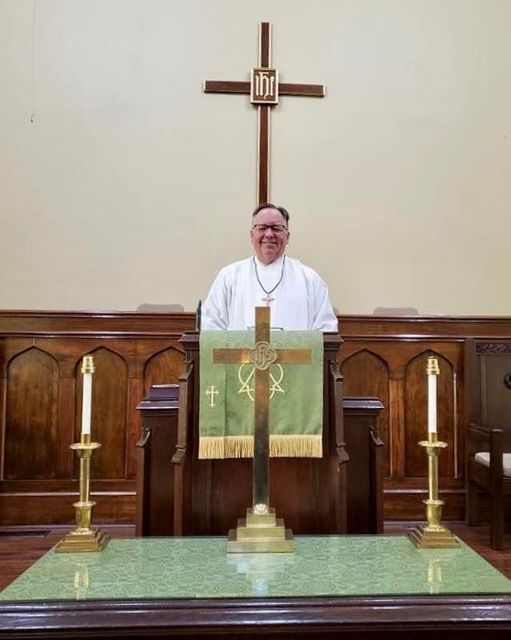
 Eastman First Methodist Church