“Why He Came”
Isaiah 40:21-31 (O.T. Lesson)
Mark 1:29-39 (Gospel Lesson)
The words from the Prophet in our Old Testament Lesson come from what the Bible scholars refer to as Isaiah 2. They consider chapters 1-39 as Isaiah 1; chapters 40-55 as Isaiah 2; and chapters 55-65 as Isaiah 3. In our text this morning Isaiah is prophesying to the people of Israel who are in exile.
They have suffered much and probably think God had forgotten them. Interestingly, they had chosen to ignore and forget God which has brought them to this position (Happening today!). These words from Isaiah are meant to give them some hope.
To the weary, the prophet proclaims that God does not faint or grow weary as we do and have. “Do you not know? Have you not heard?”
Even youths get weary—they even faint. But to those who wait on the Lord shall renew their strength. Not those who sprint ahead or take things into their own hands.
When you feel life crushing you and you cannot go another step, remember that you can call upon God to renew your strength.
Mark 1:29-39
Three middle-aged men—Joe, Fred, and Tom were discussing the possibility of sudden death.
“What would you do if you only had four weeks of life remaining?” Joe asked. “First of all,” Fred said, “I would quit my job and for those four weeks I would do nothing but fish.”
“Not me,” Tom said somberly. “For those four weeks, I would spend as much time as possible with my children and let them know how much I love them.”
Joe thought for a few minutes and then said, “I’ll tell you what I would do. For those four weeks, I would travel throughout the United States with my wife and my mother-in-law in a tiny compact car and stay in a cheap motel every night.”
Fred and Tom were puzzled by his answer. “Why would you do that?” they asked. “Because” Joe smiled sarcastically, “It would be the longest four weeks of my life.”
Jesus and His disciples have left the synagogue where we found them last week and have walked across the street to Peter and Andrew’s house. When they arrive, they discover that Peter’s mother-in-law is in bed with a raging fever. When they tell Jesus He goes to her—takes her by the hand—helps her up—and the fever is gone, and she gets up to wait on them.
Though there are later stories of rabbis taking the hand of another man and healing him, there are no such stories of rabbis doing so for a woman, and especially not for a woman who was not a member of the healer’s family. In addition, there is the fact that Jesus performed this act on the Sabbath. Thus, while touching a non-related woman was in itself an offense, and touching one that was sick and therefor unclean was doubly so, performing this act on the Sabbath only compounds the social offense.
The Pharisees and teachers of the law must have been going insane. Jesus was taking everything they believed in—everything they had followed—every rule and law they obeyed—and turning them upside down. But the people were loving it, they were showing up with all of their sick friends and relatives, after sundown of course, they weren’t quite ready to break the laws and traditions themselves.
But early the next morning, Jesus slipped off to be alone with His Father, which, according to the Scriptures He did often.
We are busy—we are rushed—we are distracted by many gadgets and things. Jesus, Lord of all creation and Savior of the world, needed, wanted, had to have time alone with God the Father.
In the latest book I read, Be Still, author Brian Heasly writes, “A quiet time is simply a daily time set aside to specifically tune in to God through prayer, Bible reading, and reflection. It’s a time when I not only speak to God but also ask God to speak to me.”
Brian does that every day, with a cup of coffee, his journal, his Bible, and his books, he sits in a chair in his living room. That’s how he spends the first hour of most mornings. He says that the reason he goes to his chair is his desire for regular encounters with God.
My chair (picture on the screen) Cup of coffee, Bible, Upper Room, journal, iPad, and my prayer beads.
Do you need to redesign your schedule to find time for earnest prayer? It is vitally important to (1) seek the Lord before your busy schedule takes over your thoughts; (2) withdraw from the noise and demands so you can focus on God; (3) take up Jesus’ attitude of regular communion with the Father; (4) reflect on the priorities Jesus had for His life; and (5) determine to pray on a more regular basis, not just in times of crisis. If prayer was important for Jesus, then it must be important for His followers. Pray—even if you have to get up early in the morning to do it.
“Everyone is looking for you” is what the disciples said. It was truer than they knew. And it is still true today. He is the answer to every man’s, every woman’s, every young and every old person’s deepest need. He gives us direction and purpose for our lives. We never need to fear what lies ahead for He goes with us when invited. He never takes us anywhere He has not already been Himself. He is the prisoner of our faith. And the destination is sure and abundant life with the Father.
Why did He come? Our text says, “Let us go somewhere else—to the nearby villages—so I can preach there also. That is why I have come.” I think Jesus sells Himself short here. Yes, He came to preach and teach—to heal—to restore our relationship with God the Father. But maybe the most important thing He came to teach us is the importance of our alone time with God. The time we spend getting quiet before him and saying, “Speak Lord, your servant is listening!”
Thanks be to God!
Sermon: February 4, 2024
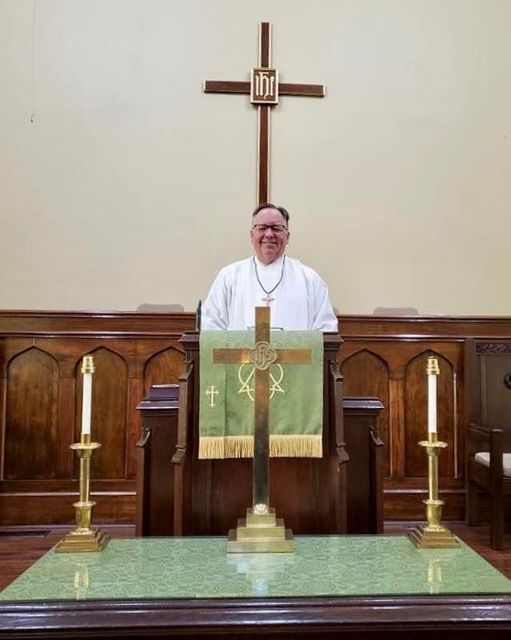
 Eastman First Methodist Church