“The Next Day…”
1 Samuel 3:1-10 (O.T. Lesson)
John 1:43-51 (Gospel Lesson)
Both of our texts this morning have something to do with a call—help to understand that call—and answering the call.
You know, before I became a true student of the Bible and answered my own call to the ministry, I used to think that people who said, “The Lord said” were either crazy or just looking for attention. Maybe you’ve had the same thoughts.
As we begin this new year, I guess our question could be, “How can we hear from God in 2024?” Well, there are several ways, beginning with daily prayers. That’s our current theme on the Daily Wake-Up Call that I share on mine and the church’s Facebook Page every morning. We are trying to answer the question, “What is prayer?”
Another way is the time that we spend in the Scriptures. I’ve shared with you over the past few weeks that I am spending 2024 in the Gospels and rather than reading several chapters of text every day I read about five or six verses and then I journal on what those verses say to me. I’ve chosen to go slower and deeper versus farther and faster.
The third way would be hanging around with other spiritual people—our mentors—small groups—Sunday school classes—discipleship bands and the like. Through these folks we can encounter God, if only indirectly.
In our Old Testament lesson Israel was in a mess. God seemed to be very distant from them. Although He had spoken directly and audibly with Moses and Joshua, His Word was rare in the three centuries we think of as the Judges period. By Eli’s time, few prophets were speaking God’s messages to Israel. Eli wasn’t getting any younger—and his sons, his heirs, well, they were useless.
In his prime, Eli was probably the prototypical priest, but he wasn’t a good parent. He had been warned about his sons, but he chose to ignore the warnings.
It also seems that he chose to be more concerned with the symbols of his religion than with the God they represented. Things like the Arc. It had become a relic to be protected rather than a reminder of the Protector. His faith had shifted from the Creator to the created.
Barbara Brown Taylor, in her book When God Is Silent says that our prayers should be less, “Lord, hear our prayers,” and more, “Speak Lord, for your servant is listening.” As I’ve shared with you, I try to spend quiet time before the Lord every morning. I set a timer on my phone, and I get quiet, and I say, “Speak Lord, your servant is listening.” Some days this is easy to do. Some days I’m barely quiet for a minute and I’m thinking about my day ahead or what I need to pick up at the store. But I’m getting better at it.
But Samuel shares good news this morning—for his particular situation—for Israel’s future—and for us as well: “The lamp of God had not gone out yet.” No matter how desperate the situation you find yourself in, God isn’t done—He’s still active—He still cares—He’s still in charge.
Listening and responding is vital in our relationship with God. Although God doesn’t always use the sound of a human voice; He always speaks clearly through the Bible. To receive His messages, we need to be ready to listen—to get quiet before Him—and to act upon what He tells us.
John 1:43-51
Jesus and Moses went golfing one day. Jesus was about to hit a shot and said, “Hey Moses, watch this! Just like Arnold Palmer!” Moses said, “Jesus, you can do anything but don’t try to be like Arnold Palmer.” Jesus said, “No, watch this—just like Arnold Palmer.”
Jesus hit the ball in the water, so He asked Moses to get His ball. Moses parted the water and got the ball. This continued for about fifteen minutes. Finally, Jesus hit His ball into the water for the seventh time. “Please get my ball for me,” Jesus asked Moses. Moses said, “No, I told you to quit trying to be like Arnold Palmer so I’m not getting it this time.”
Jesus walked across the water, reached down, and got his ball. While He was doing this, a couple rode by in a cart and asked, “Who does He think He is, Jesus?” Moses said, “No! He thinks He’s Arnold Palmer!”
All of us can’t be like Arnold Palmer, but all of us can be like Jesus! In fact, we have been called to be like Jesus—to love like Jesus—to make a difference like Jesus—to change the world like Jesus. The Bible says we have been empowered to be like Jesus.
Mark starts our Gospel Lesson this morning with the words, “The next day.” Maybe you’re thinking, the next day after what? Well to answer that question, once again, we need to read backward in the Scriptures. John 1:29 says, “The next day John saw Jesus coming toward him and said, ‘Look, the Lamb of God, who takes away the sin of the world.’”
That next day was the day after Jesus was baptized, which we recognized and celebrated last Sunday. The next day in our text this morning is the day after that, two days after Jesus’ baptism.
John the Baptist and these new disciples used several names for Jesus: Lamb of God, Rabbi, Messiah, Son of God, and King of Israel. As they got to know Jesus, their appreciation for Him grew. The more time we spend getting to know Jesus, the more we will understand and appreciate who He is.
The Synoptic Gospels (Matthew-Mark-Luke) all share that after His baptism Jesus was led by the Spirit into the wilderness for a time of tempting but John writes that when He returned, He was ready to get started with His ministry, but He is going to need help—He’s going to need followers. We know that He would eventually call twelve (12 tribes of Israel, 12 gates into Jerusalem) to be a part of His inner circle but this would just be the beginning because according to the scriptures there would also be seventy others who would comprise an outer circle. Jesus has called us to be His followers—He wants us to help others answer their call to be followers as well.
In our lesson today, Jesus found Philip, then Philip found Nathaniel (aka Bartholomew). One of the ways God finds people in through God’s people.
Jesus doesn’t seem interested in solo spirituality. John Wesley famously said that the Christian faith is not meant to be done alone. We find ourselves in Jesus’ community, together. We need one another. We need friends. These men called this morning could have been friends prior to their meeting Jesus. We know they were all from the same place, Bethsaida.
Archaeologists can’t agree where Bethsaida actually was. It was a real place with real people, like our cast of characters for this morning. It might be here—or there—or anywhere else. It might even be right here where we are this morning.
Larry Bird (not the basketball player), Ed McMinn, Randy Mosely, Dr. Billy Key, Jay Braswell, Frankie Faircloth, Milton Sutherland, and Paul Williams. Not household names for any of you here but all had an important part in my call to the ministry. They all helped me during my discernment period. They helped me to understand it—to get over the fear of it—and they encouraged me to answer—much the same as Eli did for young Samuel in our O.T. Lesson—reminding us that sometimes we need help along the way and sometimes we need a gentle nudge, like the future disciples we find in John’s gospel this morning.
The call of Philip and Nathanael introduces the name of two disciples who are more prominent here in this Gospel than anywhere else. It shows us once again that Jesus uses the ordinary—the infamous. And John seems to recognize the unimportance of being important. God doesn’t call the equipped—He calls the ordinary and equips them!
We know that not everyone accepts our invitation to follow Christ or even to come to church. Look at Nathanael’s initial response to Philip, “Can anything good come from Nazareth?” Nothing important ever happened in Nazareth—no one important had come from Nazareth. It was a hick town—a one-horse town on the other side of the tracks. But look at Philip’s response. “Come and see.”
Our calling is always to “come and see.” We don’t ponder anybody from a distance. We go to others, to those not really expecting us. And we find Jesus, and ourselves there.
You all believe that God can redeem a soul. I know you believe that. So, from this moment on might we all live a little on the edge like Philip. Might we all go out and ask someone to come and see. Invite them to worship with you—invite them to Sunday school—invite them to one of our Lenten activities coming up.
Wouldn’t it be a wonderful thing if each one, at least once a month, invited another human being to “Come and See?” Wouldn’t it be wonderful if “Come and See” became a natural part of our life and our relationships?
Jesus promised Nathaniel that he would see greater things—that he would see heaven open and the angels of God ascending and descending on the Son of Man. And the three years they were together that’s exactly what he saw.
In closing, Fred Everybody—Thomas Somebody—Peter Anybody—and Joe Nobody were neighbors, but not the type that most would want to know. They were odd people, troublesome, and difficult to understand. The way they lived their lives was a shame. These men were all members of the same church, but most wouldn’t want them as parishioners. Everybody went fishing on Sundays or stayed home and spoke with his friends. Anybody wanted to worship, but he was afraid that Somebody would speak to him. Thus, guess who went to church—that’s right, Nobody. Actually, Nobody was the only decent one in the lot. Nobody helped with church business, and Nobody joined the Church Council.
One day there was a notice in the bulletin about the need for a teacher in the Sunday school program. Everybody thought Anybody would apply—Anybody thought Somebody would apply. Guess who applied? Right again—Nobody.
My friends, let’s not be an everybody, somebody, or anybody. Rather, let us strive to be a nobody. In such a way we empty ourselves so we can be filled with the amazing power of Christ, who died to set us free and, thus, will always be our brother, friend, and Lord.
Or in the words and wisdom of Uncle Si of Duck Dynasty fame: “Do not ask God to guide your footsteps if you’re not willing to move your feet.”
Thanks be to God!
Sermon: January 14, 2024
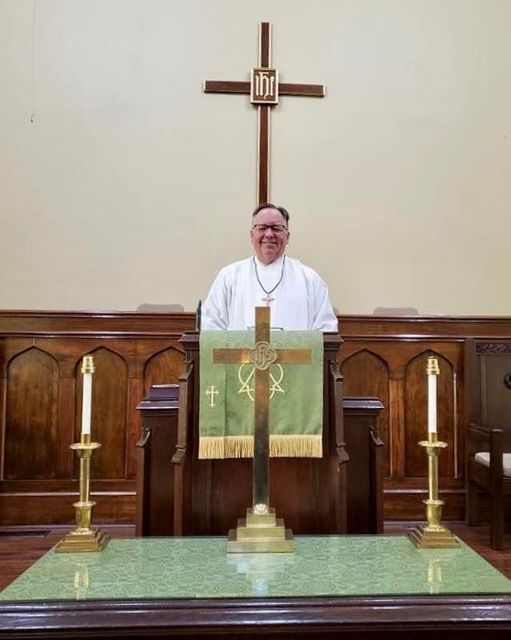
 Eastman First Methodist Church