“The Lord Is With You…”
There was once a story reported in the Canadian version of the Reader’s Digest about a large moose who wandered into a residential area in Calgary, Canada. The moose ended up on the lawn of a lady named Lorna Cade. A Fish and Wildlife Officer was dispatched to try and coax the rather large animal back into the wild. After two hours with no progress the officer shot the moose with a tranquilizer dart. The moose bolted down a lane and eventually collapsed on another lawn.
The reporters who had been following the event interviewed the lady at the house where the moose collapsed. They asked what she thought about the moose which had passed out on her lawn. “I’m surprised,” she answered, “but not as surprised as my husband will be. He’s out moose hunting.”
While this lady’s husband had gone out hunting a moose a large one had come looking for him—that’s the message of Christmas—while we spend our time seeking after God, God comes to us in the form of a baby. Christmas is a God-thing—not something we can purchase in a store or on Amazon!
Luke 1:26-38
When a pastor asked a class of boys and girls, “Why was Jesus born in Bethlehem?” a boy in the class raised his hand and replied, “Because his mother was there.” Probably not the answer the pastor was seeking but a good answer, nonetheless.
And that’s true. Without Mary’s obedience to God, the Christmas story would be quite different. “Obedience,” wrote C.S. Lewis, “is the key to all doors.”
God, in choosing the one family through whom His son should come into the world, bypassed the ruling families around Jerusalem and instead a woman, from a lowly home, in an obscure village in the distant hills of Galilee.
In those days people generally started towns where there was water, and there was a spring on the site that became Nazareth. Mary would have grown up fetching water from that spring, and in fact it still flows today. In biblical times spring water—cool, clean, and bubbling up from the earth—was referred to as “Living water.”
I wonder if Jesus, who spent thirty years of His life in Nazareth, was thinking about that spring when He spoke to His disciples of living water and when he said to the woman at the well, “If you knew the gift of God and who it is that asks you for a drink, you would have asked him and he would have given you living water” (John 4:10 NIV).
Orthodox Christians believe it was there, while drawing water, that Mary received word from the angel Gabriel that she would bear the Christ Child—while Roman Catholics believe she was at home when the angel visits her. The angel Gabriel not only appeared to Zechariah and to Mary but also to the prophet Daniel more than 500 years earlier. The word “angel” is a Greek word that means “messenger.” We imagine these as winged creatures flying around holding their harps, but more than likely Gabriel appeared to Mary and these others as an ordinary man.
God chose, and He still chooses to work through the least and the lowest of people and places—reminding us of our responsibilities to the least and the lowest as well. Many of the deprived and outcast of this world identify in a special way with the Christ child who lay in a feeding trough for a bed and was attended by shepherds, donkeys, and cattle. Everything about Christ’s birth affirms God’s love for the least and the lowest.
Mary was only a child herself, maybe as young as twelve—girls were considered women when they had their first menstrual period, and they typically married shortly thereafter. Mary was engaged to be married and according to custom, there would be a year-long legal engagement followed by a formal ceremony—but Mary wouldn’t have a year now—which brings us to the man she’s betrothed to, Joseph.
Not much is written about Joseph and never in the Scriptures is he quoted as saying anything. In Christmas plays Joseph is the character every young boy wants to be because he doesn’t say anything—he just stands there trying to look important. Joseph was a righteous man, a devout man, and thankfully a man who slept on any important decisions.
You see, Mary said yes despite knowing that according to law, young women who were legally engaged but found to be pregnant by someone other than their betrothed were to be stoned to death and Joseph knew this law as well (Deuteronomy 22:23-24). But thankfully, Joseph, like another man with the same name, was a dreamer and he obeyed his dream which told him that everything would be okay, that the child Mary would have was from the Holy Spirit.
If Joseph had chosen not to take Mary as his wife, she would have probably remained unmarried for life. And if her own father rejected her, she could be forced into begging or prostitution in order to earn a living and survive. And Mary, with her story about becoming pregnant by the Holy Spirit, risked being considered crazy as well.
God asked to take on flesh—to become real in Mary—which is precisely what God asks each of us.
Heaping attention on Mary would only make her blush, and she would gently insist that we stop. Martin Luther was right: “Mary does not desire to be an idol; she does nothing, God does it all.” Her loveliness—her holiness—and her appeal reside in her unawareness. A simple young woman saying “Yes” to the life of God already growing in her: without realizing it, she was now the Ark of the Covenant, the Holy of Holies, the open space where the infinite, uncontainable God became finite, contained in her womb.
Gabriel told Mary that her child would be “very great”—that her son was destined to be the long-awaited messianic king who would rule over the house of David forever.
Just like us when we learn of shocking news Mary had a process that she had to work through.
The divine revelation came to Mary as something that disturbed her to the point of fear. Have you noticed that every time an angel shows up in our Scriptures they usually say, “Do not be afraid.” Gabriel says to Mary in our text, “Greeting, you who are highly favored! The Lord is with you.” Some kind of favor, wouldn’t you agree?
The first stage for Mary was awe, the second perplexity.
-How will this be?
-She wasn’t married, she’d never been with a man.
-This could bring her grave danger, even costing her life.
-Gabriel used Mary’s cousin Elizabeth as an example of the power of God, to put her at ease and strengthen her faith—to be her mentor.
-With God nothing is impossible
If you are following our Advent Study, you may remember this little Advent timeline:
-Adam & Eve = the failed couple who were kicked out of the garden yet allowed to live. (the great fall of humanity)
-Abraham & Sarah = too old to have a child but do.
-Zechariah & Elizabeth = too old to have a child but do.
-Joseph & Mary = an unwed virgin giving birth (not supposed to happen).
-Jesus, the second Adam will redeem us and lead us back to the garden and through the Son we will know the Father.
-Nothing is impossible for God!
The angel said to Mary, “The Holy Spirit will come on you, and the power of the Most High will overshadow you.” The same things happen for us when we are born again, born from above—Jesus comes from within.
Mary said yes despite knowing the consequences—the law that forbid it—knowing that many women died in childbirth, especially at her age—that it could be the end of her dreams of her wedding days—and despite knowing that she may end up an unwed mother.
This season brings us an invitation as surely as Gabriel brought Mary an invitation. Part of the invitation of Advent, the season leading up to Christmas, is to offer ourselves, wholly to God just as Mary did. Christmas is not about how much you buy or what you eat or whom you visit. It’s about your willingness to say, with Mary, “I am the Lord’s servant, may your word to me be fulfilled”
Not—I can’t do this or that—I’m not qualified—my health is bad—I don’t have the time—I’m not prepared—because “the word of God will never fail.” This year may you be the manger where God shows up!
I’m going to give the Grinch the last word this morning:
And the Grinch, with his grinch-feet ice-cold in the snow,
Stood puzzling and puzzling: “How could it be so?”
“It came without ribbons! It came without tags!”
“It came without packages, boxes or bags!”
And he puzzled three hours, till his puzzler was sore.
Then the Grinch thought of something he hadn’t before!
“Maybe Christmas,” he thought, “doesn’t come from a store.”
“Maybe Christmas…perhaps…means a little bit more!”
This Christmas, may we be the Lord’s servant—and may His Word be fulfilled in each of us!
Thanks be to God!
Sermon: December 24, 2023
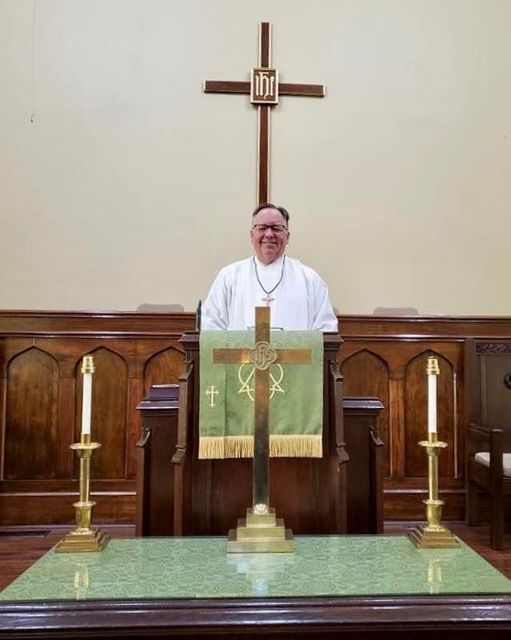
 Eastman First Methodist Church