Sermon Series: “Getting Out of Town”
“A Festival To The Lord”
Morris calls his son in NY and says, “Benny, I have something to tell you. However, I don’t want to discuss it. I’m merely telling you because you’re my oldest child, and I thought you ought to know. I’ve made up my mind, I’m divorcing Mama.” The son is shocked and asks his father to tell him what happened. “I don’t want to get into it, my mind is made up,” replied Dad. But Dad, you just can’t decide to divorce Mama just like that after 54 years together, what happened?” “It’s too painful to talk about it. I only called because you’re my son, and I thought you should know. I really don’t want to get into it anymore like this. You can call your sister and tell her. It will spare me the pain. Finally, Dad promises not to do anything rash until after Yom Kippur.
A half an hour later, Morris receives a call from his daughter who tells him that she and her brother were able to get tickets and that they and their children will be arriving in Florida the day after tomorrow.
After hanging up from his daughter, Morris turns to his wife and says, “Well, it worked this time, but we are going to have to come up with a new idea to get them here for Passover!”
Our text this morning describes God’s instructions to Moses concerning the very first Passover, which we are reminded of and celebrate every time we celebrate the Sacrament of Holy Communion. Let’s lean into the Word of God this morning from the Book of Exodus.
Exodus 12: 1-14
Before we get into our text for this morning, I want to go backwards just a bit. I mentioned last Sunday, in my first message of this series, that there are several parallels that exist between Moses and Jesus. There was one that I didn’t mention that actually spins both men in opposite directions.
We know and recognize that Jesus was born into abject poverty and was raised in the tiny one-horse town of Nazareth, on the other side of the tracks, so to speak. (Can anything good come from Nazareth?)
But not so with Moses. He was born, as I mentioned, in Egypt when Pharaoh ordered the Hebrew mid-wives to kill all of the baby boys. After he was born his Mama placed him in a basket in the reeds along the bank of the Nile River where he was discovered by Pharaoh’s daughter, and she took him to raise. Moses grew up a prince in the palace of Pharaoh. He had everything a boy would ever dream of growing up. But after he was grown, he witnessed an Egyptian beating a Hebrew, so he killed the Egyptian, which led to his downfall and eventually running away to the wilderness of Midian.
I mentioned last week that Moses had failed. This was what I was talking about. He murdered a man. Maybe this can help us understand why it was that he wasn’t thrilled with God calling him to return to the place of his failure? Would the people remember and recognize him for who he was? The Hebrew people, though slaves, had been in Egypt a long time (430 years), though there couldn’t have been much comfort in how they lived, at least in Egypt they felt safe that they would have food to eat, jobs to perform, and a roof over their heads.
There is an American insurance company whose advertisements seek to convince consumers that they are in good hands when insured by them. All companies, including insurance companies, are in business to make a profit, not to do the consumer a favor. They may receive a benefit as a result of your doing business, but if the company isn’t profitable, it ceases to exist.
Families invest thousands upon thousands of dollars in securing the house of their dreams called “home.” Once acquired, they are reluctant to leave it or even live in it for fear of someone breaking in to steal or even kill.
So, Moses really had two jobs. First, he must convince the Pharaoh to let God’s people go, in whatever way that might take. And second, he had to convince the Hebrews that God had a better plan for them, a better insurance policy—an eternal insurance policy.
I mentioned last week that Moses had several excuses as to why he wasn’t the man to lead God’s people to freedom. He didn’t understand who it was that was calling him, and God pretty well cleared that up, “I am who I am.” Next, evidently Moses stuttered a bit and claimed that he wasn’t eloquent with words so he couldn’t do what God was asking of him. So, God sent Aaron, his brother, to be his mouthpiece.
Next, God made Moses a magician—not in the terms that we might imagine a magician. He gave Moses the ability to turn his staff into a snake and back to a staff. He gave Moses the ability to stick his hand in his cloak and pull it out leprous—but heal it by putting it back in his cloak. And he gave Moses the ability to take water from the Nile, put it on dry ground, and it would become blood. All of this to convince the people that he was indeed there to rescue them and lead them to freedom—sent by God.
Next, he was instructed to perform these same miracles for Pharaoh, but Pharaoh had magicians of his own who could do the same things and God told Moses, “But I will harden his heart so that he will not let the people go.” Wait a minute, he was sending Moses to free his people but yet he was hardening Pharaoh’s heart to make the job that more difficult. What’s up with that? Well, I believe that Pharaoh needed to see the power of God but even more importantly, the Hebrew nation needed to see the power of God even more.
Next, came the plagues: blood—frogs—gnats (we understand that one, don’t we?)—flies—on the livestock—boils—hail—locusts—and darkness. Which brings us up to our text this morning—the Plague of the Firstborn and the Passover.
Certain holidays were instituted by God himself. Passover was a holiday designed to celebrate Israel’s deliverance from Egypt and to remind the people of what God had done. Holidays can be important today, too, as annual reminders of what God has done for us.
For the Israelites to be spared from the plague of death, a lamb with no defects had to be killed and its blood placed on the doorframe of each home. In killing the lamb, the Israelites shed innocent blood. The lamb was a sacrifice, a substitute for the person who would have died in the plague. From this point on, the Hebrew people would clearly understand that for them to be spared from death, an innocent life had to be sacrificed in their place.
“The animals you choose must be year-old males without defect, and you may take them from the sheep or the goats” (v.5). God always wants our best, not our leftovers. God never expects more of us than He is willing to do. We must not forget that God gave Jesus up as a sacrifice for our sins on Calvary, allowed Him to die even though He was guilty of no wrong. God’s best was given for us. The Good Shepherd died in our behalf.
“Take care of them until the fourteenth day of the month, when all the members of the community of Israel must slaughter them at twilight” (v.6). Jesus told the parable of the lost sheep. The man who had one hundred sheep discovered that he had one missing and left the 99 to search for just that one. God is calling us to be shepherds today. Are we willing to take care of those entrusted to our care?
“Then they are to take some of the blood and put it on the sides and tops of the doorframes of the houses where they eat the lambs” (v.7). Sounds like Holy Communion doesn’t it. The body and blood of the slain animal was eaten with the blood placed on the door frame. Remember what Jesus said on the night in which He gave Himself up for us? “This is my blood of the new covenant—poured out for you and for many for the forgiveness of sin.” There is a sacredness involved in this whole experience that causes chills to run throughout our bodies.
Jesus also said, “I am the door.” God is giving directions to put the blood on the door frames as a sign. All houses with the blood will be passed over when the angel of death comes through town. Life will be spared if you have the blood in place. The blood represents a sign of divine protection—an eternal insurance policy.
Inside their homes, the Israelites ate a meal of roasted lamb, bitter herbs, and bread made without yeast. Unleavened bread could be made quickly because the dough did not have to rise. Thus, the Israelites would be ready to leave at any time. The bitter herbs signified the bitterness of the slavery they had lived under.
Eating the Passover feast while wearing traveling clothes was a sign of the Hebrew’s faith. Although they weren’t yet free, they were to prepare themselves to be, for God had said he would lead them out of Egypt. Their preparation was an act of faith. Preparing ourselves for the fulfillment of God’s promises, however unlikely they may seem, demonstrates our faith.
This was the birth of a nation, a birth brought about by the gracious power of Yahweh, a birth which Israelites would never forget, and a birth which carried within its symbolism the seeds of an even greater revelation of the character and goodness of God.
As St. Peter said so eloquently: “But you are a chosen people, a royal priesthood, a holy nation, God’s special possession, that you may declare the praises of him who called you out of darkness into his wonderful light. Once you were not a people, but now you are the people of God; once you had not received mercy, but now you have received mercy” (1 Peter 2:9-10 NIV).
The wisdom of God is without boundary or limitation. It was most important for Israel to do as instructed by God. Their deliverance was at stake. Likewise, our salvation is dependent upon our willingness to be obedient to the directives of God. Disobedience leads to death and obedience leads to eternal life. If God says to be ready to go, we had better be ready to go. Finally, there is a day of commemoration and celebration. The day was to be celebrated as a festival to the Lord—a lasting ordinance.
God has given with clarity a sign of divine protection. Let us, therefore, give to God a quality life so that the blessing received will not be in vain. We were saved in order that others might see the light and share in the salvation experience, as they claim the revelation of being in good hands with eternal insurance!
Thanks be to God!
Sermon: September 10, 2023
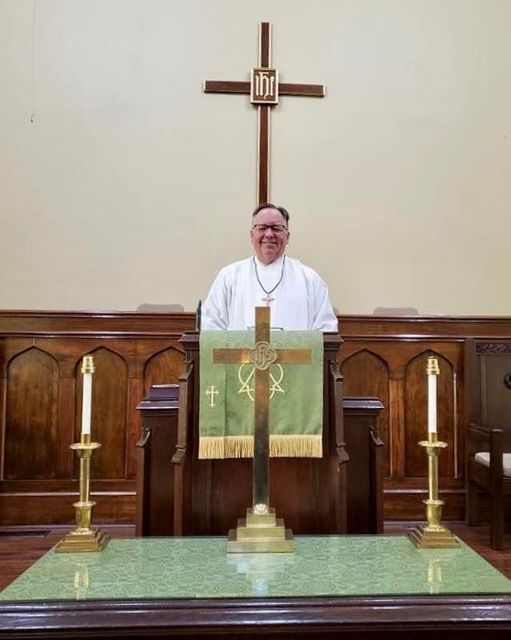
 Eastman First Methodist Church