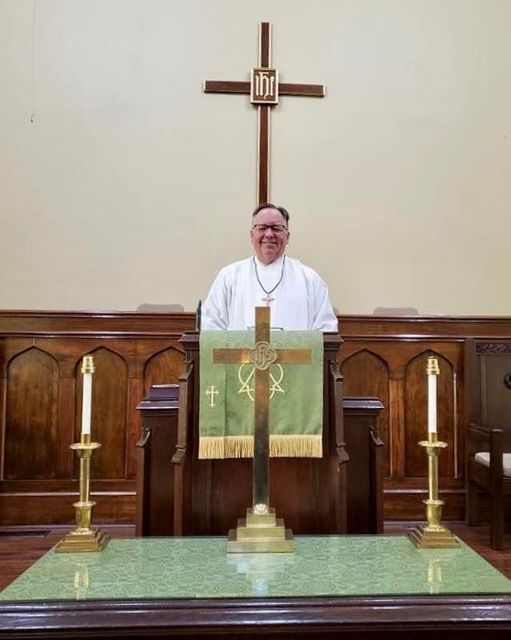
Sermon Series: “Getting Out of Town”
Week 1 – “I Am Who I Am”
Exodus 3:1-15
For the three Sunday’s that I’ll be in the pulpit during this month of September I’ve decided to do a sermon series based on readings from the Book of Exodus, beginning today with the man God elects to lead his people from bondage in Egypt to their actual release and the crossing of the Sea of Reeds.
In one of my daily Scripture readings this week I came across this: “There is no one like you, Lord, and there is no God but you, as we have heard with our own ears. And who is like your people Israel—the one nation on earth whose God went out to redeem a people for himself, and to make a name for yourself, and to perform great and awesome wonders by driving out nations from before your people, whom you redeemed from Egypt? You made your people Israel your very own forever, and you, Lord, have become their God” (1 Chronicles 17:20-22). These were the words of King David responding to God’s message sent through the prophet Nathan, that he wasn’t the man to build His Temple.
I would imagine that most of you know a little bit of the story of Moses. If you don’t, stick around and linger after our worship and I’ll tell you more. Moses came along when the Hebrew people were slaves of Pharoah in Egypt. The Hebrew nation was growing in leaps and bounds, and Pharoah decided to instruct all the Hebrew mid-wives to only let the little girls survive. So, Moses had a contract out on his life from the very beginning, much like Jesus did when Herod instructed the killing of all Jewish boys under the age of two after his encounter with the Wise Men. And there are several other parallels that I see between Moses and Jesus.
Moses gave up his throne and ran for his life after he was discovered killing an Egyptian slave master.
Jesus gave up His throne to come to our world in the form of a baby. “Who, being in very nature God, did not consider equality with God something to be used to his own advantage; rather, he made himself nothing by taking the very nature of a servant, being made in human likeness. And being found in appearance as a man, he humbled himself by becoming obedient to death—even death on a cross!” (Philippians 2:6-8 NIV).
Moses spent 40 years in the wilderness while God prepared him to save His people.
Jesus spent 40 days in the wilderness (crash course) while God prepared Him to save His people.
Moses instituted the Passover Celebration which we celebrated this morning in the Sacrament of Holy Communion, and I’ll speak more about that next Sunday.
Jesus became the Sacrifice for the Passover Celebration.
Jesus was born in the fall of 2 BCE, 1591 years after the birth of Moses, but 1471 years after Moses died. Yet, it’s incredible the parallels that we see between the two and how God used them both to save His people.
When most people think about Moses they picture the Charlton Heston Moses, who leads the people out of Egypt, parts the Red Sea, and gives commands. Not exactly the Moses we are introduced to today.
The place where God interacts with Moses this morning is Mount Horeb. Another name for Mount Horeb is Mount Sinai, the place where God would give the people his revealed law, know to us as the Ten Commandments. By calling it “the mountain of God,” the text looks ahead to that time.
God spoke to Moses from an unexpected source: a burning bush—a bush that was on fire yet not consumed by that fire. When Moses went to investigate, and I’m not sure I would still be in the vicinity at this point—God spoke to Moses. I surely would have been gone after that—or at least looking around to see just who was messing with me.
Blaise Pascal was a Christian believer and philosopher, and one of the great minds of history. When he died it was discovered that he had sewn into the inner lining of his coat the description of an experience he had had one night. It read: “In the year 1654, Monday, twenty-third November, from about half past ten in the evening until half an hour after midnight…Fire…God of Abraham, God of Issac, God of Jacob, and not of the philosophers and of the learned. Certainty. Certainty. Feeling. Joy. Peace.” Pascal was not talking about a sight of eternal flames but of an experience of the presence of God—what fire in the Bible so often represents.
God may use unexpected sources when communicating with us, too, whether through people, thoughts, experiences, or even a burning bush. We need to be willing to investigate, to be open to God’s surprises.
Well, we know that Moses came up with several excuses why he couldn’t deliver on God’s expectations for him, and God had an answer for every one of his excuses. This morning we’ll concentrate on this question: “Suppose I go to the Israelites and say to them, ‘The God of your fathers has sent me to you,’ and they ask me, ‘What is his name?’ Then what shall I tell them?”
When Jesus prayed, he called God “Abba,” and that was a showstopper. It was scandalous. It was the sort of thing that didn’t come out of the mouth of a rabbi. You see, Israel already knew God’s name—it was Yahweh. That’s how it looks in English, at least. In Hebrew, a written language made up of only consonants, it’s YHWH. The way they arrived at that name shows the incomparable reverence they had for God.
When God identified himself to Abraham (the man whom Christianity, Judaism, and Islam all trace their roots back to), he said, “I am El-Shaddai.” In a Canaanite world that believed in many gods over many nations, El meant “king of the gods.” El-Shaddai was the Canaanite way of saying, “I’m the king of all the gods, but I’m also so much more than what you conceive of when you hear that name.”
Today, God introduces himself to Moses, calling himself, “I Am Who I Am,” meaning, “I am the unchanging one, the one who has always been, the one who will always be.” So, YHWH is Hebrew shorthand for “I Am Who I Am.” It’s a way of saying God is incomprehensibly constant. He is completely “other” from our humanness in all the best ways.
If you linger behind after worship this morning, ask me about some other famous “I Am” sayings.
Moses had failed, and he considered himself a failure. One can fail without being a failure, but Moses hadn’t learned this yet. He was in Midian, running away, running away from his failure, and running away from God.
But God wouldn’t let him go. High in the mountains of Midian, God set a bush on fire. Nothing really remarkable about a burning bush—lightning caused bushes to burn quite frequently. But this bush was not consumed: it burned and burned, but it didn’t burn up. And that got the attention of Moses, and Moses “turned aside” to see. And that’s where God got him. Out of the bush God spoke, and Moses returned to Egypt, the place of his failure, to lead the people out.
Well, God is calling for our attention this morning. And to a degree, at least, he has it: we have, in fact, “turned aside” from where we have been going, and we have left off what we’ve been doing, and we are here. We have turned aside to pause at this place and time, here before God’s altar. May we hear him say, as Moses heard: “The place where you are standing is Holy Ground.”
And from this holy place and time may we go, as Moses went, in the way that God appoints, and, going, may we also hear, as Moses heard, that most significant of all promises, “I will be with you.”
Thanks be to God!
 Eastman First Methodist Church