“Weeds In The Wheat”
Former Chief Justice of the United States Supreme Court, William Rehnquist was born in Shorewood, Wisconsin. After law school, his first practice was in Phoenix, Arizona, and while he was there, he heard this story about Arizona that pretty well sums up life there.
In the very earliest days of the settlement of Arizona, the Archbishop of Los Angeles sent a missionary out to Phoenix to try to establish a church there. After two years, the priest returned to tell the archbishop that he could not establish a congregation in Phoenix.
“Why not?” asked the Bishop. “Are there no people there?’ “Well, yes, there are people there,” said the priest. But those who are living there during the winter have no need of heaven and those who live in Arizona during the summer have no fear of hell.” I worry the same thing is going to happen here!
Matthew 13:24-30, 36-43
With all that we had going on in worship last Sunday I was forced to edit my message on the fly and only share a little less than half of what I had prepared. I wanted to tell you that these last few weeks in July would all be spent in the 13th chapter of the Gospel according to Matthew which contains seven parables with visions of the Kingdom. This would be in line with Matthew’s custom of collecting items by topics. It also highlights his central emphasis on the kingdom of Heaven which all these parables will portray.
The term “parable” literally means, “to throw alongside” or “a comparison.” Parables are stories drawn from life—or fictitious stories used to illustrate one and only one point. They are example stories—brief metaphorical sayings and similes. And they can also be an occasional allegory which is a story that communicates an important truth in a symbolic form.
Following a message on this same subject once I had a dear church member who has gone on to be with the Lord come to me with another definition of a parable: “It’s an earthly story with a heavenly meaning.”
Parables are not meant to pat us on the back, but to give us a kick in the pants. They are not intended to comfort us, but to challenge and change us. Parables speak against the status quo. Parables are demonstrators waving signs of protest, speaking out against our ways of thinking, our traditional ways of experiencing and obeying God, our spiritual institution.
Last Sunday we talked about planting seeds. This week we are talking about pulling weeds. The two go together. Every gardener knows that planting seeds is the easy part of having a successful garden. It’s much more time consuming to weed that same garden. And it’s hard work. I do know, in my limited farming background, that weeds are the only thing you don’t have to plant—they will come up any and everywhere. (even in the sidewalk)
Some of you can relate to one unknown homemaker who wrote: I don’t do windows because…I love birds and I don’t want one to run into a clean window and get hurt. I don’t wax floors because…I am terrified a guest will slip and get hurt then I’ll feel terrible (plus they may sue me). I don’t disturb cobwebs because…I want every creature to have a home of their own. I don’t Spring clean because…I love all the seasons and I don’t want the others to get jealous. I don’t put things away because…my husband will never be able to find them again. I don’t do gourmet meals when I entertain because…I don’t want my guests to stress out over what to serve when they invite me over for dinner. I don’t iron because…I choose to believe them when they say, “Permanent Press.” And finally: I don’t pull weeds in the garden because…I don’t want to get in God’s way, He is an excellent designer!
In our parable this morning Jesus is making a comparison of the kingdom of heaven with a farmer who goes out and plants perfectly good seed, but in the night, when everyone is sleeping, the enemy comes and sows weeds among his wheat.
This particular weed that Jesus speaks of was called “darnel” which looked almost exactly like wheat, and you couldn’t tell the difference between the two until they ripened. The man’s servants, upon finding the weeds, ask their master first if he had planted good seed—they inquire as to who would have sown the weeds among the wheat—and they asked if he would want them to uproot the weeds. Rather than risk losing some of the wheat in the process of uprooting the weeds, the farmer chooses to allow the two to grow together, side by side. (The roots of the weeds wrap around the roots of the wheat so to pull one up would be pulling both up.)
Later, at harvest time, the weeds must then be separated from the wheat because if those weeds were ground into meal, they would spoil the flower and often cause dizziness and nausea when eaten. Once separated, the workers would bundle together the weeds as fuel—which was a very scarce item in Palestine; and the wheat would be taken into the barn.
I hit a wall right about here. That’s how it goes with these things. I have lots of notes and ideas rolling around in my head and on paper, but my writing comes in spurts. I’ll write a section and take a break, go for a walk, get a cup of coffee or tea, and then maybe not even come back to where I left off but move to a completely different section. And then sometimes it all just kind of flows together. But not this week. I hit a wall. So, I took a break. I scrolled through my phone. You know, God can reach you through your phone, and He did. Bam, I came across this quote: “The Church should be a community where messed-up people are welcome, outcasts are loved, underdogs find a champion, the hopeless find hope, and the friendless find a friend.”
Could that be what Jesus was getting at, not just this week but last week as well? Last week we had the farmer (God) casting out seed on four different kinds of soil. Today we have weeds and wheat that look identical.
Several years ago, our conference decided that every church should have an Evangelism Plan that is included in our Charge Conference reports. I balked at it then and I continue to do so because in my eyes everyone that comes through the church doors is in a different place in life. We come to God in different conditions, like the soil from last week. Yet, we all look the same, like the weeds and the wheat.
The young weeds and the young blades of wheat look the same, so they can’t be distinguished until they are grown and ready for harvest. The weeds (unbelievers) and wheat (believers) must live side by side in this world.
An old Cherokee once told his grandson about a fight that was going on inside him. He said it was a fight between two wolves. One was evil: anger, envy, greed, arrogance, self-pity, gossip, resentment, and false pride. The other was good: joy, peace, love, hope, serenity, humility, kindness, generosity, truth, compassion and faith. The grandson thought about it for a moment and then asked his grandfather, “Which wolf do you think will win?” The old Cherokee replied, “The one I feed.”
All of us are part wheat and part weeds and the portion that grows the most is the portion that we feed.
Churches today contain true and false believers, but we must be cautious in our judgment because only Jesus is qualified to make the final separation. For us to pluck up the weeds would be to rob God of the chance to make a change in their lives. It would rob us of the opportunity to rub off on them—to show them through our witness that there is another way.
Verse 47 of our text this morning says, “Then the righteous will shine like the sun (son) in the kingdom of their Father.” What was the message from Vacation Bible School last week? SHINE JESUS’ LIGHT!
Would we ourselves like to be “purged” from the church and the fellowship of Christ? We are weeds too: only by self-righteous pride can we claim that our field—our life—is free of weeds!
God is the gardener who wants to pull the weeds from our life. It’s not God’s will that any of His children should suffer. God wants to help. Regardless of what a mess our lives are in right now—God can turn that mess into a masterpiece.
In closing, Pastor Johnny Dean shares a story about his church organist, the mother of two beautiful children. Her father called and gave him the news. “We’ve had to have her committed to the mental ward at Baptist Hospital. She was okay as long as she was taking her medicine. But she didn’t think she needed it anymore, so she stopped taking it last week. Please go up to see her. We told them it was okay to let you in.” He was just a seminary student, a minister in training, not a psychiatrist. He didn’t want to go. He didn’t know what he would say that would make a difference. But he was her pastor. As he entered the room, she was huddled over in the corner, gazing off into space, her eyes hauntingly empty. He called her name softly, not wanting to startle her, but got no response. He walked over and knelt in front of her, gently placing his hand on her shoulder. She looked at him but gave no sign of recognition for a moment. Then she whispered, in a shaky voice, “Preacher, the bad people are winning, and there’s nothing I can do.” He managed to make it all the way back to his car before breaking down in tears. The next day, the chairman of the elders said, “You need to tell her to find another church. We’ve got enough problems as it is.” In other words—weed the garden, preacher. But which one do I pull out? They both look the same. What a mess!
What’s the point of our parable this morning? Why did the farmer tell his servants to allow the weeds to grow with the wheat? We have no idea what is going on in the life of those we associate with—those we sit beside in church—who we break bread with—who we work and play beside. But the good news of this parable is that God knows—God cares—and He seeks to use us in changing those lives from being weeds to becoming wheat!
Thanks be to God!
Sermon: July 23, 2023
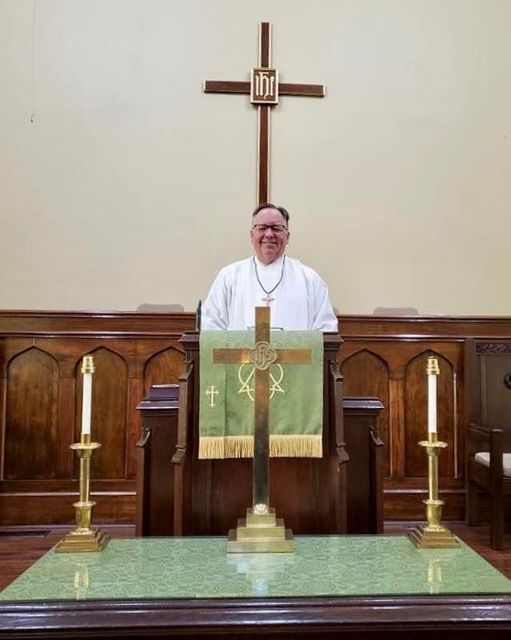
 Eastman First Methodist Church