“Buried With Jesus”
The preacher, as he finished his temperance sermon (drinking), said, “If I had all the beer in the world, I’d take it and throw it in the river. And if I had all the drink in the world,” he said with humility, “I’d take it and throw it in the river. And if I had all the whisky in the world,” he finally admitted, “I’d take it and throw it in the river.”
Finishing his message, he sat down in his chair and the choir director stepped up. Taking a cautious step forward and smiling, she announced, “Let us all stand and sing Hymn #365, Shall We Gather at the River.”
Romans 6:1b-11
In his book, Talking Straight, Lee Iacocca shared some interesting stories about raising funds for the 100th birthday celebration of the Statue of Liberty. For example, there was a man from Poland who sent $2.00 for “this beautiful symbol.” He never expected to see the statue himself, but at least he could dream about it. There was a money order from a refugee camp in Thailand. Seventy-eight homeless Vietnamese had passed the hat and come up with $114.19 as “Our humble share for the rehabilitation of her hundredth birthday.”
“That one floored me,” wrote Iacocca. “These were people who had lost everything, everything but hope. And the Lady was a symbol of that hope. They were simply pleading with us to ‘keep the torch lit.’”
The Statue of Liberty. What a beautiful lady she is. An almost universal symbol of political freedom. There is another symbol of freedom, however, far more important than the Statue of Liberty in the total scheme of things. Anyone care to guess what it is? And no, it’s not the river! It is, of course, the cross on which Jesus Christ died.
If you go to the Holy Land today, there are a couple of spots where authorities believe Jesus died on the cross and the location of the borrowed tomb where He was buried. If you go there with a tour company, they will more than likely take you to both spots.
The first is known as the Church of the Holy Sepulcher (sep-ul-cher). It’s a massive cathedral-like building that takes up the space of a small city block. Inside the cathedral is the place the authorities say is the place where Jesus was crucified on the cross. Nearby, in the cathedral is the empty tomb. Most say the place feels like neither. Across town, actually outside the city gates of the Old City is the other site, known as the “Garden Tomb.” There’s a rocky crag there on which you can trace the contours of a skull (i.e., Golgotha) and nearby there is an ancient cave-like tomb cut into the side of a small hill complete with a large stone next to the mouth of the cave.
Which of these sites isn’t what is important. The important thing is that the tomb is still empty. The tomb, which ever one it is, could not hold the risen body of Jesus Christ (are you with me?). He isn’t there—nor are His bones. In another sense, however, it isn’t empty. It is full. It is filled with the sins of you and me—and all of the saints who have come before us—and all of the saints who will come after us. As Jesus was laid in His tomb, the sins of the world, past, present, and future, were laid there in His body.
Our sin and our sins are buried in a tomb. They are dead, rotten and ever rotting, dead to us, dead to eternity, forever dead and buried.
When Jesus was laid in His tomb, we were laid there with Him—our old self, our old sin. When Jesus rose from the dead, we rose with Him, our new self, our new life, free from sin and delivered from death.
We have many and varied understandings of what Christian baptism is and what it means. As I have shared before, if you want to start a good argument among Christians just mention the world baptism.
I was doing a devotion in a nursing home once and I shared that there are parts of the Jordon River that are only about a foot deep. I said that it would be impossible to immerse someone in less than a foot of water. A little old man, probably a Baptist, jumped up from his seat like he was going to challenge me to a duel and exclaimed, “Jesus was immersed!”
In the church in Paul’s day, immersion was the usual form of baptism—new Christians would be completely “buried” in water. They understood baptism to symbolize the death and burial of the old way of life. Coming up out of the water symbolized resurrection to new life with Christ. If we think of our old sinful life as dead and buried, we have a powerful motive to resist sin. We can consciously choose to treat desires and temptations of the old nature as if they were dead. Then we can continue to enjoy our wonderful new life with Jesus.
Here in this part of his letter to the church at Rome, Paul gives us the ground zero picture of baptism. Death—Burial—Resurrection. Right here and right now.
Baptism is not a symbolic rite of passage as we are so prone to believe. It is, according to Paul, the literal living participation in the real, the physical, and the embodied deliverance of Jesus Christ from sin and death into life and love which is freedom.
Changing gears a little here, I mentioned to you a few weeks ago that two major themes have made themselves very prevalent in my life and ministry. One is the Holy Spirit. The power and the voice of the Holy Spirit. The other is resurrection. Paul also saw the importance of this, especially the resurrection of Christ and he touches on it in all of his letters. Later on in this letter to the Church at Rome he writes, “If you declare with your mouth, ‘Jesus is Lord,’ and believe in your heart that God raised him from the dead, you will be saved” (Romans 10:9 NIV).
If you believe it in your heart. In other words, if you believe in the resurrection of Christ with your entire being, you will be saved.
The resurrection of Jesus Christ is central to the Bible and our faith. As Paul write to the Corinthians, “If Christ has not been raised, then your faith is useless and you are still guilty of your sins. In that case, all who have died believing in Christ are lost! And if our hope in Christ is only for this life, we are more to be pitied than anyone in the world” (1 Corinthians 15:17-19).
Without the Resurrection, our faith is useless. Without the Resurrection, our sins are not forgiven. Without the Resurrection, we are lost. Without the Resurrection death continues to have dominion over our lives. Without the Resurrection, we won’t be with Christ in heaven.
After Peter’s salutation in his first letter, he points to the centrality of the Resurrection with the following declaration: “All praise to God, the Father of our Lord Jesus Christ. It is by his great mercy that we have been born again, because God raised Jesus Christ from the dead. Now we live with great expectation” (1 Peter 1:3 NIV).
Saint Peter ties the Resurrection to the mercy of God in our lives, to our salvation, and to the anticipation of seeing Christ again. The Resurrection was central to the first-century Christians and the Church they served.
The same can be said about the four Gospel writers. They also saw the Resurrection as central to our faith and the Bible in general. None of the four Gospels would be complete without some recollection of the Resurrection. Even though all four write from a different perspective, they all affirm the centrality of this event.
The truth is powerfully clear: God’s power raised His Son from the dead, and the same power can raise us from the dead as well; even for some who aren’t physically dead yet! (Are you with me?)
In conclusion (second wind), a family once had two little puppies. One of the puppies was a boy and the other was a girl…and for some strange reason wherever the sister went, the brother was on her tail right behind her. Every morning as they were let out to play, they would go scampering out the door, down the steps, across the lawn and through a hole in the fence, and always, the brother was right behind his sister.
One day, the family decided to fix the hole in the fence, and the next morning, they let the dogs out to play. As usual, the puppies went out the door, down the steps, across the lawn. And as the lead dog approached the fence, she saw that the hole had been repaired and quickly turned to the right to avoid hitting the fence. Her brother, however, wasn’t so fortunate; he crashed right into the fence. Later, the family discovered why: he was blind and had been blind from birth. He had simply learned that to get around he had to listen, listen to the sounds of his sister’s footsteps, listen to where his sister was going and follow her.
There is a blind world out there beyond our walls. If you don’t think so read the headlines in your paper or watch the news. More than anything else people need to see the grace, the love and the peace of Jesus Christ lived out in human form and that will only happen when we who have been buried with Christ in Christian baptism are resurrected with Him to new life. Do not settle for making Christ our whipping boy. Make Him the Lord of your life. The world—our world, depends on it!
Thanks be to God!
Let’s go to the river!
Sermon: June 25, 2023
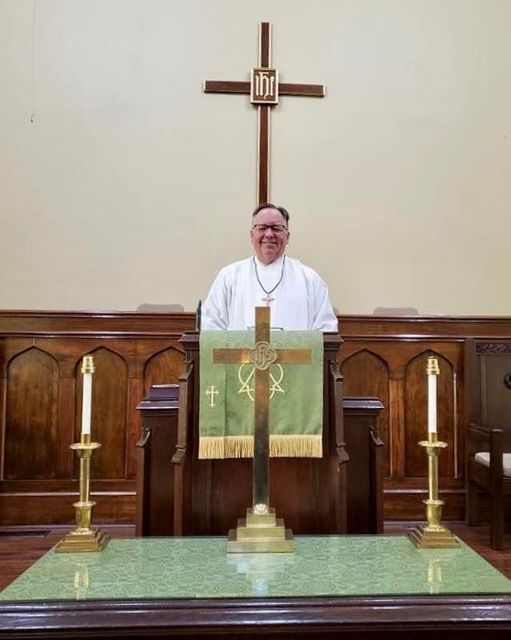
 Eastman First Methodist Church