“While We Were Still Sinners”
There’s a ridiculous story going around about a man trying to cross the street. However, when he steps off the curb a car comes screaming around the corner and heads straight for him. The man walks faster, trying to hurry across the street, but the car changes lanes and is still coming at him. So, the guy turns around to go back, but the car changes lanes again and is still coming at him. By now, the car is so close and the man so scared that he just stops in the middle of the road.
The car gets really close, then swerves at the last possible moment and stops next to the man. The driver rolls down the window. Lo and behold, it’s a squirrel driving the car. And the squirrel says to the man, “See, it’s not as easy as it looks, is it?
Well, it’s not easy. No matter how fortunate any of us feel and how virtuous we are, there comes a time when our luck runs out and life slams us in the face. At such times we feel like a squirrel trying to cross a busy street and it seems like there is nowhere left to turn. Some of you have already been through such times. Others of us don’t like to think about it—but we know our time is coming.
Romans 5:1-8
This section of Paul’s letter to the church at Rome has been described by some as the most important section of the letter—if not the most of all Paul’s correspondence. I have a preacher friend who wrote in his blog about this text that it plays perhaps the pivotal role in Paul’s plot of redemption. He says that it’s the kind of text that we should just read slowly, and repeat it, letting you savor the words. Trying to explain them is kin to explaining a joke—once you explain you’ve lost the point. And yet, thoughts stir in our heads. For Paul, Christianity is hardly about being saved—justification necessarily involves reconciliation—with God and others. We were God’s enemies, but totally by grace we are beyond lucky to discover we are God’s friends.
Romans 5 is entirely in first person plural. It’s not “I have peace with God,” or you, as an individual person. It’s “We”: we who are part of the Body. God doesn’t intend for us to do this alone (I’ve said that before and will continue to say it). It’s a fact. It’s done. And not by you but by Christ, and at immense cost to Himself.
Paul begins our text for this morning with one of his favorite words: “Therefore.” I’m sure you’ve been told that when you see the word “therefore” you should try to learn what it is there – for. Since it’s the very first word in the sentence I believe it’s a safe bet that what he is saying in this 5th chapter is tied to the last verse of the 4th chapter: “He was delivered over to death for our sins and was raised to life for our justification.”
Because of what Jesus did we have justification which is NOT an accomplished fact. In other words—justification isn’t something we can obtain by our own efforts—it’s something that Christ has done that we can’t do for ourselves.
And because we have this justification by faith then we have peace with God! This Peace with God indicates the “peace of complete reconciliation with Him” or “the security and calm of acceptance.” You see, the wrath of God no longer is a threat to those who are accepted by Christ which then forms a relationship between God and man. If there were no other reason for being Christians—peace should be enough!
We should remember that peace with God doesn’t mean merely a state of inward contentment. It’s possible to have a certain kind of peace without having satisfied any of the conditions which govern the gift of peace with God. This is why Jesus so sharply contrasted “My peace” with the peace that the world gives or understands.
And because we have been justified by our faith and we have this new-found peace with God—we have now been granted access to His grace! Some equate this grace with the peace from our first verse. Certainly, both describe the benefits into which one comes by the redemption. What is the meaning of this grace? It is God giving Himself to us!
The peace and stability of the justified bear fruit in a hope that goes beyond Christian maturity to actual partaking in the glory of the heavenly kingdom. We exult—or rejoice—in hope of the glory of God.
This glory of God refers to man’s true character and destiny as created in God’s likeness and for fellowship—or sharing—with Him. This glory was lost through sin—but now we are assured that it will be restored—and in that hope we triumph.
We lack the merit which would enable us to stand before God—and we cannot gain it by our own efforts. What we could not do ourselves—Christ has done for us—it is through Him that we have our new status with God.
Paul writes that “We also rejoice in our sufferings.” Bodily suffering isn’t usually an occasion for rejoicing, and I can think of few who suffered as much as Paul. He was shipwrecked on more than one occasion. He was once stoned to the point of death—in fact—his closest followers who were there believed that he was dead. He suffered through sickness—he was ridiculed—and he was imprisoned for what he taught and believed. In His Sermon on the Mount Jesus said: “Blessed are those who are persecuted because of righteousness, for theirs is the kingdom of heaven. Blessed are you when people insult you, persecute you and falsely say all kinds of evil against you because of me” (Matthew 5:10-11).
Difficulties are not to defeat us but to strengthen our endurance. Paul didn’t mean that we should rejoice because we are surrounded by affliction but that we should rejoice BECAUSE of our sufferings. A strong reliable character gives the assurance of hope.
Two weeks ago, at Annual Conference I celebrated my 20th year of ministry. Today, I begin my second year here as your Pastor. The Scripture that I used this morning was what I used for my first sermon as a Lay Speaker at old Friendship UMC, probably around 2001. I don’t really remember what I said that day. I probably used some frilly stories and illustrations since I hadn’t received any theological training to that point and had no idea what the gift of prophecy was yet.
I do remember a story about a donkey who fell in a well. His owner decided to just bury the donkey and enlisted all his neighbors to help. As they dumped dirt down in the well the donkey would shake off the dirt and it kept getting higher until he was able to walk out of the well.
Our suffering produces perseverance—our perseverance produces character—our character produces hope—and our hope grows strong only when it is exercised!
Paul is describing men and women whom suffering leads not to despair but to an increasing confidence. This is not man in his own strength but rather those who have the righteousness by faith—peace with God—and a firm foothold in grace.
Amazing grace can only come from one place: amazing love. Love is the question and the answer. It is the rule and the reason. The love of God in Jesus Christ is not only the grace that saves us, but it is the very life of God in us that makes us agents of salvation for others.
Grace is an idea. Love can only be a person. Indeed, grace is the big idea of God, but love is His nature and His name.
Obviously, we are not invincible by any strength of our own. It was while we were yet weak that Christ died for us. Worse than that—we were not only weak morally—we were ungodly—destitute of awe for God. Yet He died for our benefit!
What Jesus taught by word He demonstrated by conduct. While men and women were yet sinners, they learned that they could come to Him—and in coming to Him they have found forgiveness and a new life.
There was a certain speaker who started off his seminar by holding up a $20 bill. “Who would like this $20 bill?” he asked. Hands started going up throughout the audience.
He said, “I am going to give this $20 to one of you, but first let me do this.” He proceeded to crumple up the bill. He then asked, “Who still wants it?” The same hands went up in the air.
“Well,” he replied, “What if I do this?” He dropped it on the ground and started to grind it into the floor with his shoe. He picked it up, all crumpled and dirty. “Now who wants it?” Again, hands went into the air.
“You have all learned a valuable lesson,” the speaker said. “No matter what I did to the money, you still wanted it because it did not decrease in value. It was still worth $20. Many times in our lives, we are dropped, crumpled, and ground into the dirt by the decisions we make and the circumstances that come our way. We feel as though we are worthless. But no matter what has happened or what will happen, you will never lose your value in God’s eyes. Dirty or clean—crumpled or finely creased—you are priceless to Him!”
This past Wednesday morning I was on my weekly zoom call with my spiritual band brothers. Just before we were done the bottom dropped out here and my phone started going crazy with tornado warnings, so I told my brothers I needed to jump off in case it got bad. Later in the day one of my brothers texted me to check on things. I responded that things were getting ready to fire up again and he asked if we had a cellar. My response: “No, but I have a Savior!”
Who am I that the King of the world
Would give one single thought about my broken heart?
Who am I that the God of all grace
Wipes the tears from my face and says, “Come as you are”?
You paid the price, You took the cross
You gave your life and You did it all with me on your mind
—Me on Your Mind by Matthew West
“But God demonstrated his own love for us in this: While we were still sinners, Christ died for us.”
Thanks be to God!
Sermon: June 18, 2023
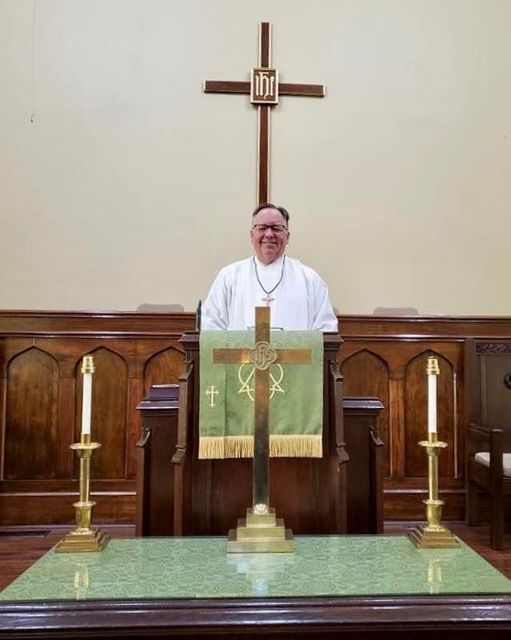
 Eastman First Methodist Church